



Art Deco Dressing Table Set
These art deco dressing table set pieces bring geometric polish and bright enamel to the bedroom, making them prized vanity items.
Art Deco Dressing Table Set
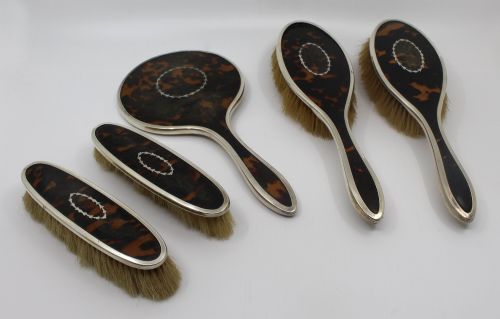
An art deco dressing table set brings together matching accessories designed to sit upon bedroom furniture, ranging from complete silver and guilloche enamel groupings to smaller glass and ceramic vanity arrangements. Buyers seek these pieces to capture the distinct geometric lines and functional elegance characteristic of the period.
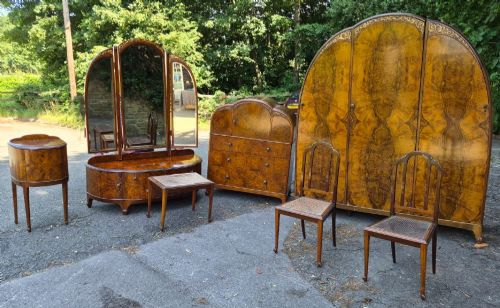
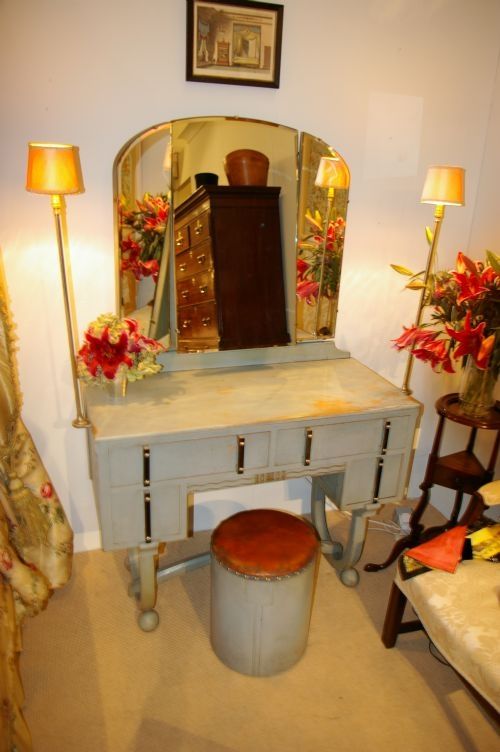
The selections span comprehensive bedroom suites complete with dressing tables and wardrobes alongside portable tabletop boxes of brushes and mirrors. Most examples originate from the 1920 and 1930 decades, utilising durable materials intended for daily morning routines.
Smaller groupings often consist of perfume bottles, powder boxes and hand mirrors designed to coordinate visually with larger bedroom furniture sets. These smaller items allow collectors to introduce period style to modern dressing areas without requiring full bedroom suites.
How they were made
Makers combined sterling silver, brass and painted wood with glass and natural bristle inserts, applying enamel techniques to metal surfaces for vibrant colour. Artisans also utilised burr walnut and limed oak veneers over structural timbers to construct the larger furniture elements.
Guilloche enamel work involved machining geometric patterns into metal before applying translucent coloured glass coatings, creating reflective surfaces on brushes and mirrors. Glass perfume bottles and powder boxes were moulded into angular silhouettes matching the prevailing design aesthetic.
Brushes retain their original natural bristles, having survived decades of hair management.
What varies in quality
Quality rests upon the preservation of fragile enamel surfaces and the integrity of natural bristles within brushes, where intact coatings elevate a piece significantly. Complete sets retaining their original fitted presentation boxes demonstrate superior original status compared to assembled groupings.
The precision of geometric marquetry and the choice of timbers such as burr walnut separate standard production furniture from superior workshop output. Hallmarks on silver components provide definitive proof of metal purity and date of manufacture.
Frank Taylor & Co.·Heals·Gaylayde·B Cohen & Sons·Hermanova·Rowley Gallery·Mappin and Webb·James William Benson
The Art Deco Dressing Table Set Glossary
- Guilloche enamel
- Enamel applied over a metal surface that has been mechanically engraved with precise geometric patterns. This technique produces a shimmering, patterned background beneath translucent coloured glass.
- Sterling silver
- An alloy consisting of ninety-two point five percent silver and seven point five percent other metals, usually copper. It forms the durable foundation for many top-tier vanity accessories.
- Natural bristle
- Stiff hair obtained from animals, traditionally used in hairbrushes and clothes brushes within vanity sets. These bristles fit securely into wooden or silver mounts.
- Marquetry
- Inlays of different woods applied to a structural wood panel to form decorative geometric patterns. It appears frequently on the surfaces of period bedroom suites.
- Atomiser
- A spray bottle mechanism fitted to perfume containers to disburse scent in a fine mist. They are commonly found in glass and metal vanity groupings.
Art Deco Dressing Table Set: Frequently Asked Questions
What is included in a set?
Sets generally comprise hand mirrors, hairbrushes and clothes brushes, often accompanied by silver-topped glass jars and perfume bottles.
Larger groupings can extend to matching powder boxes, trays and complete bedroom furniture suites with integrated dressing tables.
How do I date these items?
Silver components usually bear hallmarks indicating the assay office and year of manufacture, allowing for precise dating.
Stylistic cues such as geometric forms and specific timber choices point towards the 1920 and 1930 decades.
Are these pieces functional?
Many items remain entirely suitable for daily use on a modern dressing table, particularly glass perfume bottles and silver-backed brushes.
Fragile enamel items require careful handling during use to preserve the decorative surfaces over time.
What woods were used?
Cabinet makers utilised burr walnut and limed oak for larger furniture pieces and bedroom suites.
These timbers were often enhanced with marquetry details to achieve the characteristic aesthetic.