
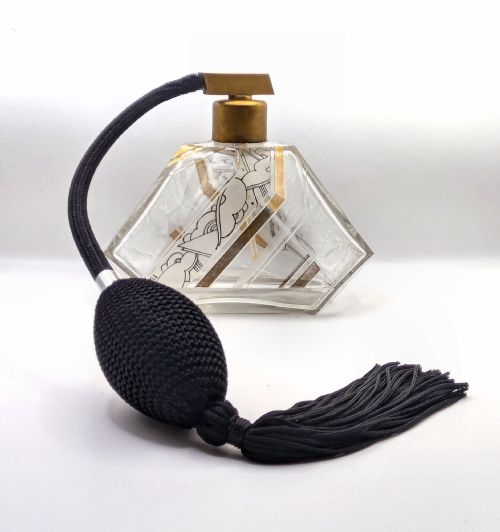


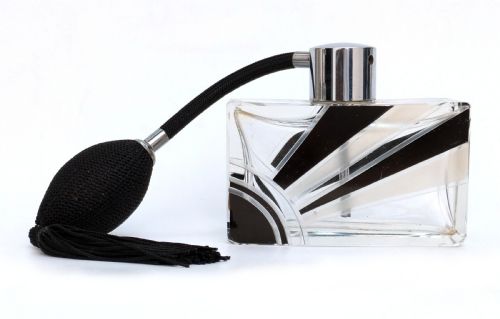


1930s Glass Perfume Spray
A 1930s glass perfume spray brings sophisticated Art Deco glamour to a dressing table with its colourful glass and gleaming metal fittings.
1930s Glass Perfume Spray
A 1930s glass perfume spray is an elegant dressing table accessory designed to mist fragrance through a hand-operated bulb mechanism. These items take the form of perfume bottles, scent bottles, and perfume atomisers, often mounted on stands or presented as large display pieces.
Most examples found here date strictly to the 1930 period and embody the unmistakable geometry of the Art Deco style. Makers from France, Bohemia, and Czechoslovakia dominate the origin of these vessels, combining vibrant coloured glass with contrasting metal mounts.
How they were made
Makers utilised heavy glass, crystal, and cut crystal to form the main body of each vessel, often employing intricate cutting techniques to catch the light. Sunray patterns and faceted surfaces were achieved through careful grinding and polishing of the raw glass.
The metal components rely on chrome, brass, and occasionally enamel or fabric elements to secure the spray mechanism atop the bottle. Czech and French workshops integrated Bakelite details and sturdy stands to support the heavier perfume atomisers.
Many of these lavish Czech glass bottles spent the 1930s safely tucked inside vanity cases before finding a permanent home on dressing tables.
What varies in quality
The distinction between standard production and finer execution lies in the depth of the glass cutting and the purity of the crystal. Superior examples feature crisp facets and substantial weight, whereas lesser pieces display simpler moulding with minimal hand finishing.
Complexity of the mountings also dictates the calibre of the piece, particularly where enamel or intricate chrome work frames the bottle. Czechoslovakian and French works attributed to known designers often demonstrate a higher degree of sculptural ambition in their stands and atomiser heads.
Karl Palda·Rudolf Hlousek·Hermanova
The 1930s Glass Perfume Spray Glossary
- Atomiser
- A device used to turn liquid fragrance into a fine mist via a squeezable bulb and internal tube. This mechanism sits directly on top of the scent bottle.
- Art Deco
- A design style spanning the 1930s characterised by geometric shapes, stylised motifs, and sleek lines. It heavily influences the silhouette of these perfume bottles.
- Cut Crystal
- Glass containing lead oxide that is deeply carved with geometric patterns to enhance brilliance. This material gives these atomisers significant weight.
- Bakelite
- An early synthetic plastic utilised for decorative caps and structural mounts on dressing table items. Its deep colour adds contrast to the clear or coloured glass.
1930s Glass Perfume Spray: Frequently Asked Questions
How do perfume atomisers work?
An internal tube draws liquid up from the base when air is forced through the nozzle by an attached bulb. This creates a fine mist of fragrance.
Most 1930s glass perfume spray designs rely on this pneumatic action to dispense scent cleanly.
Where were these glass bottles made?
Production was centered primarily in France and Czechoslovakia during the 1930 period. These regions were renowned for advanced glass-cutting and metal-mounting techniques.
Bohemian workshops produced many of the large, highly decorative examples found today.
Are these bottles meant for daily use?
Original mechanisms from the 1930s often degrade over time and may not retain an airtight seal. Modern collectors generally treat them as decorative dressing table display objects.
Using them gently for exhibition preserves the delicate chrome, enamel, and glass components.
How do I identify Art Deco style?
Art Deco pieces display strict symmetry, sharp angles, and sunray motifs rather than flowing floral curves. This aesthetic defined the 1930s design landscape.
Heavy geometric crystal and chrome mountings are clear indicators of this period.