
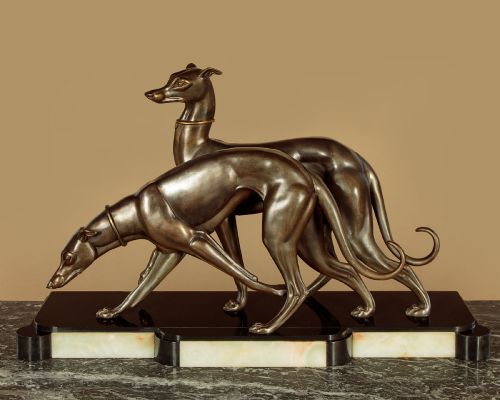


Art Deco Dog Sculpture
An art deco dog sculpture captures the sleek lines and dynamic energy of the period, making it a striking focal point for any mantel or desk.
Art Deco Dog Sculpture
When you search for an art deco dog sculpture, you encounter figures that span table lamps, bookends, mantel clock sets, and standalone figurines. Greyhounds, borzois, Alsatians, and gun dogs dominate the forms, often captured in mid-stride or repose during the 1920s and 1930s. Spelter, bronze, and marble appear frequently, alongside combinations involving onyx and glass.
The most common pieces on this page are metal figures mounted on marble or onyx bases, reflecting the interior tastes of the interwar decades. Alongside standalone hounds, you will find dogs paired with children, girls, or figures running, as well as specialised items like car mascots and night lights.
How they were made
Foundries cast metal figures in bronze or spelter, often finishing them with silvering, cold painting, or patination to highlight muscle and coat texture. Spelter provides a lighter, more pliable medium for large casts, while bronze offers durability and fine detail for racing greyhounds and hunting dogs.
Many metal sculptures are anchored to heavy bases of polished marble or banded onyx, providing stability for dynamic leaping postures. Porcelain works such as greyhound figures undergo high-temperature firing and glazing to achieve a smooth, glossy finish.
One hound wears a permanent look of intense aerodynamic determination while permanently bolted to a car bonnet.
What varies in quality
The distinction between tiers rests on the crispness of the casting and the integration of the figure with its base. Superior examples exhibit clean chisel work on the metal fur and secure mounting to the stone, whereas simpler pieces show softer contours and less refined finishing.
Artisanal skill also dictates quality, seen in the fluid posture of a leaping hound or the naturalistic expression of a German shepherd. Signed works by known sculptors demonstrate a higher degree of anatomical precision and compositional balance than unsigned factory productions.
C Masson·Karl Hagenaur·Alexandre Kelety·Geo Maxim·H Bal·Louis Lejeune·Michel Decoux·Rene Varnier·Godard·Uriano·Louis-Albert Carvin
The Art Deco Dog Sculpture Glossary
- Spelter
- A zinc alloy commonly used as a substitute for bronze in interwar metalwork. It accepts patination and silvering well, though it is softer than bronze.
- Animalier
- A nineteenth and twentieth-century artistic focus on the realistic portrayal of animals. Sculptors in this tradition concentrated on the musculature and movement of hounds and sporting dogs.
- Onyx
- A banded variety of chalcedony used frequently for the plinths and bases of figures. Its layered stone patterns complement the geometric lines of interwar design.
- Mascot
- A decorative ornament mounted on the radiator caps of automobiles during the period. Greyhound and racing dog motifs were popular choices for these motoring figures.
- Garniture
- A set of ornamental objects for a mantelpiece, usually comprising a clock flanked by matching side pieces. Dog sculptures frequently form the central figural element of these sets.
Art Deco Dog Sculpture: Frequently Asked Questions
What dog breeds appear most often?
Greyhounds, borzois, and Alsatians are the most frequent subjects in these metal and stone figures. Gun dogs and bulldogs also appear across various periods.
Their elongated, athletic forms suited the stylised aesthetic of the interwar decades.
How were night lights constructed?
Sculptures involving night lights combined a metal dog figure with an illuminated glass or frosted element mounted on a marble base. These pieces served a dual decorative and practical purpose in period interiors.
The glow emanated from behind or beneath the hounds, casting ambient light across the stone.
Are these figures mounted on stone?
Many examples utilise heavy bases made from marble or onyx to anchor the dynamic postures of leaping or running hounds. These mineral plinths provide necessary weight and stability.
They also introduce contrasting colours and textures beneath the patinated metal.
What is a car mascot?
A car mascot is a sculptural ornament attached to the exterior of an automobile during the period. Racing greyhounds were favoured for this role to suggest speed and forward motion.
They screw directly onto the vehicle body or radiator cap.