
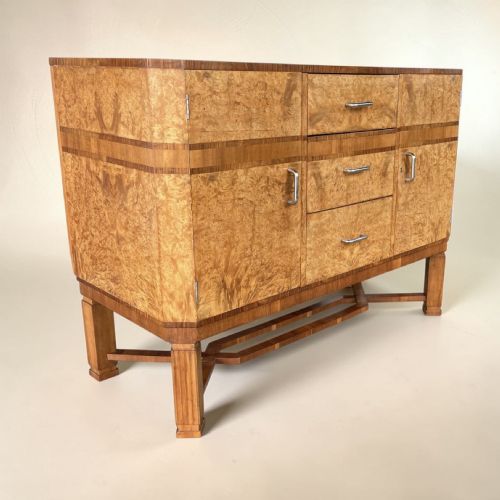
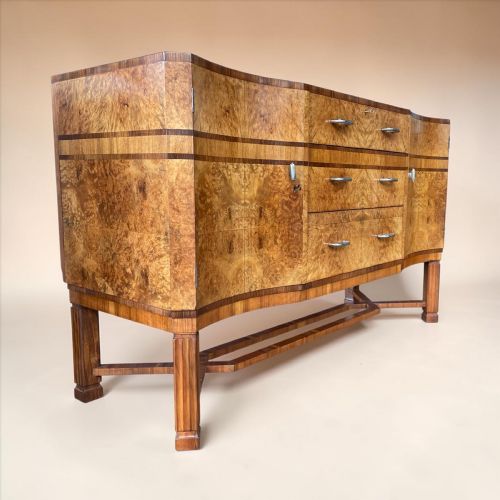
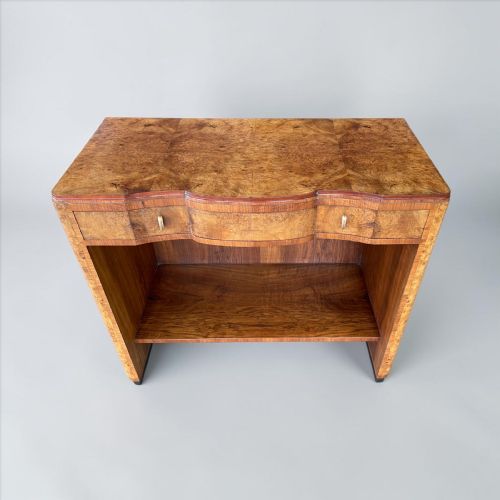
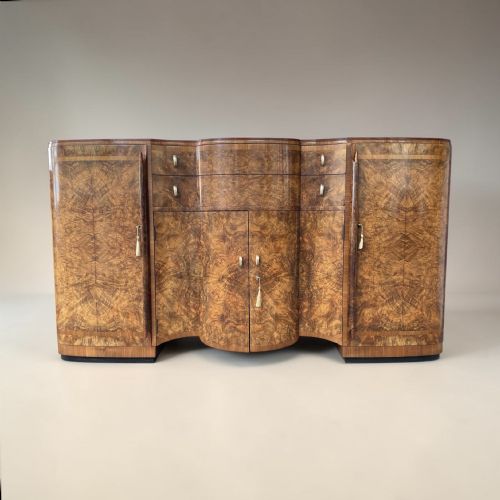

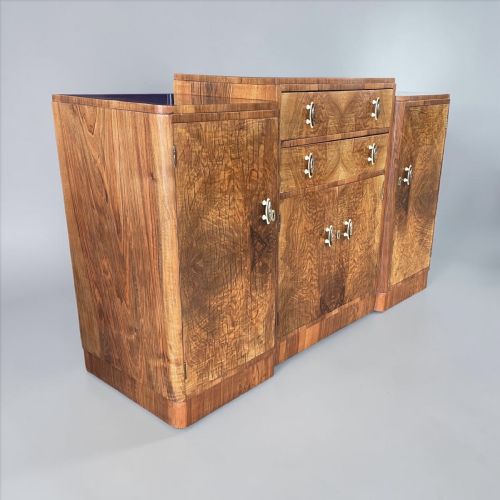
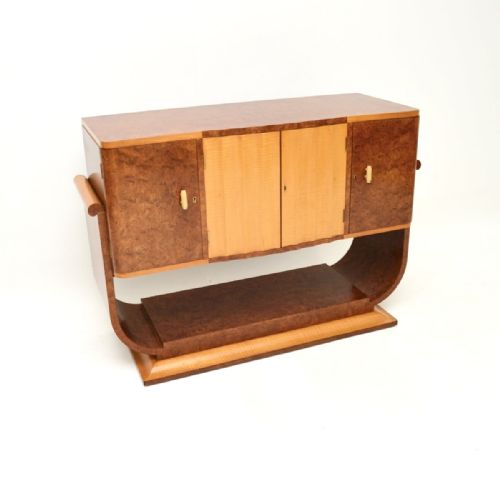
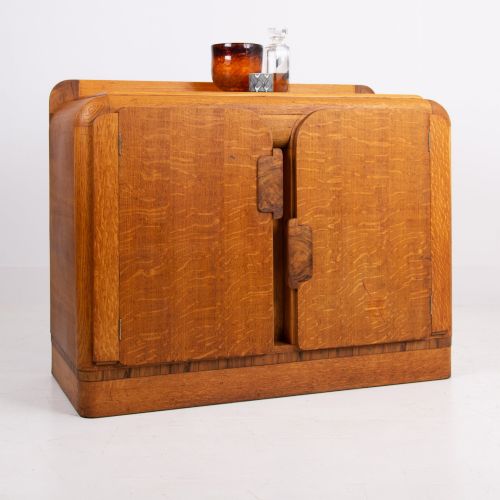
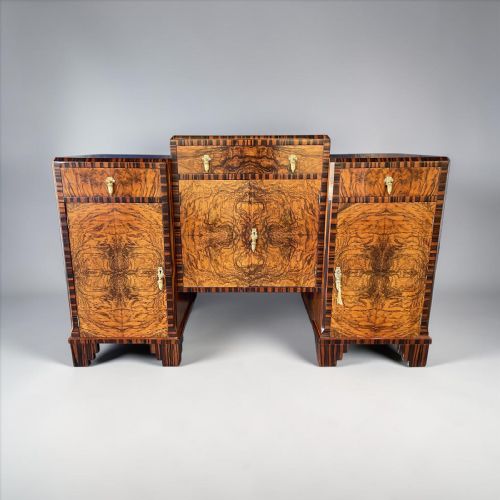
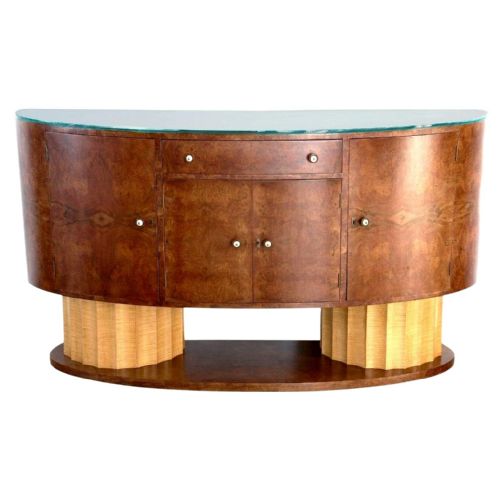


Art Deco Dining Sideboard
An art deco dining sideboard brings geometric elegance and serious storage to a room, uniting period craft with practical function.
Art Deco Dining Sideboard
An art deco dining sideboard provides substantial surface area and cupboard space for hosting, originating primarily from the nineteen-twenties and nineteen-thirties. These pieces range from streamlined cabinets to serving tables and cocktail cabinets designed for dining rooms.
The selections here span standard sideboards, serving tables, and larger cabinets, often emerging from British and continental workshops. Buyers encounter forms ranging from compact oak cupboards to large burr walnut server units.
Maker-marked examples by notable furniture houses appear alongside pieces defined simply by their distinct period styling and geometry. Walnut and oak remain the dominant timbers across these dining room designs.
Materials and construction methods
Cabinetmakers utilised timber veneers such as burr walnut, sycamore, calamander, macassar, and mahogany over solid frames. These veneers were arranged to create striking symmetrical grain patterns across large cabinet doors and drawer fronts.
Metal, brass, glass, and bakelite elements frequently complement the woodwork on handles, trim, and internal fittings. Secondary timbers like oak provide the structural carcase for heavy serving units and sideboards.
French polishing and specialised varnishes were applied to bring out the natural depth and figure of the exotic wood veneers. Construction often involved curved double bow fronts and serpentine shapes requiring advanced joinery skills.
Listings feature items built from nineteen-twenty to nineteen-thirty, utilising burr walnut, oak, mahogany, calamander, and metal.
Separating high quality from standard execution
The choice and book-matching of veneers heavily dictate the visual impact and standing of a sideboard. Exceptional examples display continuous, carefully aligned grain patterns across multiple doors and drawers.
Maker attribution elevates certain pieces, particularly items bearing signatures or stamps from established London workshops and continental makers. The complexity of the woodwork, such as curved double bow fronts or multi-timber marquetry, also signals higher grade execution.
Maurice Adams·Gomme·Hille·Heals of London·Epstein·Harry and Lou Epstein·Hamptons of Pall Mall London
The Art Deco Dining Sideboard Glossary
- Veneer
- A thin slice of figured wood applied over a stable secondary timber base. This technique allowed makers to utilise expensive exotic woods efficiently while creating symmetrical patterns.
- Burr walnut
- A prized wood growth featuring swirling, irregular grain patterns. It forms the decorative surface on many high-end cabinet doors.
- Serpentine
- A furniture front shape that curves inward in the centre and outward at the sides. This contour requires precise woodworking skill to execute properly.
- Cocktail cabinet
- A specialised storage unit fitted for glassware, bottles, and mixing drinks. These pieces often feature drop-down serving flaps and mirrored interiors.
- Bow front
- A convex, outward-curving furniture facade. Double bow variants feature two rounded projections across the front elevation.
Art Deco Dining Sideboard: Frequently Asked Questions
Where do I put a sideboard?
These large cabinets sit best against a dining room wall where they provide both a serving surface and storage for tableware.
Ensure there is adequate clearance for doors and drawers to open fully without obstruction from dining chairs.
How do I clean walnut veneer?
Dust the surface regularly with a soft, dry cloth to prevent grit accumulation.
Avoid chemical polishes and excess moisture, using only specialist wax sparingly when the wood appears dry.
What is the difference between a sideboard and a serving table?
Sideboards typically incorporate extensive enclosed cupboard space and drawers for storing cutlery and linens.
Serving tables focus more on open top surfaces for presenting food during meals, sometimes with minimal under-tier storage.
How can I tell a nineteen-twenties piece from nineteen-thirty?
Dating relies on stylistic shifts from early geometric restraint to bolder curves and exotic veneer combinations later in the period.
Construction methods and maker documentation also help narrow down the decade of production.