


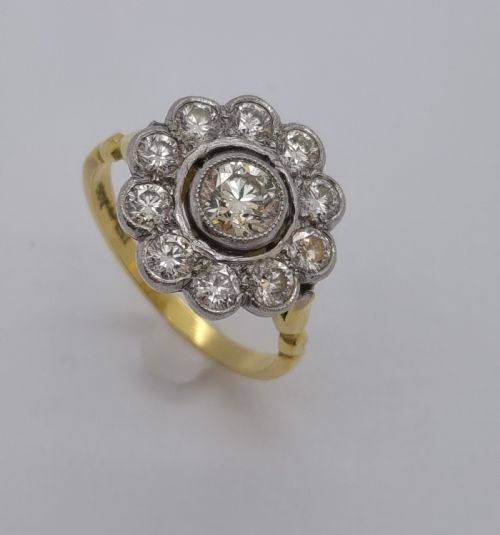
Art Deco Daisy Ring
An art deco daisy ring gathers central diamonds within a radiating halo of smaller stones, offering geometric brilliance from the early twentieth century.
Art Deco Daisy Ring
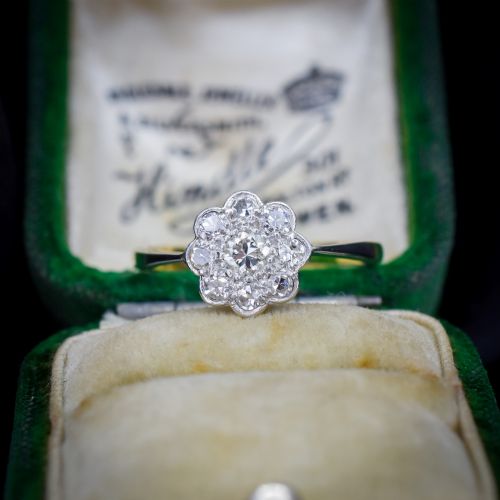
An art deco daisy ring forms a central cluster resembling a floral head, designed with concentric tiers of gemstones. The pieces on this page span the 1920s and 1930s, alongside Edwardian and mid-century examples.
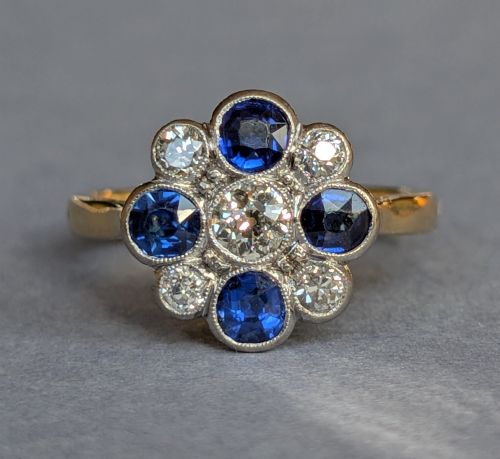
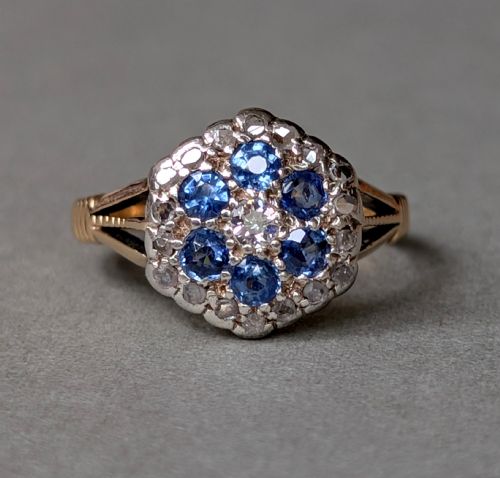
Most entries combine diamonds with sapphires or rubies, set into distinct circular or target configurations. The cluster format projects light outward from a raised central stone, creating substantial finger presence from compact geometric modules.
How They Were Made
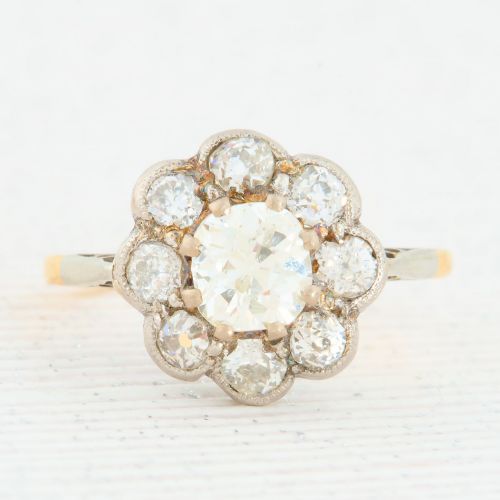
Metalsmiths built these mounts using platinum or white gold combined with yellow gold, employing platinum claws to reflect maximum light through upper diamonds. Old European and old cut diamonds predominate, shaped by hand before modern symmetrical standards took hold.
Settings often feature millegrain detailing, where tiny beaded metallic borders edge the bezels and platforms. Jewelers constructed these rings to support intricate stone arrangements while maintaining slender, durable shanks.
Listings feature platinum, yellow gold, and white gold combined with diamonds, sapphires, and rubies across 1920 and 1930 dates.
What Varies In Quality
Quality rests upon the matching and proportion of the peripheral stones relative to the central focal point. Tighter stone spacing and higher diamond clarity grades, such as VS or VVS, elevate the optical cohesion of the cluster.
The precision of the metalwork defines the construction standard, visible in the crispness of millegrain edges and the structural integrity of the platinum setting over the gold base.
H Samuel
The Art Deco Daisy Ring Glossary
- Old European Cut
- An early form of brilliant cut diamond featuring a small table, high crown, and a large culet. This cut produces broad, dramatic flashes of candlelight reflection.
- Millegrain
- A decorative technique involving tiny raised metallic beads along the edge of a setting. It softens harsh metal lines with a textured border.
- Cluster Ring
- A ring featuring a central gemstone surrounded by a group of smaller stones. This layout maximises overall visual surface area.
- Target Ring
- A specific cluster variation with concentric contrasting colour rings resembling a bullseye. Sapphires or rubies frequently form the inner coloured band around a central diamond.
Art Deco Daisy Ring: Frequently Asked Questions
What defines an art deco daisy ring?
An art deco daisy ring uses a geometric cluster design where a central diamond sits surrounded by a ring of matching stones. The overall silhouette mimics a floral blossom interpreted through modern, linear aesthetics.
These pieces typically date from the 1920s and 1930s, combining platinum settings with yellow or white gold bands. The configuration maximises the brilliance of smaller diamonds into a unified focal point.
How do you wear an antique ring safely?
Wearing an antique ring daily requires mindful care due to the age of the delicate platinum settings and slender gold shanks. Avoid wearing them during rigorous physical activities or housework to protect the millegrain and prongs.
Periodic checks by a jeweler ensure the tiny claws holding the cluster stones remain secure. Store the ring separately in a lined box to prevent scratching against modern hard gemstones.
Are sapphires common in these rings?
Sapphires frequently accompany diamonds in these clusters, often forming a contrasting band around the centre stone. This combination delivers the classic target ring appearance popular during the 1920s.
Rubies also appear as accent stones alongside diamonds, adding deep red contrast to the white sparkle of the platinum mount.
How do old cut diamonds differ?
Old European cut diamonds possess hand-faceted proportions with smaller tabletops and deeper pavilions than modern brilliant cuts. These historic stones produce distinct, chunky light patterns rather than uniform pinfire sparkle.
Each stone was shaped individually by hand, meaning no two cluster arrangements feature identical optical characteristics.