


Blue Sapphire Flower Ring
A blue sapphire flower ring gathers bright petals around a deep centre, offering the enduring charm of a botanical cluster.
Blue Sapphire Flower Ring
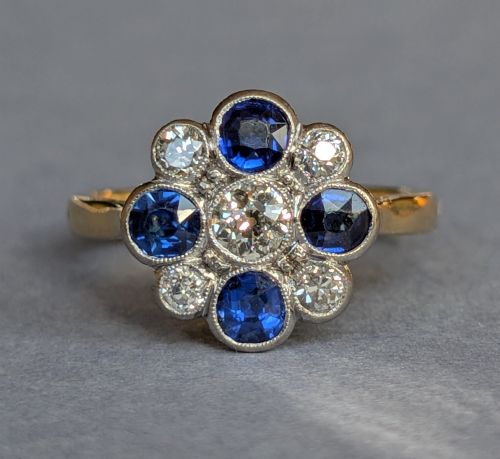
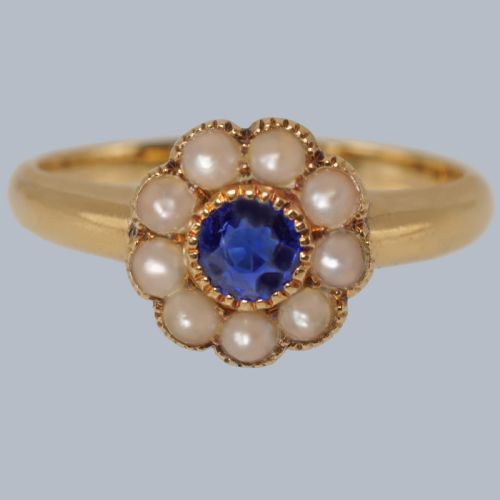
A blue sapphire flower ring presents a central gemstone encircled by diamonds or pearls to form a botanical cluster, often called a daisy ring. These pieces appear across multiple eras, including Victorian, Edwardian, Art Deco, and mid-century periods. The form relies on concentric arrangement to mimic natural floral symmetry.
How they were made
The construction of these pieces relies on precious metals such as eighteen-carat yellow gold, eighteen-carat white gold, nine-carat gold, and platinum. Metals are worked into settings that hold a central sapphire surrounded by smaller accent stones. Platinum frequently appears in Edwardian and art deco examples to provide secure claw or bezel work.
Stones are selected for colour and cut, with sapphires paired alongside diamonds or split pearls. The lapidary work shapes central stones into oval or circular profiles while surrounding them with brilliant or single-cut diamonds. Goldsmiths then finish the mounts with polished shanks and detailed gallery wirework.
Listings span periods from eighteen ninety through to nineteen sixty, utilising sapphire, diamond, split pearl, platinum, and various gold karats.
What varies in quality
The standard of a blue sapphire flower ring depends on the saturation of the central sapphire and the matching consistency of the surrounding diamonds. Superior examples feature stones with uniform brilliance and well-balanced proportions between the centre and the petal elements. Lower tiers often show mismatched stone sizes or paler colour distribution.
Execution of the metalwork also separates tiers of production, particularly in the crispness of the claw settings and the weight of the gold or platinum shank. Finer pieces demonstrate meticulous stone placement with minimal visible metal between the perimeter stones. Simpler iterations rely on heavier shared claws that obscure the individual facet lines.
The Blue Sapphire Flower Ring Glossary
- Cluster ring
- A ring design featuring a central gemstone surrounded by a cluster of smaller accent stones. This arrangement forms the basis of the floral style.
- Daisy ring
- A specific cluster configuration where a round centre stone is encircled by white diamonds, resembling the petals of a daisy.
- Split pearl
- A natural pearl cut in half and used flat-backed in jewellery settings. These appear in Victorian examples alongside sapphires.
- Platinum
- A dense, durable white metal utilised in Edwardian and later mountings for secure stone setting. It allows for delicate yet strong claw work.
- Cornflower blue
- A specific vivid, medium-blue shade often associated with high-grade sapphires seen in historical records.
Blue Sapphire Flower Ring: Frequently Asked Questions
How do I wear a flower ring daily?
These rings suit everyday wear provided the setting remains secure and regular checks are made on the claws. Pairing them with plain bands prevents rubbing against adjacent jewellery.
Removal during heavy manual tasks protects both the gold or platinum shank and the central sapphire from impact.
How do I tell an Edwardian ring from a mid-century one?
Edwardian examples often utilise platinum-topped yellow gold with delicate pierced gallery work and fine millgrain detailing around the stones. The floral motifs lean towards light, airy daisy configurations.
Mid-century pieces from the nineteen fifties and sixties tend to feature heavier white gold or yellow gold castings with bolder, more structured cluster profiles.
What is a cluster ring?
A cluster ring groups multiple stones together to create a larger visual impact on the hand than a single gem would provide. In this category, the arrangement specifically imitates a flower.
Central sapphires dominate these groupings, held by surrounding tiers of diamonds or pearls.
Can I resize an antique cluster ring?
Most gold and platinum bands can be adjusted by a skilled jeweller to fit different finger sizes. The feasibility depends on the shoulder design and whether any engraving extends around the band.
Consulting a specialist ensures the structural integrity of the basket and the security of the outer stones remain intact.