
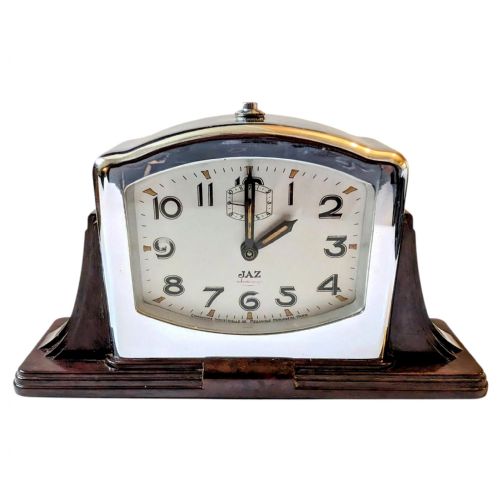
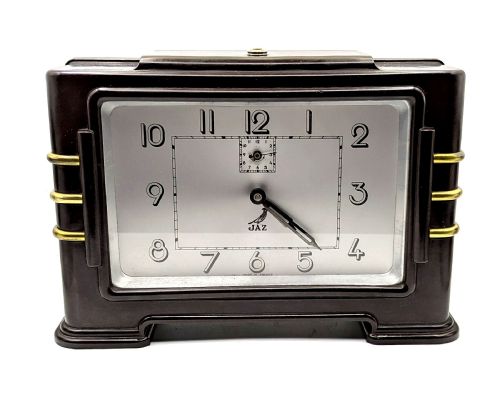


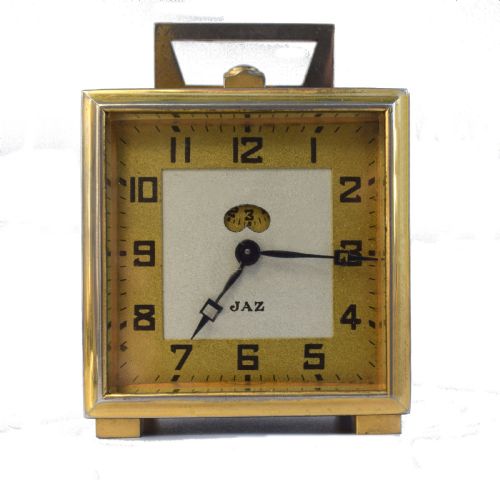


Art Deco Alarm Clock
An art deco alarm clock brings geometric rhythm and utilitarian style to a bedside table, combining period engineering with striking visual presence.
Art Deco Alarm Clock
An art deco alarm clock represents a convergence of early twentieth-century timekeeping and modernist design, emerging predominantly from French and British workshops during the nineteen-twenties and nineteen-thirties. These pieces function as desk clocks, mantel clocks, and travel clocks, designed to sit neatly on a bedside table or office desk.
The versions most commonly met on this page originate from French makers utilising moulded plastics and polished metals. They take forms ranging from miniature portable travel timepieces to larger architectural mantel models incorporating calendar functions and novelty housings.
Materials and Construction
Makers constructed these timepieces using a combination of heavy metal alloys and early synthetic materials. Chrome-plated metal, brass, bronze, and silvered surfaces provide the reflective gleam characteristic of the machine age.
Moulded bakelite appears frequently in contrasting tones of cream, brown, and black, paired with glass dial covers and sometimes marble or onyx bases. Travel versions frequently incorporate leather cases to protect the mechanical movements inside.
Listings feature pieces spanning the nineteen-twenties and nineteen-thirties, constructed from glass, chrome, bakelite, brass, and bronze.
Judging Quality and Finish
The distinction between standard examples and superior pieces rests on the weight of the metal chassis and the complexity of the case architecture. Architectural designs such as skyscraper steps or streamlined curves demand greater skill in metal shaping and moulding than plain circular housings.
Signatures on the dial or movement by recognised French and Swiss clockmakers elevate a piece, as do original fitted leather cases and undamaged polychrome bakelite mouldings that retain their intended contrast and sheen.
Jaz·DEP·Bayard·Blangy Clockmakers·Japy·Jaeger·ImHof·LeCoultre·Rotherham·Odyv·Ingersoll·UTI Paris·Harrods of London
The Art Deco Alarm Clock Glossary
- Bakelite
- An early thermosetting phenol formaldehyde resin used extensively for durable, brightly coloured clock cases. It feels dense and warm to the touch compared to modern plastics.
- Streamline
- A late phase of the style characterised by smooth, aerodynamic curves, horizontal lines, and rounded corners inspired by modern transport design.
- Skyscraper style
- An architectural form mimicking the vertical setbacks and tiered towers of twentieth-century metropolitan architecture.
- Travel clock
- A compact timepiece, frequently equipped with a folding metal strut or protective leather case, designed for portability.
Art Deco Alarm Clock: Frequently Asked Questions
How do I wind an art deco alarm clock?
Most mechanical models feature separate butterfly keys on the rear plate for the time train and the alarm spring. Turn each key gently clockwise until firm resistance indicates full tension.
Avoid over-winding older movements, as this places unnecessary stress on the internal springs and gear trains.
Were these clocks made for travel?
Many compact examples were built specifically for journeys, housing the metal case inside a fitted leather sleeve with a clasp. Folding stands allowed the clock to prop upright on a hotel nightstand.
Heavier mantel and desk variants remained stationary, relying on solid bronze, marble, or stepped bakelite bases to stay upright.
How do I date an art deco alarm clock?
Dating relies heavily on typographic styles on the dial, case materials, and maker marks recorded from the nineteen-twenties and nineteen-thirties. The presence of early synthetic plastics like bakelite alongside chrome plating typically points directly to this interwar window.
Consulting movement serial numbers or maker signatures helps narrow the production decade further.
Can I use one as a daily alarm?
These mechanical timepieces function well for daily use if serviced by a professional horologist to clean the vintage oils. The bell or buzzer mechanism relies on a separate wound spring that releases at the set time.
Gentle handling and regular professional maintenance ensure the vintage components continue to run accurately.