
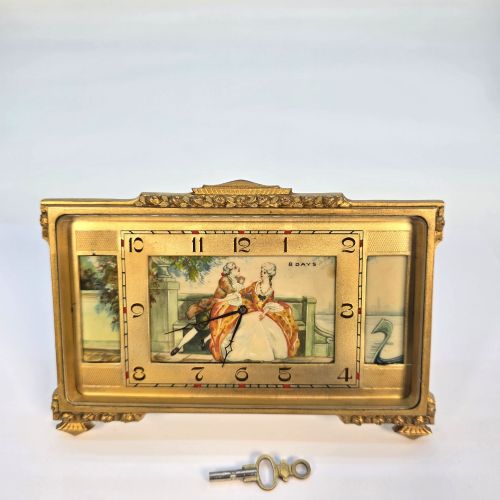
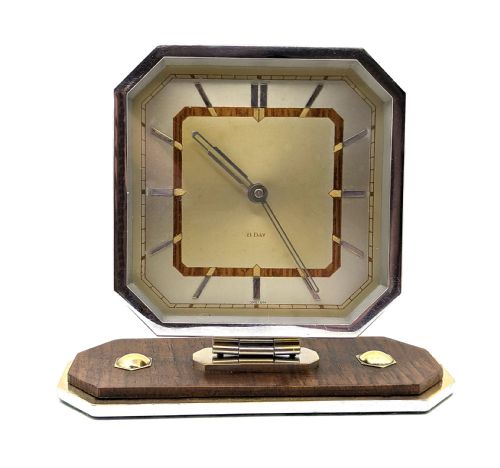


Art Deco 8 Day Clock
An art deco 8 day clock brings mechanical dependability and striking geometric design to a desk or mantelpiece.
Art Deco 8 Day Clock
When searching for an art deco 8 day clock, collectors encounter desk clocks, mantel clocks, and wall clocks spanning the 1920s and 1930s. These pieces combine long-running mechanical movements with the clean lines and geometric styling typical of the period.
The most common examples on this page are compact desk clocks and substantial mantel clocks housed in chrome, glass, and polished walnut. Many retain their original English or continental movements, designed to run for over a week before requiring a manual wind.
Materials and construction
The construction relies heavily on machined metals such as chrome-plating, brass, and nickel, paired with polished hardwoods like walnut and oak. Makers also incorporated structural glass, mirrored panels, and vitreous enamel faces to achieve the signature aesthetic.
Movements were engineered to last, utilising jewelled escapements and sturdy mechanical gearing that required minimal intervention between weekly windings. Casing construction ranged from streamlined skyscraper silhouettes to heavy marble and onyx blocks.
Some travel clocks featured clever folding mirror designs so gentlemen could check their ties while winding.
Judging quality
Quality in these clocks rests upon the precision of the movement and the integrity of the materials used in the casing. Pieces carrying signatures from notable makers or retailers often demonstrate superior finishing on dials, bezels, and internal gearing.
The weight and clarity of glass components, the smoothness of pivoting or folding mechanisms, and the depth of the metal plating distinguish standard production models from finer examples.
Mappin And Webb·Harrods Of London·Asprey·Smiths Clocks Ltd·Junghans·CYMA
The Art Deco 8 Day Clock Glossary
- Escapement
- The internal mechanism that controls the release of power in a clock, translating the spring tension into regulated ticks. Jewelled escapements reduce friction and improve timekeeping accuracy.
- Champlevé
- An enamelling technique where troughs are dug into a metal surface and filled with vitreous enamel powder before firing. This adds colourful decorative detail to the clock bezel or case.
- Skyscraper clock
- A vertical architectural case design inspired by modern urban architecture of the 1920s and 1930s. These forms use stepped tiers to emphasise height and clean geometric lines.
- Strut clock
- A portable timepiece featuring a hinged prop or stand on the back for resting upright on a desk or dressing table. They are frequently framed in precious metals or enamelled brass.
Art Deco 8 Day Clock: Frequently Asked Questions
How often do you wind an 8 day clock?
These movements are engineered to run for approximately eight days on a single winding. Establishing a weekly routine prevents the mainspring from running down completely and maintains consistent timekeeping.
Wind the clock gently until resistance is felt, taking care not to over-wind the mechanism. Regular maintenance ensures the longevity of the vintage gears.
Where were these clocks made?
Production was centered in England, France, Switzerland, and Germany during the interwar years. Prominent retailers and specialist clockmakers across these regions supplied domestic and international markets.
English and French workshops frequently utilised local hardwoods and marble, while Swiss and German manufacturers specialised in compact, high-precision movements for desk and travel use.
How do I date an art deco clock?
Dating relies on stylistic markers such as stepped skyscraper forms, modernist numerals, and the choice of materials like chrome plating and tinted glass. Hallmarks on silver or precious metal cases offer precise year markers.
Internal movement stamps and retailer signatures provide additional historical context, helping to place a piece securely within the 1920s or 1930s.
Can these clocks be used daily?
Most serviced examples function reliably as daily timekeepers in a home or office setting. Placing them away from direct sunlight and excessive moisture protects the delicate finishes on the wood and metal.
Routine servicing by a professional horologist keeps the mechanical movement operating smoothly and preserves the internal components for continued use.