


Arch Top Longcase Clock
These arch top longcase clocks bring remarkable movement and presence into a room, spanning periods from the eighteenth century to the twentieth.
Arch Top Longcase Clock
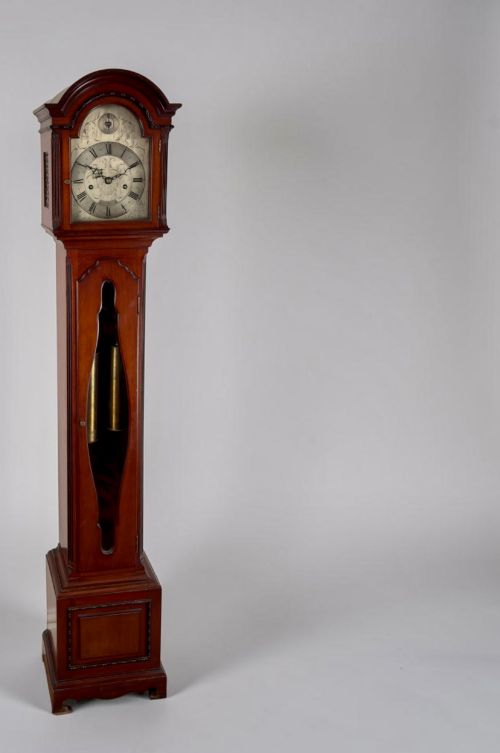
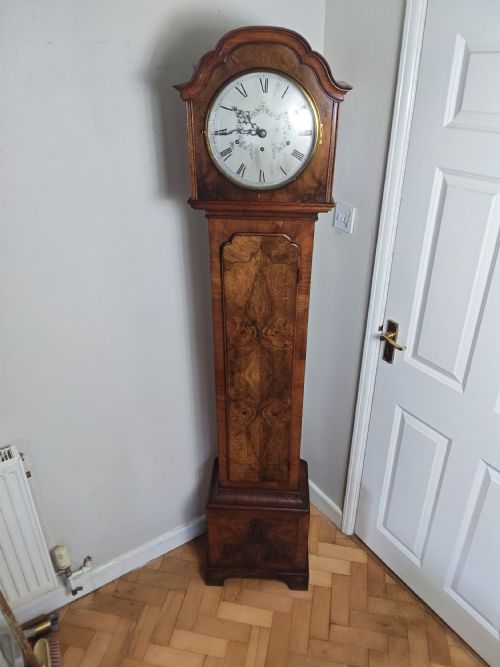
An arch top longcase clock houses a tall weight-driven or spring-driven movement within a fitted wooden case featuring a rounded hood top. Collectors searching for an arch top longcase clock encounter tall grandfathers, smaller proportions, and grandmother clocks across Georgian, Victorian, Edwardian, and later twentieth-century iterations.
The timber used for the case ranges from figured mahogany and burr walnut to traditional oak. Makers fashioned these enclosures to protect the delicate brass and steel gear trains while serving as commanding floor-standing furniture.
Georgian examples sit alongside Edwardian revivals and 1930s musical models. The dial format often incorporates brass fittings, moonphase displays, and quarter-chiming mechanisms housed beneath glass panels.
Materials and construction
Cabinetmakers selected solid and veneered hardwoods including mahogany, oak, and walnut, often choosing burr figures for the primary display surfaces of the case. These timbers were joined and polished to create tall vertical housings with arched hoods above the dial.
Horologists fitted brass and steel into the movements, driving gear trains with hanging weights or springs. Dials incorporated engraved brass, silvered chapter rings, and glazed doors to protect the hands and pendulum.
Arch Top Longcase Clock Retail Price Guide 2026
Typical asking prices for arch top longcase clock among the pieces listed under this phrase on Sellingantiques today, from the lower quarter to the upper quarter. They describe what is for sale here now, not the wider market.
Some clocks keep time so faithfully they outlive empires, dynasties, and several generations of pocket watches.
What separates examples
The refinement of the cabinetwork and the complexity of the internal movement dictate the standing of an individual piece. Highly figured burr walnut or mahogany veneers paired with sophisticated chime or musical mechanisms represent superior workmanship compared to simpler oak housings.
Proportion and execution of the arched hood and dial ornamentation reveal the skill of the original maker. Original components remaining intact across the movement and case preserve the integrity of the piece.
Gillett & Johnston of Croydon·Thomas Goddard London·JAMES COSTER OF HENLEY·French Royal Exchange·THOMAS HALL - ROMSEY
The Arch Top Longcase Clock Glossary
- Arch top
- A hood design featuring a curved upper section above the dial. This profile distinguishes many Georgian and later longcase clocks.
- Grandmother clock
- A smaller version of the traditional longcase clock produced during the twentieth century. These shorter pieces suit domestic spaces with lower ceilings.
- Moonphase
- A dial mechanism tracking the lunar cycle through a rotating disk behind an opening. This feature appears on eighteenth-century and later clocks.
- Quarter chiming
- A movement mechanism striking the quarters of the hour on bells or gongs. This adds complexity to the gear train beyond standard hour strikes.
- Regulator
- A high-precision clock designed for exact timekeeping with a compensated pendulum. These movements emphasise accuracy over domestic chime functions.
Arch Top Longcase Clock: Frequently Asked Questions
How do I wind an arch top longcase clock?
Winding involves using a crank key to raise the weights inside the trunk or adjusting the spring barrels behind the dial door. Care must be taken not to over-wind the movement.
Consulting the specific mechanical requirements of the gear train ensures the clock continues to keep accurate time without placing undue strain on the lines or chains.
Where should I place a longcase clock?
Position the clock against a solid interior wall away from direct sunlight, central heating vents, and damp areas. A stable floor surface prevents vibrations from disturbing the pendulum.
Securing the tall wooden case to the wall using discreet fixings protects the structure from accidental tipping in busy hallways or living spaces.
How do I tell an 18th-century clock from a 1930s piece?
Eighteenth-century examples typically feature hand-carved solid timbers, engraved brass dial plates, and weight-driven movements constructed by regional makers. The proportion and patination of the wood reflect early cabinetmaking techniques.
Twentieth-century grandmother clocks and 1930s models often incorporate machine-cut parts, smaller dimensions, and modern chime configurations while adopting earlier revival styles.
What is the difference between a grandfather and grandmother clock?
Grandfather clocks are the standard full-size floor-standing timepieces developed across the Georgian and Victorian eras. Their tall proportions require adequate ceiling clearance.
Grandmother clocks are scaled-down versions produced predominantly during the Edwardian period and the 1930s, offering the traditional aesthetic in a shorter format.