
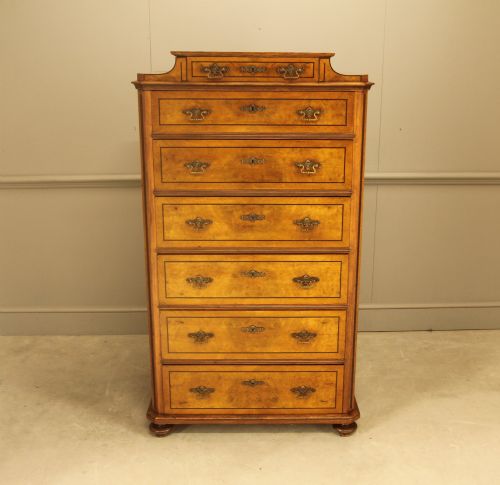
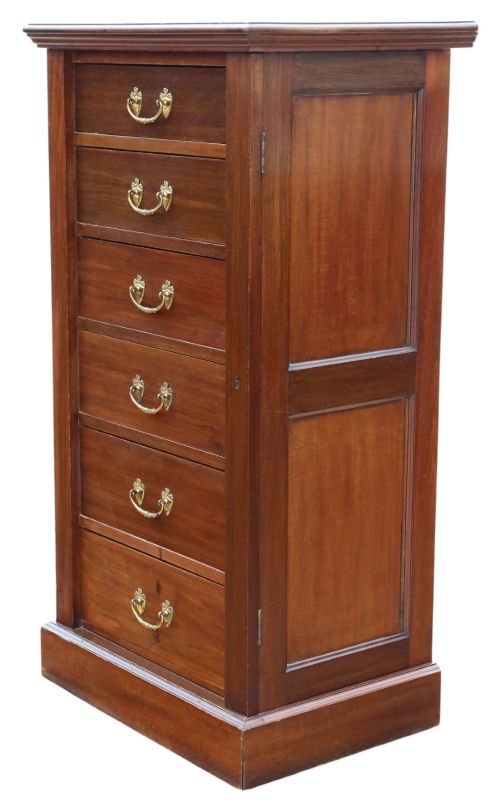

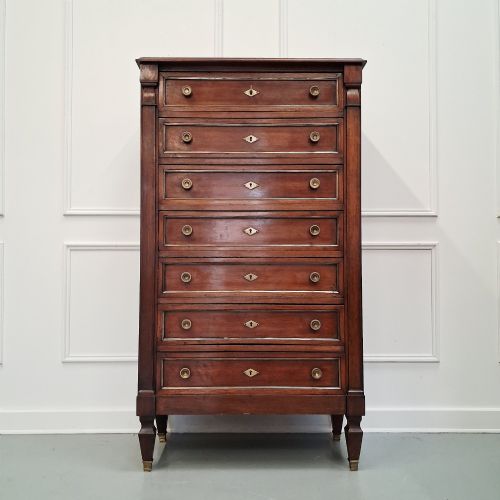
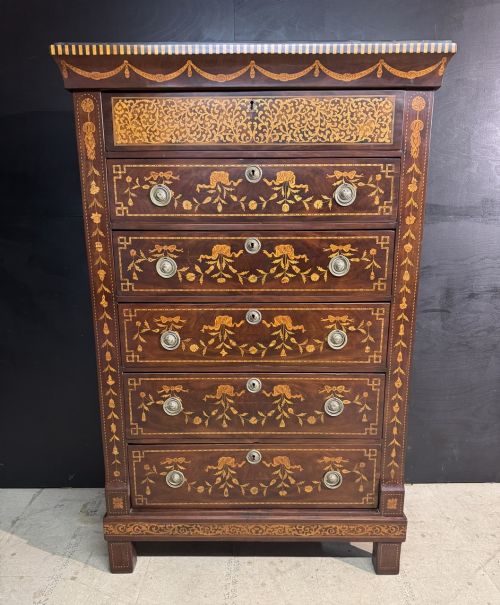
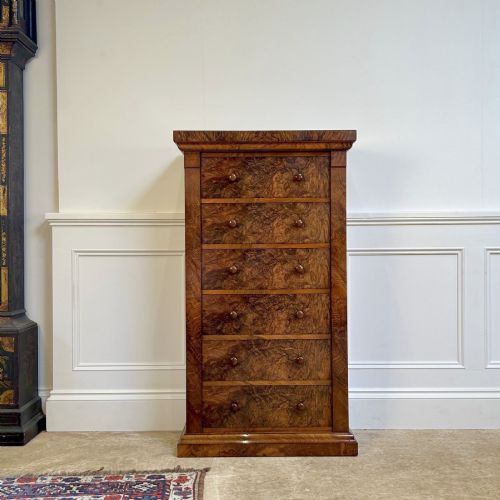


Antique Wooden Semainier
An antique wooden semainier is a slender tower of seven drawers built to hold the week's linen and papers.
Antique Wooden Semainier
An antique wooden semainier presents itself as a tall, narrow chest of drawers designed to occupy minimal floor space while offering generous vertical storage. The form originates in France, though British buyers frequently encounter related tall cabinetwork such as Wellington chests and narrow Georgian or Victorian drawers.
Most examples found in commerce span the nineteenth century and the early twentieth century, utilising traditional cabinetmaking forms. They appear in styles ranging from Victorian and Edwardian to revival designs like Louis XV and Georgian.
Buyers look to these pieces for functional bedroom or study storage that introduces a strong architectural vertical line to a room. Their slender proportions distinguish them from standard horizontal chests of drawers.
How they were made
Cabinetmakers constructed these carcases using dense timbers such as mahogany, walnut, burr walnut, and rosewood, often laid over sturdy secondary woods. Surface enrichment frequently includes figured veneers, fruitwood inlay, and marquetry.
Many examples incorporate specialist locking mechanisms, such as the hinged side locking stile typical of Wellington chests that secures all drawers simultaneously. Drawer construction relies on hand-cut dovetails and solid timber linings.
The seven drawers of a true semainier were said to keep a tidy aristocrat supplied with clean linens without ever opening a wardrobe twice.
What varies in quality
The choice of timber grain dictates much of the visual merit, with matched burr walnut and figured mahogany setting apart the finest workshops. Grain continuity across drawer fronts reveals the care taken by the maker during initial board selection.
Internal engineering marks the distinction between standard and superior pieces, particularly in the precision of locking bars, secret drawers, and smooth drawer runs. The integrity of the timber movement and the crispness of inlaid details further define the hierarchy of manufacture.
Gillows·Betty Joel
The Antique Wooden Semainier Glossary
- Semainier
- A tall, narrow chest traditionally featuring seven drawers, one for each day of the week. The form developed in eighteenth-century France for linen and personal papers.
- Wellington chest
- A tall, narrow Victorian chest of drawers featuring a hinged locking stile on the right side that secures all drawers with a single key. It is closely related to the semainier in proportion.
- Marquetry
- The art of applying decorative pieces of veneer to a structure to form intricate pictorial designs. It appears on several continental and revival examples.
- Stile
- A vertical framing member of a door, panel, or cabinet carcase. In Wellington chests, the locking stile plays a structural and security role.
Antique Wooden Semainier: Frequently Asked Questions
What is a semainier used for?
A semainier provides tall, vertical storage designed originally to organise a week's worth of personal linen, hosiery, or stationery.
Its compact footprint allows it to fit into tight spaces where a standard wide chest would block movement.
How do I spot a Wellington chest?
A Wellington chest is identified by its tall, narrow proportions and a hinged locking pilaster or stile on the right side. Lifting this locking piece reveals the mechanism that secures every drawer at once.
Most examples date from the Victorian era and utilise dense timbers like mahogany or walnut.
Where did semainiers originate?
The semainier originated in France during the eighteenth century as a refined piece of bedroom furniture. The name derives from the French word for week.
Over time, cabinetmakers across Europe adopted the proportion for various tall storage forms.
How do I care for antique wood?
Protect antique wood by keeping it away from direct sunlight and maintaining steady room humidity. Sudden temperature shifts can cause timber to split and veneers to lift.
Apply traditional wax polish sparingly to nourish the grain without building up a heavy residue.