
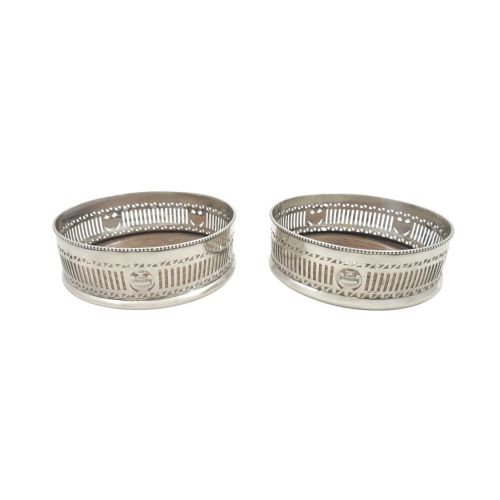


Antique Wine Sliders
Antique wine sliders are traditional dining table accessories designed to pass bottles smoothly between guests, and collectors prize them for their practicality and period charm.
Antique Wine Sliders
Antique wine sliders and bottle coasters serve the social ritual of passing drinks around the dining table without marking the polished timber surface. The selection here spans the George III, Regency, Victorian, and Edwardian periods.
Most examples take a circular form suitable for single wine bottles or decanters, whilst larger trolley formats appear from the early nineteenth century. These pieces originate primarily from nineteenth-century English workshops working in both metal and organic materials.
The assortment includes pairs and sets from the Regency and Victorian eras, reflecting the formal dining habits of the period. Buyers encounter both individual items and matched pairs designed to sit at either end of a formal table layout.
How they were made
Silversmiths utilised sterling silver and Old Sheffield plate, fusing a thin layer of silver to a copper base to create durable serving vessels. Silver plate also emerged later in the Victorian period as plating techniques advanced.
Cabinetmakers and specialised artisans turned wood, papier-mâché, and lacquer to form the bodies of non-metal sliders, often incorporating gilding and decorative rims. Turned wood provides a traditional warm texture, whilst papier-mâché offers a smooth, painted surface typical of Regency fancy goods.
Tableware made from papier-mâché proved surprisingly resilient, though guests needed steady hands when passing drinks over vintage table linen.
What varies in quality
The crispness of the chased or pierced metalwork distinguishes finer items from simpler production pieces, particularly around floral rims and heraldic shields. Early Old Sheffield plate displays a characteristic rich lustre where the base copper subtly shows through high points.
The integrity of the turned wooden base and the lining materials dictate the durability of table sliders. Better examples maintain tight joints in the turned wooden inserts and retain secure mountings for their central bosses.
The Antique Wine Sliders Glossary
- Old Sheffield plate
- An early form of plated metal created by fusing a sheet of silver to a copper ingot before rolling. This technique predates modern electroplating and leaves a distinctive edge where the copper core remains visible.
- Papier-mâché
- A composite material made from paper pulp or layers of paper reinforced with glue, then pressed and dried. Artisans often finished these pieces with lacquer and gilding for decorative dining accessories.
- Decanter trolley
- A larger table accessory fitted with small wheels or castors designed to roll along the surface. These pieces allow heavier bottles or multiple decanters to travel safely down the centre of a long dining table.
- Sterling silver
- A silver alloy containing a specific proportion of pure silver and other metals to increase hardness. Items made to this standard frequently bear official hallmarks denoting the assay office and year.
Antique Wine Sliders: Frequently Asked Questions
What is an antique wine slider?
An antique wine slider is a portable tabletop coaster or small trolley designed to hold wine bottles and decanters. They protect polished dining tables from moisture rings and allow guests to pass bottles easily.
These pieces date primarily from the Georgian, Regency, and Victorian periods, reflecting formal dining customs. They combine functional utility with decorative metalwork or turned materials.
How were wine sliders used?
Hosts placed bottles or decanters inside the sliders after dinner to circulate port or claret around the guests. The base protected the wood whilst the sides kept the bottle upright during transit.
Longer tables utilised small trolley versions fitted with wheels to roll the drinks smoothly between diners. This kept the hospitality flowing without requiring guests to lift heavy decanters across the table.
How do I date a wine slider?
Dating relies on material composition, manufacturing techniques, and stylistic markers of the period. Old Sheffield plate and papier-mâché point towards the Georgian and Regency eras, whilst later Victorian pieces often employ standard silver plating.
Silver examples frequently feature hallmarks that provide exact assay years. Stylistic details such as Regency gadrooning or Edwardian proportions also help place the piece in its era.
How do I care for antique sliders?
Care depends upon the primary material of the piece, whether silver, plate, wood, or papier-mâché. Silver and plated items require occasional gentle polishing with a non-abrasive cloth to preserve the surface without wearing away thin plating.
Wooden and papier-mâché components benefit from dry dusting and stable environmental humidity. Avoiding excessive moisture protects glued joints and decorative lacquered finishes.