


Antique Wall Hanging Clock
These antique wall hanging clock examples bring practical timekeeping and period design into a room, spanning Victorian school clocks to ornate French cartel models.
Antique Wall Hanging Clock
An antique wall hanging clock brings timekeeping and period craftsmanship directly to domestic interiors, drawing on forms such as Victorian drop-dial designs, school clocks, and French cartel pieces. Buyers seeking an antique wall hanging clock will encounter wood and metal cases housing mechanical movements, often paired with enamel dials and protective glass covers.
The selection ranges widely across the nineteenth and twentieth centuries, taking in English mahogany and walnut wall clocks alongside French carved oak and giltwood pieces. Simpler institutional timepieces sit alongside elaborate Louis XVI or Art Deco variants, reflecting the diverse domestic and commercial spaces these clocks originally occupied.
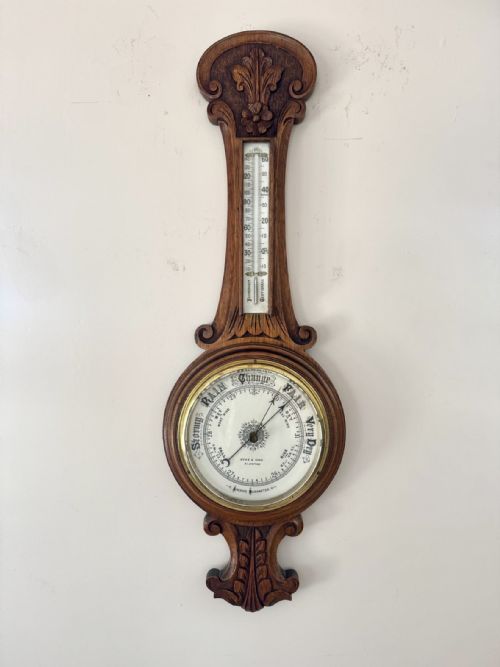
Regional styles introduce distinct regional character to the category, from Vienna wall clocks and Gustavian neoclassical pieces to Industrial and French Country examples. Each piece relies on wall mounting to display its dial, whether driven by a fusee mechanism, an eight-day striking train, or an aneroid barometer combination.
Materials and construction
Cabinet makers utilised dense timbers like mahogany, walnut, oak, and ebonised wood to build sturdy cases capable of housing complex movements. Giltwood and gilt metal were employed for ornate cartel frames, while brass and enamel formed the durable faces and bezels.
Movements relied on precise metalwork for fusee and striking mechanisms, protected behind glass doors and glazed panels. Painted decoration, carved details, and applied bronze or ormolu finished the exterior surfaces of finer architectural and decorative models.
Some wall hanging timepieces abandoned subtle ticking entirely to masquerade as giant pocket watches for eighteenth-floor jewellery shop displays.
Assessing quality and craftsmanship
Quality rests in the precision of the case carving, the crispness of giltwood or ormolu mounts, and the fidelity of the timber grain used in mahogany and walnut housings. Finer examples display meticulous attention to dial legibility, whether through hand-painted numerals on enamel or cleanly etched brass chapters.
The sophistication of the internal movement dictates the standard of the piece, distinguishing standard timepieces from eight-day striking mechanisms or fusee setups. Original components, uncompromised carved details, and signed dials by known makers elevate the overall integrity of the clock.
Hyde & Sons Sleaford·WETTERSTRANDS·JOHANN BAPTIST BEHA·Perivale of England
The Antique Wall Hanging Clock Glossary
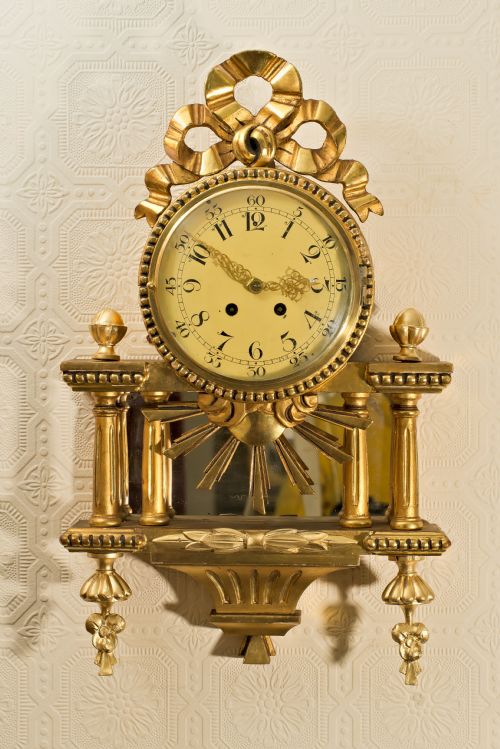
- Cartel clock
- A wall clock housed in an ornate, decorative frame made of giltwood, gilt metal, or bronze, popular in French interiors. These designs often feature asymmetrical rococo scrolls or neoclassical motifs.
- Fusee mechanism
- A conical pulley device inside the clock that ensures even tension on the drive chain as the mainspring unwinds, promoting accurate timekeeping. It is a hallmark of better quality English clockmaking.
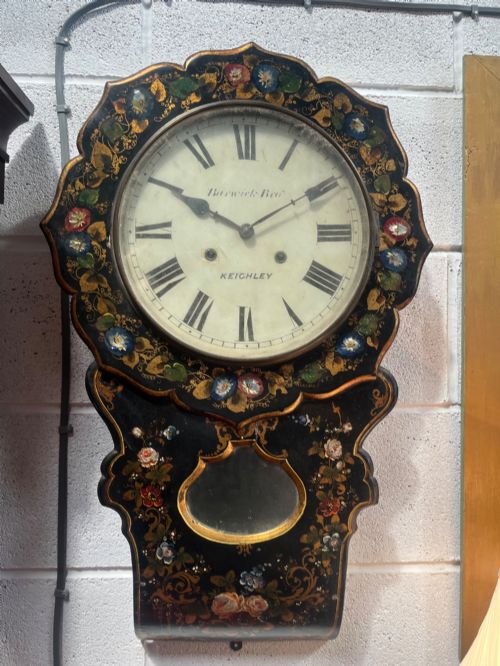
- Drop-dial
- A clock case featuring a circular dial at the top with an extended wooden trunk below to accommodate the pendulum swing. This form was common in offices, schools, and domestic hallways during the Victorian era.
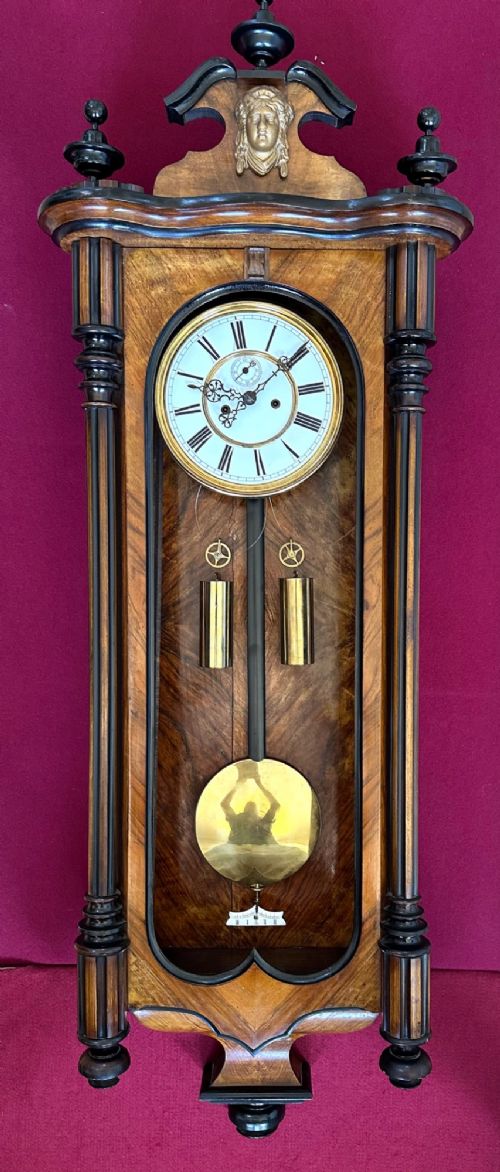
- Vienna regulator
- A precision wall clock developed in Austria, typically housed in a tall wooden case with full-length glass side panels to display the weights and pendulum. They are prized for their accurate movements and architectural walnut or mahogany cases.
- Comtoise clock
- A large pendulum clock originating from the Jura region of France, frequently adapted for wall mounting with exposed lead weights and pressed brass surrounds. They often feature hand-painted enamel dials and striking trains.
Antique Wall Hanging Clock: Frequently Asked Questions
How do I wind a mechanical wall clock?
Winding requires a dedicated key inserted into the winding holes on the dial face, turning gently until resistance is felt.
Care must be taken not to overwind the spring, as this can damage the internal mechanism and affect timekeeping accuracy.
Where should I hang a heavy wall clock?
Heavy models require secure mounting directly into wall studs or solid masonry using appropriate fixings to support the total weight of the timber case and movement.
Positioning the clock away from damp areas and direct sunlight protects both the wooden housing and the delicate enamel dial.
Why does my clock need to be level?
A level hanging position ensures that the pendulum swings with an even beat, allowing the escapement mechanism to distribute power regularly.
If the beat sounds uneven, the case can be adjusted slightly on the wall until the ticking rhythm sounds steady and balanced.
How do I identify a Victorian wall clock?
Victorian examples often feature walnut or mahogany cases, Roman numerals on white enamel dials, and sturdy mechanical movements designed for daily or weekly use.
Stylistic cues range from the plain circular bezels of school clocks to the carved architectural detailing found on Vienna-style regulators.