

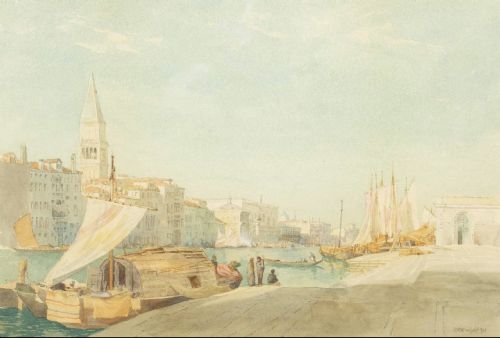


Antique Venice Watercolour
An antique venice watercolour captures the shifting light and historic architecture of the lagoon using delicate pigment on paper.
Antique Venice Watercolour
When you examine an antique venice watercolour, you are looking at paintings that record the canals, gondoliers, and historic palazzos of the Italian city. The pieces span the nineteenth and early twentieth centuries, capturing the changing moods of the Grand Canal and the lagoon.
You are most likely to meet works dating from the Victorian and Edwardian eras, executed by British and European artists who travelled to Italy. These paintings range from detailed architectural studies to atmospheric impressions of water and sky.
The subjects frequently include familiar landmarks such as Santa Maria della Salute, the Bridge of Sighs, and the Giudecca Canal. Each sheet offers a specific viewpoint recorded by artists responding directly to the Venetian atmosphere.
Materials and technique
These works are created using watercolour pigment applied to paper, often supported by wood frames and protected beneath glass. Artists used transparent washes to capture the luminous quality of light on the Venetian lagoon.
The technique relies on the white of the paper shining through thin layers of watercolour paint to create brilliance in the water and sky. Painters built up details of gondolas, bridges, and stone facades with precise brushwork over broader atmospheric washes.
Gondoliers navigate historic bridges across the lagoon, bringing motion to quiet canal corners.
Assessing quality
Quality in these watercolours depends on the artist's ability to handle the transparent medium and command perspective across complex architectural subjects. Stronger works demonstrate confident brushwork in rendering the reflective surfaces of water and the intricate details of stone palazzos.
The distinction between standard works and superior pieces often lies in the atmosphere captured and the precision of the composition. Skilled practitioners evoke the particular light and moisture of the lagoon rather than merely recording topographic details.
Thomas Ellison·Richard Henry Wright·Clara Montalba·Frank Wasley·Eugenio Benvenuti
The Antique Venice Watercolour Glossary
- Watercolour pigment
- The finely ground colour substance mixed with a water-soluble binder used by artists on paper.
- Grand Canal
- The main waterway of Venice, featuring prominently as a subject for nineteenth and twentieth-century painters.
- Lagoon
- The enclosed bay of the Adriatic Sea in which Venice sits, frequently depicted in these works.
- Gondolier
- A traditional Venetian rowing boatman, often shown navigating canals in these paintings.
Antique Venice Watercolour: Frequently Asked Questions
How old are these watercolours?
The works date primarily from the nineteenth and early twentieth centuries, spanning the Victorian and Edwardian periods up to the nineteen-forties.
Artists during this era travelled extensively to Italy and recorded the changing cityscape of Venice on paper.
Who painted these views?
The creators include both British and continental artists who visited Venice to capture its unique light and architecture.
Many were professional painters who exhibited their watercolours regularly during the nineteenth and early twentieth centuries.
How should I frame a watercolour?
Watercolours require framing behind glass with a mount that keeps the paper from touching the surface.
This protection helps prevent moisture damage and preserves the delicate pigments from fading in strong light.
What subjects appear most often?
The most frequent subjects are the Grand Canal, gondolas passing beneath bridges, and historic landmarks like Santa Maria della Salute.
Artists also painted views across the lagoon and quiet canals away from the main thoroughfares.