
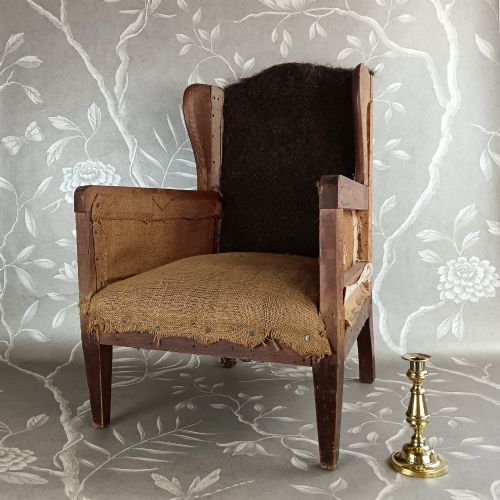


Antique Upholstered Child Chair
An antique upholstered child chair is a diminutive scale seating piece offering distinct period character and support for the young.
Antique Upholstered Child Chair
An antique upholstered child chair brings miniature scale domestic seating from earlier centuries into modern spaces, reflecting the design priorities of the household. These smaller chairs serve as decorative accents or functional seats, spanning simple side chairs to elaborate miniature wingbacks and rocking formats.
The selections on this page predominantly date from the nineteenth and early twentieth centuries, encompassing Victorian, Edwardian, and Georgian revival examples. Buyers regularly encounter walnut, mahogany, and fruitwood frames matched with period textiles, buttoned leather, and occasional brass details.
Forming part of the broader spectrum of children's furniture, these pieces range from low occasional side chairs to high chairs and rocking chairs. Each survival mirrors the adult upholstery and cabinet-making styles of its specific period, scaled down for domestic nursery use.
How they were made
Cabinet makers constructed these frames from timbers such as mahogany, walnut, rosewood, and fruitwood, frequently employing turned or carved woodwork. Selected pieces feature marquetry inlay, ebonised finishes, or structural stands that elevate the seating position.
Upholstery techniques matched those of full-sized seating, utilising traditional textiles and buttoned leather secured to padded frames. Makers incorporated functional elements like rocking rails or wingback enclosures to provide stability and comfort for a child.
The listings span the Georgian era through the Edwardian period, incorporating timber frames of mahogany, walnut, rosewood, and fruitwood.
What varies in quality
Quality in these miniature seats lies in the fidelity of the scaling and the integrity of the timber framing. Superior examples display sophisticated carving, precise joinery, and appropriate period upholstery materials that complement the smaller proportions.
The presence of distinctive stylistic elements, such as Art Nouveau inlay, Aesthetic movement ebonising, or Queen Anne style cabriole shaping, distinguishes standard utilitarian seating from pieces designed for finer domestic interiors.
The Antique Upholstered Child Chair Glossary
- Wingback
- A chair style featuring protective side panels attached to the back, designed to shield the occupant from drafts.
- Carver chair
- An open armchair, typically heavier and more decorative than a standard dining or side chair.
- Ebonised
- Timber treated with a dark finish to imitate expensive ebony wood, popular during the nineteenth century.
- Inlay
- Decorative ornamentation created by embedding contrasting materials into the surface of the wood frame.
- Rocking chair
- A seat mounted on curved wooden rockers that permit the chair to sway back and forth.
Antique Upholstered Child Chair: Frequently Asked Questions
Are these chairs meant for children to sit in?
Most antique upholstered child chair examples are structurally sound enough for gentle use, though many buyers treat them primarily as decorative display items.
Because of their historical nature, modern safety standards do not apply, so careful supervision is sensible if younger children use them.
How do I identify a Victorian child chair?
Victorian pieces often feature darker timbers like walnut or mahogany, substantial turned woodwork, and deep buttoned leather or heavy fabric upholstery.
Proportions and decorative motifs align directly with mid to late nineteenth-century interior aesthetics, distinguishing them from earlier Georgian styles.
What is the difference between a side chair and an armchair?
A side chair lacks arms and has a simpler, more compact frame intended for occasional seating or placement beside tables and walls.
An armchair incorporates supportive armrests on either side, often providing a more enclosed and substantial appearance suitable for a nursery.
How do I fit a child chair into a room?
These diminutive seats work effectively in living rooms, hallways, or bedrooms as standalone decorative accents that add texture and history.
Pairing them with larger furniture highlights their unusual scale and brings a distinct period focus to empty corners.