


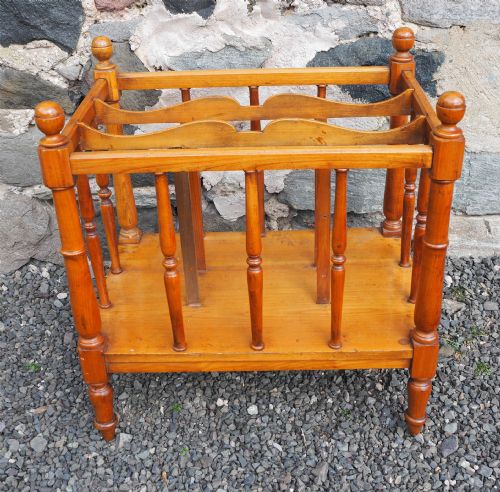


Antique Turned Spindle Stand
An antique turned spindle stand offers tiered display and storage, bringing upright timber architecture and functional shelving into traditional rooms.
Antique Turned Spindle Stand
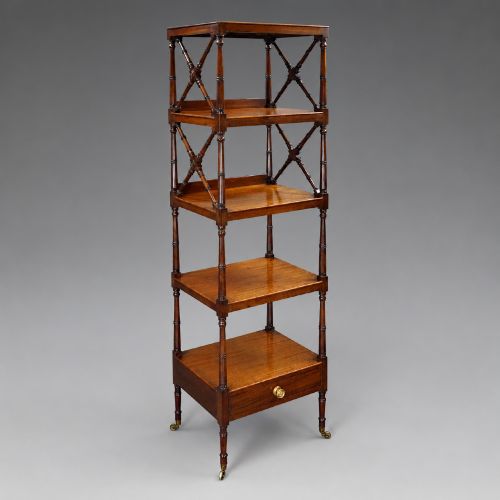
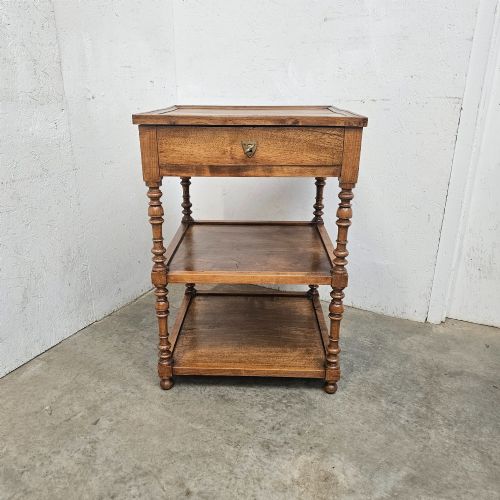
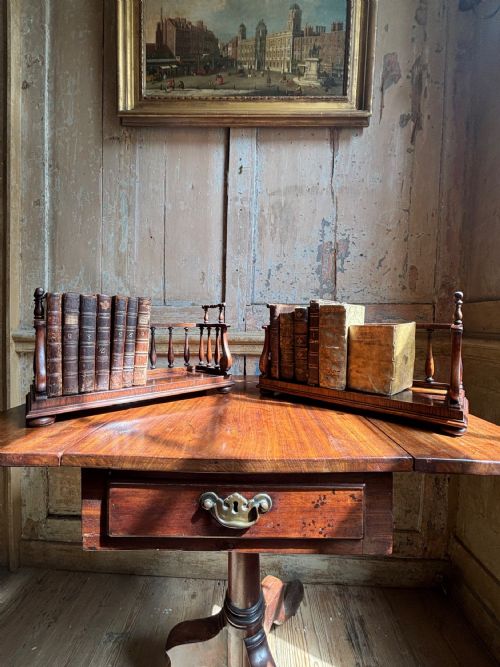
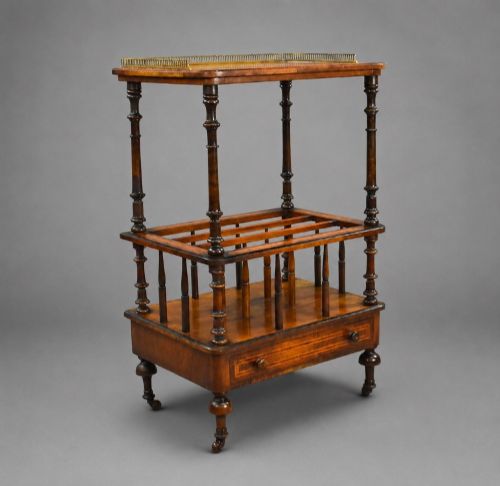
An antique turned spindle stand encompasses tiered display furniture, incorporating forms such as whatnots, canterburys, etageres, and book stands designed for domestic utility.
The pieces appearing in this category span the Georgian, Regency, William IV, and Victorian eras, often constructed as multi-tiered open shelving or compartmentalised rack units.
Makers and workshops of the nineteenth century produced these stands to hold books, sheet music, magazines, and ornamental objects within drawing rooms and parlours.
Materials and construction methods
Cabinetmakers utilised dense hardwoods including mahogany, walnut, rosewood, fruitwood, and burr walnut, frequently pairing them with turned wooden spindles and brass castors.
Surface treatments range from natural polish and figuring to ebonised finishes, alongside inlaid details and applied ceramic elements seen in Aesthetic Movement and Anglo-Moorish examples.
Victorian households expected these stands to hold everything from sheet music to potted plants without ever letting the spindles wobble.
Distinctions in quality
Superior examples demonstrate precise timber selection, evident in strongly figured walnut veneers, richly grained rosewood, and cleanly turned structural spindles.
The refinement of joinery, the integration of dovetailed drawers, and the presence of makers' marks separate standard production pieces from higher-tier workshop output.
Gillows·Edwards and Roberts·Shoolbred
The Antique Turned Spindle Stand Glossary
- Canterbury
- A low, multi-partitioned stand fitted with vertical divisions for holding sheet music or books, often featuring a base drawer and carrying handles. This form gained popularity during the Georgian and Victorian periods.
- Whatnot
- An open shelving unit with three or more tiers supported by upright posts or turned columns, designed for displaying ornaments. The style developed in the eighteenth century and remained common through the Victorian era.
- Etagere
- A piece of furniture consisting of a set of open shelves for displaying small objects, typically lighter in construction than a whatnot. French provincial and English variants both utilise this tiered format.
- Ebonised wood
- Timber treated with a dark finish to imitate expensive ebony, frequently utilised during the Victorian period for Aesthetic Movement and Anglo-Moorish designs. This technique created a striking contrast against inlaid brass or ceramic details.
- Spindle
- A slender, turned wooden rod used as a structural and decorative support between shelves or partitions. These elements define the open, airy profile characteristic of nineteenth-century tiered stands.
Antique Turned Spindle Stand: Frequently Asked Questions
What is an antique whatnot used for?
These multi-tiered stands were originally designed to display ornaments, china, and small decorative objects in formal reception rooms. Their stacked shelving allowed households to maximise vertical display space without crowding floor areas.
Over time, owners adapted them to hold books, papers, and everyday items. Today, they function well in sitting rooms and hallways for holding plants, lamps, and collections.
How do I identify a Victorian Canterbury?
A Victorian canterbury is typically recognised by its low, partitioned upper section built specifically to hold sheet music or periodicals. Many examples include a small drawer beneath the racks and rest on short turned legs with castors.
Woods commonly include walnut and mahogany, sometimes ornamented with marquetry inlay or ebonised surfaces. Their compact footprint made them easily moveable around the nineteenth-century parlour.
What is the difference between a whatnot and an etagere?
A whatnot is traditionally a heavier, multi-tiered shelving unit often incorporating enclosed cupboards or drawers at the base. They were constructed primarily in mahogany and walnut to serve utilitarian display and storage roles.
An etagere tends to be lighter and more decorative in intention, frequently associated with French designs and open structural framing. Both types rely on turned vertical supports to separate the individual shelves.
How do I care for antique turned wood furniture?
Maintain these pieces by keeping them away from direct heat sources and strong sunlight, which can dry out timber and crack delicate veneers. Dust regularly with a dry, soft cloth to prevent particulate buildup on turned spindles and carved details.
Apply a microcrystalline wax polish occasionally to nourish the wood surface and preserve the historic finish. Avoid using liquid silicones or modern household sprays that can permanently damage old polish.