
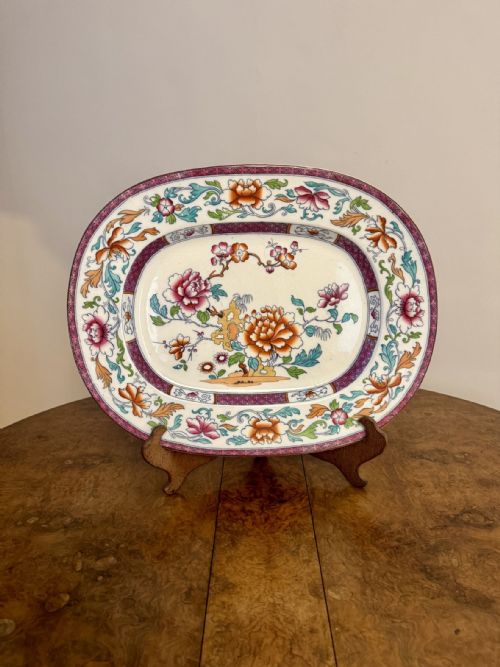


Antique Turkey Serving Platter
These antique turkey serving platter items are substantial Victorian earthenware and ironstone dishes designed for grand feasts.
Antique Turkey Serving Platter
When you search for an antique turkey serving platter, you are looking at large ceramic and ironstone dishes made to handle substantial joints of meat during Victorian banquets. The pieces appearing here span the nineteenth century, including specific dates such as eighteen eighty and eighteen ninety.
You will most frequently meet large blue and white meat platters decorated with transfer-printed designs like Chinese Garden, Cathedral Church Glasgow, and Italianate Landscape. These generous serving dishes often measure large proportions to accommodate a whole bird or significant roast.
The selection also includes silver-plated warming trays, items with drainers, and well and tree designs engineered to catch juices during carving. Alongside earthenware, you find ironstone china pieces bearing factory marks from makers like Minton and Mason's.
Materials and production
These platters are formed primarily from earthenware and heavy ironstone ceramic, fired to create durable bodies capable of supporting heavy roasted meats. Cobalt blue transfer printing applies complex scenic decorations across the white glazed surfaces before final firing.
Certain metal variants incorporate silver plate over a base metal, occasionally paired with wood elements or gold leaf detailing for formal dining. Specialised forms like well and tree platters include channels and wells moulded directly into the ceramic body.
Listings feature nineteenth-century items spanning the Victorian era, utilising earthenware, ironstone, and silver plate.
Quality and execution
Quality in these large serving pieces rests on the clarity of the transfer print and the crispness of the moulded ceramic form. Finer examples display deep, uniform blue tones without blurring, alongside sophisticated border patterns and well-defined pictorial scenes.
The presence of specialised functional elements, such as matching drainers or integrated warming reservoirs, elevates a piece above standard utility items. Maker attributions and coats of arms further distinguish exceptional production standards.
Copeland and Garrett·Minton·Mason's Ironstone China
The Antique Turkey Serving Platter Glossary
- Transfer print
- A decoration technique where an engraved copper plate transfers a design onto tissue paper, which is then stamped onto the unglazed ceramic body.
- Ironstone
- A dense, durable type of earthenware patented in the nineteenth century that resists chipping and mimics fine porcelain.
- Well and tree
- A platter design featuring a carved trough and central channels that drain meat juices away from the roast into a well at one end.
- Drainer
- A perforated ceramic insert that sits inside the platter to keep the meat elevated above accumulated pan juices.
- Chinoiserie
- A European artistic style reflecting Chinese motifs, frequently seen in nineteenth-century blue and white transfer printed landscapes.
Antique Turkey Serving Platter: Frequently Asked Questions
What were turkey platters used for?
These large dishes served grand holiday roasts, massive joints of beef, and whole birds at large dining tables.
Their generous proportions and heavy ceramic bodies provided a stable, impressive surface for carving meats in front of guests.
How do I date a blue and white platter?
Dating relies on stylistic clues like transfer print motifs, ceramic bodies such as ironstone, and specific nineteenth-century registration marks.
Pottery marks from established factories like Minton or Mason's also help narrow down the production decade.
Can I use these antique platters for serving food?
Many collectors continue to use nineteenth-century ironstone and earthenware platters for festive dining and holiday meals.
Careful hand washing preserves the historic glaze and prevents damage to the transfer-printed decorations.