


Antique Tea Box Stand
An antique tea box stand offers a dedicated place for tea caddies, appearing in mahogany, rosewood and burr elm across Regency and Victorian rooms.
Antique Tea Box Stand
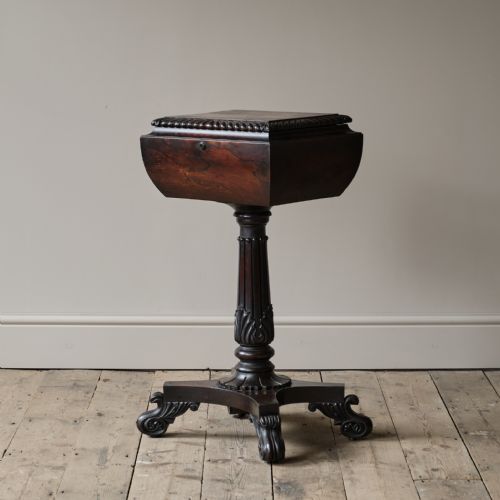
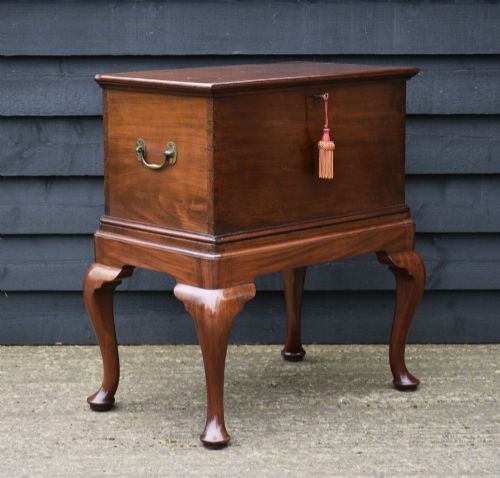
An antique tea box stand, commonly known as a teapoy or tea poy, serves as a specialised small table designed to hold tea caddies and mixing bowls. These pieces emerge primarily from the Georgian, Regency, William IV and Victorian periods, reflecting the high status of tea in historical households.
The most frequent form on this page is a lidded box on a stand, often featuring internal compartments for black and green teas alongside a glass mixing bowl. Woods such as mahogany and rosewood dominate the listings, shaped in rectangular, sarcophagus or pedestal configurations.
What separates the fine examples
The distinction between standard and superior pieces rests on the choice of timber and the precision of the cabinetwork. Figures in the wood, crispness of carved details and complexity of brass inlay separate utilitarian items from exceptional ones.
Internal arrangements and original components heavily influence the character of a piece. Retained mixing bowls, intact mixing compartments and original stands reflect careful preservation by makers and past owners alike.
The listings span the nineteenth century, covering Georgian, Regency, William IV and Victorian periods with woods including mahogany, rosewood, burr elm and burr maple.
Gillows
The Antique Tea Box Stand Glossary
- Teapoy
- A small stand or table designed to hold tea caddies, originating from the Hindi word for three feet. They evolved to include four-legged stands and pedestal bases during the nineteenth century.
- Sarcophagus
- A coffin-like shape with a domed or sloping lid utilised for the box portion of many Regency and William IV stands. This form allowed for generous internal storage for tea canisters.
- Rosewood
- A dense, dark timber featuring contrasting dark grain patterns that was favoured by Regency and William IV cabinetmakers for high-status furniture. It takes a high polish.
- Burr
- The knotted growth of a tree that produces intricate, swirling grain patterns when sliced into veneer. Cabinetmakers applied burr maple, burr elm, burr walnut and burr yew to exterior surfaces for visual impact.
- Brass inlay
- The technique of embedding thin strips or shapes of brass into the wood surface to create geometric or floral patterns. This ornamentation is characteristic of Regency design.
Antique Tea Box Stand: Frequently Asked Questions
What is an antique tea box stand used for?
These stands functioned as secure stations for storing expensive dry tea leaves, sugar and mixing bowls in domestic drawing rooms. Servants would prepare the brew using the internal containers before presenting it to guests.
Today, they serve as decorative occasional tables or small storage chests in living spaces and hallways. Their compact dimensions make them practical for holding smaller household items while displaying rich timber grains.
How do I identify a Regency teapoy?
Regency examples typically feature classical proportions, dark rosewood or mahogany timbers and polished brass inlay or stringing. They often date from the early nineteenth century and rest on pillar and platform bases or sabre legs.
Look for crisp mouldings and sarcophagus-shaped boxes characteristic of the period between eighteen hundred and eighteen thirty. The interior compartments usually retain traces of foil lining where loose tea was kept dry.
What wood types appear on these stands?
Mahogany and rosewood form the primary structural timbers for the majority of pieces on this page. Cabinetmakers also applied decorative veneers of burr maple, burr elm, burr walnut and burr yew to the outer boxes.
Lighter hardwoods and oak occasionally appear in provincial pieces or specific Victorian interpretations. The choice of timber generally corresponds to the prevailing fashion of the manufacturing period.
Did all teapoys include mixing bowls?
Many nineteenth-century examples incorporated a central glass bowl used for rinsing spoons or blending different tea leaves. These bowls sat in a dedicated circular aperture within the fitted interior.
Some variations focused purely on storage boxes with multiple lidded canisters rather than liquid mixing. The presence of a bowl depends on the specific design commissioned from the workshop.
How do I care for a hardwood teapoy?
Maintain the finish by dusting with a dry, soft cloth and avoiding placement near direct heat sources or strong sunlight. Excessive temperature fluctuations can cause the decorative veneers to crack or lift.
Apply a conservative amount of beeswax periodically to nourish the timber grain without building up a sticky residue. Treat brass elements gently with a dry cloth to preserve their historical patina.