


Antique Stone Clock
An antique stone clock brings substantial architectural weight to a room, combining heavy mineral blocks with delicate mechanical movements.
Antique Stone Clock
When you search for an antique stone clock, you encounter heavy architectural timepieces built predominantly during the Victorian and Art Deco eras. These objects range from severe black slate drums to vibrant Sienna marble mantel pieces and green onyx sets.
The pieces on this page are most frequently Victorian marble or slate mantel clocks alongside Art Deco onyx designs. You also find specialised forms such as desk clocks, sundials, garden ornaments, and garnitures featuring paired side ornaments.
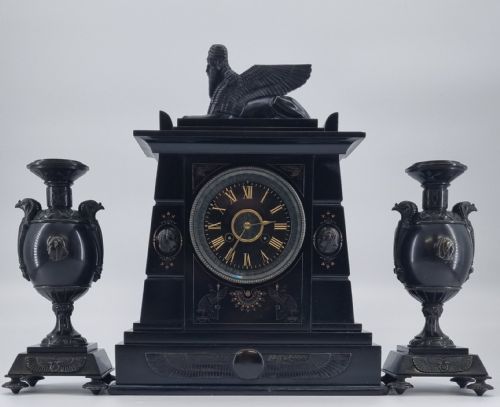
Origins span English workshops alongside significant French examples fitted with eight day movements. Architectural styles draw heavily on Neoclassical, Egyptian Revival, and classical revival vocabularies expressed through stone pillars, pediments, and mounts.
Materials and construction methods
Makers utilised solid blocks of black slate, Sienna marble, white marble, green onyx, and carved alabaster as the primary structural bodies. These mineral slabs were shaped into architectural forms resembling miniature temples, drums, and heavy rectangular blocks.
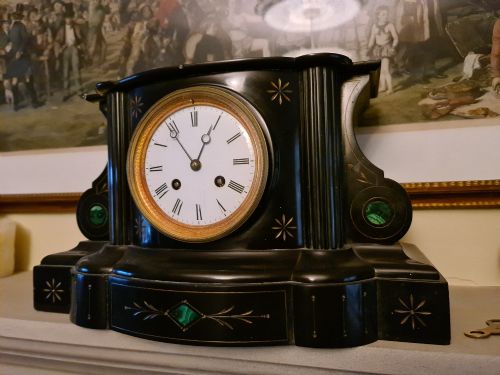
Many specimens incorporate contrasting inlays of malachite and semi-precious stones, complemented by cast bronze, ormolu mounts, and brass bezels. Enamel dials protected beneath glass faces display the numerals, while eight day mechanical movements drive the internal gearwork.
Several stone clock sets doubled as weather stations, housing barometers and thermometers right beside the ticking dial.
Distinctions in craftsmanship and design
Quality rests in the selection and integration of the mineral materials, where uniform coloration and rich natural veining elevate a piece. Master craftsmen paired dense black slate with contrasting marble or incorporated intricate malachite inlays rather than relying on plain surfaces.
The architectural ambition of the case also separates standard domestic pieces from exceptional examples. Integrated garnitures, finely cast bronze mounts, Egyptian Revival detailing, and complete desk sets containing barometers demonstrate superior workshops.
Philippes Paris
The Antique Stone Clock Glossary
- Garniture
- A set consisting of a central clock flanked by matching ornamental pieces such as urns or vases. These matched groups create a balanced mantel display.
- Slate
- A fine-grained metamorphic rock utilised extensively for dark, severe Victorian clock cases. It takes a smooth, matte polish resembling cast iron.
- Onyx
- A banded variety of chalcedony favored heavily by Art Deco makers for smooth, geometric clock bodies. Its translucent layers provide soft green and amber tones.
- Movement
- The mechanical inner workings driven by springs or weights that measure time and strike hours. Eight day versions require winding weekly.
- Bezel
- The metal ring that holds the glass protecting the dial face in place. Brass and gilt metal are common framing materials.
Antique Stone Clock: Frequently Asked Questions
What is a clock garniture?
A garniture is a matched set comprising a central clock accompanied by two side ornaments, such as vases or urns. These matched pieces utilise the same marble or slate materials to create a unified decorative arrangement.
They were designed to sit symmetrically across a mantelpiece or sideboard. Finding a complete set together preserves the original intended decorative impact.
How do I identify Art Deco stone clocks?
Art Deco examples typically date from the 1920s and 1930s, featuring smooth green onyx or polished marble blocks. The designs favor clean geometric lines over the ornate classical pilasters of the Victorian era.
These pieces often incorporate additional practical instruments into the stone body, such as barometers and thermometers. The overall silhouette reflects modern architectural trends of the interwar period.
What is Egyptian Revival style?
Egyptian Revival pieces incorporate distinct architectural motifs inspired by ancient pharaonic design, including obelisk shapes, lotus columns, and hieroglyphic markers. Victorian makers adopted these themes enthusiastically during periods of archaeological discovery.
On stone clocks, this translates to imposing architectural facades carved from marble or slate. These designs stand apart from standard neoclassical timepieces through their exotic decorative vocabulary.