

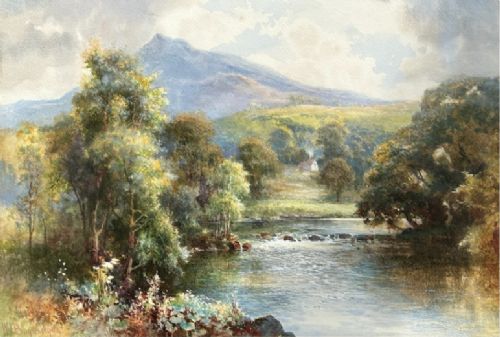


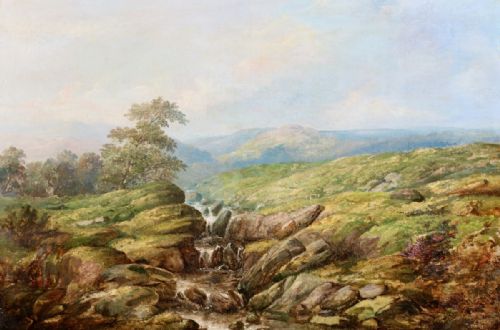


Antique River Valley Painting
An antique river valley painting brings the quiet weight of nineteenth and early twentieth century watercourses directly onto your wall.
Antique River Valley Painting
When you search for an antique river valley painting, you encounter works capturing pastoral waterways, Welsh valleys, and Scottish glens from the nineteenth and early twentieth centuries. These pieces record specific rivers, bridges, and hillsides through the eyes of Victorian and Edwardian artists.
The version you meet most often on this page is a framed watercolour on paper or an oil painting on canvas dating from the late nineteenth century. These landscape depictions range from intimate river bends to grand mountain valleys.
Makers and artists represented span the Victorian and Edwardian periods, including regional painters from the British Isles and continental Europe. Their works document how past generations viewed rural topography and river life.
Materials and construction
Artists painted these river scenes using oil paint or watercolour applied to canvas, wood panels, or heavy paper. Pigments were worked with brushes to capture the shifting light on water and the texture of surrounding hills.
Many of these works retain their original gilt wood frames which complement the palette of the paintings. The combination of traditional pigments, paper, canvas, and wooden surrounds defines the physical presence of each piece.
Geese frequently paddle across these rivers, seemingly determined to photobomb the nineteenth-century artists sketching the valley.
Assessing quality and execution
Quality rests in the sureness of the brushwork and the artist's command of light, atmosphere, and perspective across the river landscape. A superior composition breathes with natural movement in the water and depth in the distant hills.
The preservation of the paper, canvas, or panel alongside the condition of the pigment determines the integrity of the work over time. Finer pieces demonstrate careful handling of tone and detail that holds the viewer's eye.
Alfred Young Nutt·William Joseph Boyes·William George Tennick·Clarence Henry Roe·William Mellor·John Syer·Harold Lawes·George Melvin Rennie·Reginald Grange Brundrit·Edmond Defonte·Henry Sykes·Frederick Richard Lee·Cornelius Pearson·Charles Branwhite·Archer L Smith
The Antique River Valley Painting Glossary
- Watercolour
- A painting method where fine pigment is suspended in a water-based solution and applied to paper. It allows for transparent washes of colour that suit bright river light.
- Oil paint
- A slow-drying medium made by mixing pigments with oils such as linseed. It permits rich layering and deep colour saturation across canvas or panel.
- Gilt wood
- Wood coated with a thin layer of gold leaf or metallic paint. It frames numerous nineteenth-century paintings to enhance their visual depth.
- Plein air
- The practice of painting outdoors directly from the landscape. This approach captures transient natural light and weather conditions on rivers and valleys.
Antique River Valley Painting: Frequently Asked Questions
How do I date an old river painting?
Dating relies on the artist's working period, clothing styles of figures within the scene, and framing materials. Signatures and exhibition labels on the reverse also provide chronological markers.
Paper quality, canvas types, and stretcher construction offer further clues to the decade of creation.
Where should I hang a landscape painting?
These works suit dining rooms, studies, or hallways where natural light flatters the pigments without causing fading. Keep them away from direct sunlight and damp walls to protect the paper or canvas.
Pairing a watercolour with neutral wall colours helps the subtle tones of the river valley emerge.
Are watercolours fragile?
Watercolours on paper are sensitive to prolonged direct sunlight and high humidity. Proper framing behind glass with acid-free mounts protects the delicate pigments from environmental damage.
Keeping them in stable indoor conditions ensures the colours remain vibrant over decades.
What subjects appear in these landscapes?
The works depict Welsh river valleys, Scottish glens, Thameside villages, and French waterways. Scenes often include figures fishing, livestock near riverbanks, and distant hills.
Artists focused on recording recognizable British and European topography during the Victorian and Edwardian eras.