


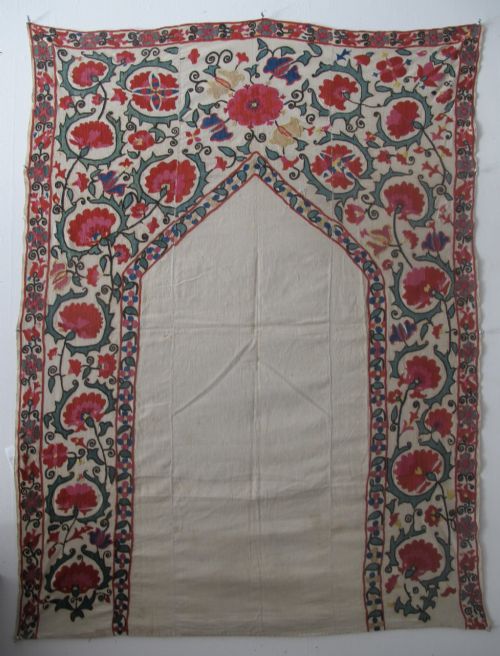


Antique Prayer Arch Rug
An antique prayer arch rug brings centuries of woven devotion and architectural mihrab design into a room.
Antique Prayer Arch Rug
When you search for an antique prayer arch rug, you are looking at woven textiles defined by a distinct architectural niche, known as a mihrab, which historically pointed the user toward Mecca. The pieces available here span regional traditions from Anatolia, the Caucasus, Central Asia, and Afghanistan, dating from the eighteenth century through the early twentieth century.
The format appears across various object types, including single rugs, multi-niche safs, and embroidered suzanis that adopt the prayer format. You will encounter tribal pieces such as Baluch and Timuri formats alongside classic town and village weaves from Ghiordes, Konya, Ladik, and Sivas.
Village and tribal workshops produced the majority of these examples, utilising heavy wool and cotton foundations with varied knotting densities. Certain pieces reflect later revival work, such as twentieth-century copies, demonstrating how enduring the architectural prayer motif proved across generations of weavers.
Materials and construction
The foundation structures rely primarily on wool and cotton, with wool frequently utilised for both the pile and the warp threads in nomadic pieces. Finer village and town workshops often employed cotton for the warp and weft to achieve a flatter, more stable structural grid that held crisp architectural lines.
Surface decoration combines knotted pile with flatweave techniques and, in the case of Uzbek textiles, fine silk thread embroidery applied to a base fabric. Natural dye palettes interact directly with these materials, allowing wool and silk to absorb deep tones over decades of use.
Antique Prayer Arch Rug Retail Price Guide 2026
Typical asking prices for prayer arch rug among the pieces listed under this phrase on Sellingantiques today, from the lower quarter to the upper quarter. They describe what is for sale here now, not the wider market.
Listings feature pieces spanning from the mid-eighteenth century to the early twentieth century, utilising wool, cotton, silk, and silk thread.
Judging quality and execution
Quality in these textiles rests upon the clarity of the mihrab arch and the precision of the drawing within the field. Stronger examples display confident proportions in the spandrels and borders, whereas lesser pieces can suffer from compressed or hesitant geometry.
The handling of materials also separates regional tiers, as tightly spun wool and properly balanced foundations maintain structural integrity far better than brittle or loose spinning. Colour saturation and the disciplined use of secondary motifs dictate whether a textile holds the eye from across a room.
The Antique Prayer Arch Rug Glossary
- Mihrab
- The arched niche in a prayer rug that symbolises the direction of prayer. It typically dominates the upper portion of the field.
- Saf
- A multi-niche prayer rug featuring a row of contiguous architectural arches. This format allowed multiple individuals to pray side by side upon a single textile.
- Suzani
- A large, decorative embroidered textile from Central Asia. Examples executed in prayer format substitute woven pile for needlework.
- Spandrel
- The triangular area situated above the arched mihrab niche. Weavers often fill these corners with floral or geometric ornamentation.
- Warp
- The stationary lengthwise threads stretched across a loom. Foundation structures rely on these parallel strands to support the pile.
Antique Prayer Arch Rug: Frequently Asked Questions
How were prayer rugs used historically?
Historically, worshippers laid these textiles on the ground to provide a clean surface for prayer, orienting the pointed arch toward Mecca. They served a personal and devotional function within the household.
Over time, many of these pieces transitioned into decorative wall hangings or collector items due to their intricate symbolic geometry.
How do I distinguish regional styles?
Regional attribution relies on examining the specific geometry of the arch, the border arrangements, and the materials used in the foundation. Anatolian town pieces often feature crisp architectural pillars, whereas tribal pieces lean towards stylised borders and darker palettes.
Familiarity with regional colour choices and wool characteristics helps separate Caucasian production from Turkish or Afghan weaving.
Can I use these rugs on the floor?
Many of these pieces possess robust wool piles suited for gentle floor placement in low-traffic areas. Placing a proper underlay beneath the textile prevents slipping and reduces fibre friction.
Fragile silk-embroidered pieces or very fine nineteenth-century examples are better suited for wall display to protect the textile structure.
What does a multi-niche saf mean?
A saf is an extended prayer rug featuring multiple consecutive arches woven in a single horizontal sequence. This format accommodated several worshippers simultaneously in larger households or communal settings.
Finding multiple arches on a single foundation makes these pieces distinct from standard single-mihrab formats.