


Antique Pond Landscape
An antique pond landscape captures the quiet intimacy of still water and rural life, offering a restorative window into pastoral scenes.
Antique Pond Landscape
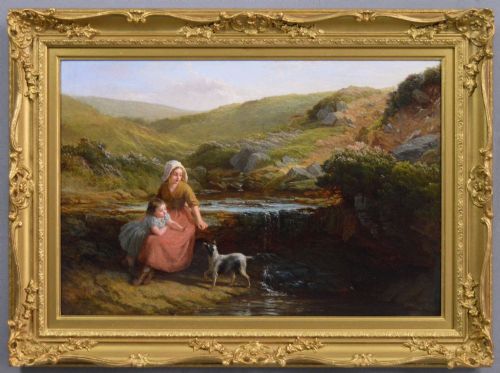
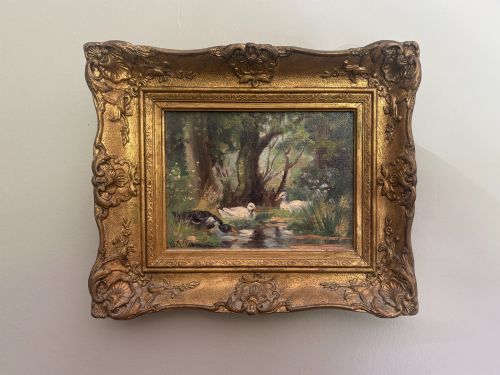
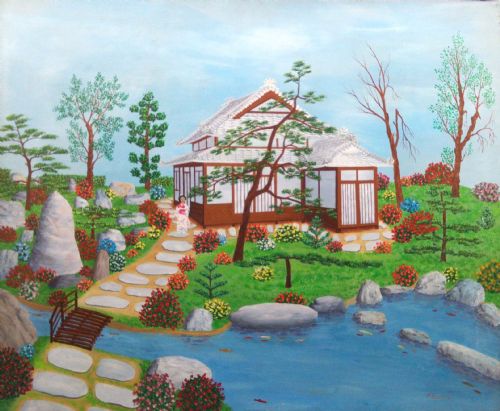
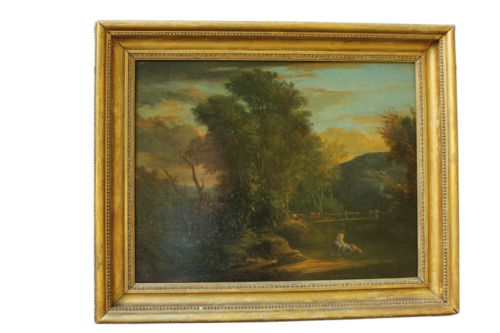
An antique pond landscape represents a distinct genre within historic art, focusing on bodies of water ranging from mill ponds to rural stock ponds. These works capture serene outdoor settings populated by figures, livestock, or waterfowl.
The pieces on this page span the nineteenth and early twentieth centuries, encompassing Victorian pastoral works and later impressionist interpretations. English and French schools dominate the selection, showing both traditional topographical views and looser painterly brushwork.
Common motifs include women beside the water, cattle drinking at the edge, and children watching model boats. Such scenes reflect a nineteenth-century fascination with domestic harmony and agrarian routines.
Materials and construction
Artists painted these works primarily with oil paint on stretched canvas or applied watercolours to heavy paper. Supporting structures include wooden stretcher frames and, in several instances, original gilt wood and gesso frames.
Canvas supports allowed painters to build up thick textures using brushes and palette knives, particularly when rendering water lilies, foliage, and muddy banks. Watercolour works on paper relied on delicate washes to capture the reflective quality of still water under overcast or autumnal skies.
Geese make repeated appearances beside the water, seemingly supervising the livestock and painters alike.
Determining quality and execution
Quality rests upon the artist's ability to handle light reflecting off the water surface and the atmospheric depth of the surrounding landscape. Stronger examples display confident brushwork and precise anatomical rendering of figures, cattle, or geese.
The integration of the pond within the wider composition separates standard decorative watercolours from accomplished fine art. Framing also plays a role, with period gilt wood and gesso frames contributing significantly to the historical integrity of the piece.
Frank Percy Wild·Ernest Walbourn·Albert-Ernest Brockbank·Kershaw Schofield·Charles Edmund Rene His·Henry Bright·Julius Jacobus van de Sande Bakhuyzen·Thomas James Lloyd·Ludwig Friedrich Hofelich·Michael Therkildsen·Lily Bristow·August Kraus·Moritz Eduard Lotze·David Bates·Frederik Christian Jakobsen Kiaerskou·George Percival Gaskell·John Syer·James Millar Mackay
The Antique Pond Landscape Glossary
- Oil painting
- A work created using pigments bound in a drying oil, typically applied to canvas or wood panels. This medium allowed artists to achieve rich colour saturation and subtle tonal gradations.
- Watercolour painting
- A method where water-soluble pigments are applied to paper to create translucent washes of colour. It was frequently utilised for lighter, more immediate outdoor sketches.
- Impressionism
- A late nineteenth-century art movement characterised by relatively small, thin, yet visible brush strokes and an emphasis on accurate depiction of light. Works in this style prioritize the overall visual effect over fine detail.
- Gesso
- A plaster-like mixture applied to wooden frames before gilding or painting, providing a smooth base. Period gesso frames often feature moulded ornamentation that dates the entire object.
- Pastoral landscape
- A genre of art depicting the rural life of shepherds, farmers, and country dwellers in an idealized natural setting. These compositions almost invariably feature tranquil bodies of water.
Antique Pond Landscape: Frequently Asked Questions
What subjects appear in pond paintings?
These works typically depict rural scenes featuring farm ponds, mill ponds, and garden lakes accompanied by figures, cattle, or waterfowl.
Artists frequently added domestic elements such as thatched cottages, country tracks, and children playing near the water's edge to evoke a peaceful pastoral mood.
How do I date an antique painting?
Dating relies on stylistic markers, artist signatures, framing materials, and inscriptions left on the reverse of the canvas or paper. Victorian works often show tighter academic brushwork, while pieces from the early twentieth century lean towards impressionist techniques.
Examining the canvas weave and stretcher frame construction also provides reliable clues regarding the exact period of manufacture.
What is the difference between oil and watercolour?
Oil paintings utilise viscous pigments on canvas, yielding rich textures, deep tones, and a robust physical presence that withstands the test of time.
Watercolours employ delicate washes on paper, offering a lighter, translucent quality that captures transient effects of light and weather with distinct immediacy.