
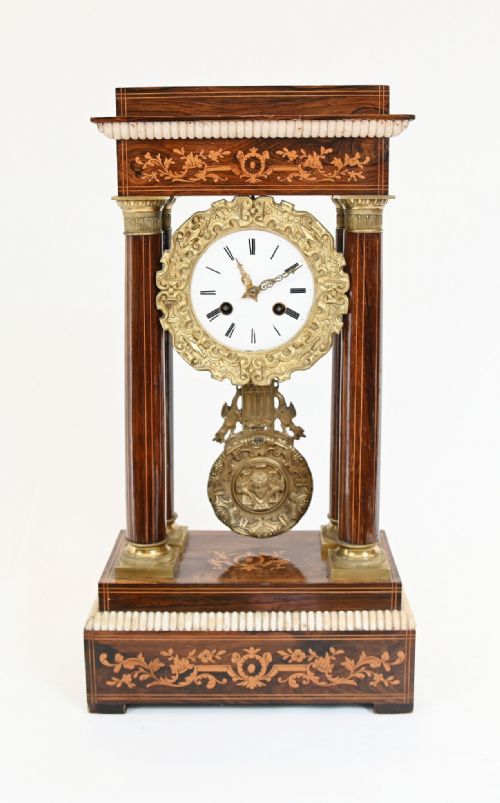


Antique Pendulum Mantle Clock
An antique pendulum mantle clock anchors a room with mechanical rhythm, combining brass, marble and wood to measure time through the centuries.
Antique Pendulum Mantle Clock
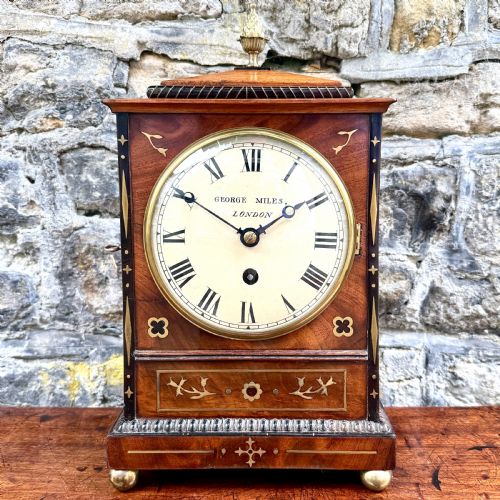
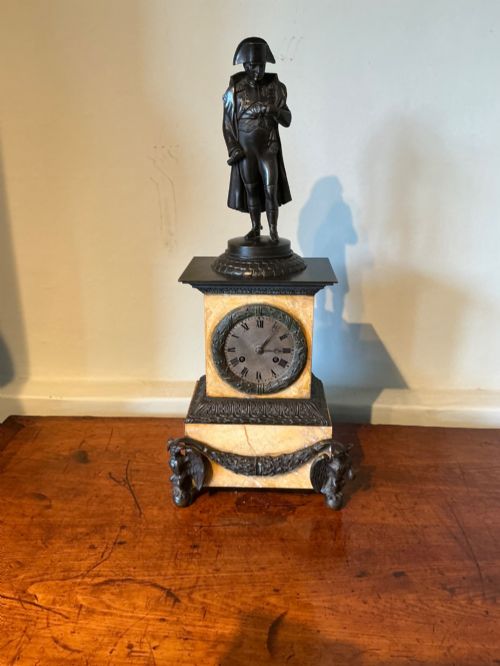
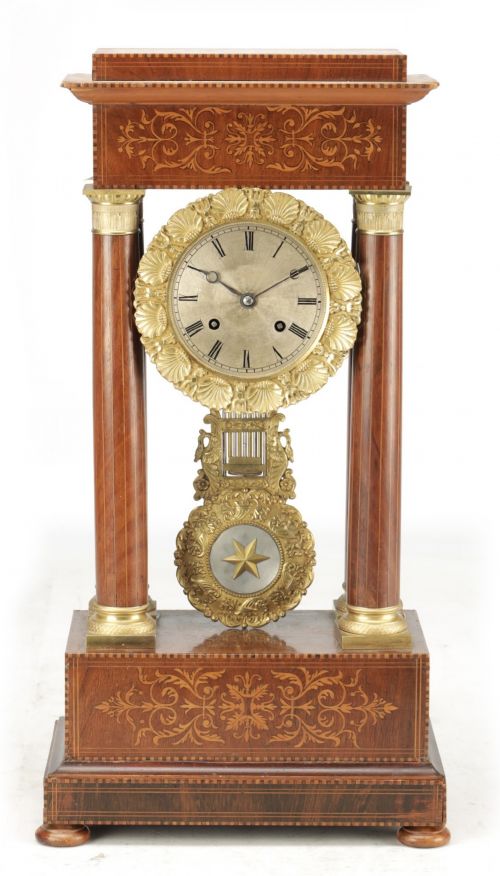
When you search for an antique pendulum mantle clock, you encounter timepieces spanning the eighteenth, nineteenth, and early twentieth centuries, with a strong representation of Victorian production. These range from substantial marble garnitures and French ormolu designs to British mahogany bracket clocks and elegant portico forms.
The material palette is broad, uniting glass, enamel, ormolu, gilt bronze, mahogany, porcelain, and gilt brass within architectural and decorative cases. French workshops produced many of the ornate gilt bronze, four-glass, and portico examples, while British makers supplied mahogany library and bracket clocks.
Mantel clocks on this page also include specific movements such as fusee-driven mechanisms, torsion year clocks, and musical portico formats. Each regional tradition imparts a distinct visual character, from the restraint of Regency timber to the elaborate gilding of French Rococo and Empire revivals.
Materials and construction methods
Clockmakers combined cast bronze, brass movements, and fitted glass panels to house intricate escapements and pendulum drives. Cases often utilised solid mahogany or walnut, finished with fine marquetry inlay or architectural mouldings.
Ormolu and gilt bronze decoration required skilled metal casting and mercury gilding, which produced a durable, luminous surface layer on French mantel clocks. Enamel dials, frequently painted with delicate numerals, were paired with hand-cut brass hands and robust gear trains.
Listings feature cases constructed from mahogany, walnut, block marble, cut crystal, and solid brass.
Distinguishing standard production from finer work
Quality in an antique pendulum mantle clock rests upon the crispness of the bronze casting, the depth of the case timber, and the precision of the movement. Finer pieces display hand-chiselled ormolu details and signed movements from recognised French and British workshops.
The integrity of the dial, the presence of original mercury gilding, and the harmony of the case proportions separate ordinary examples from exceptional ones. Clocks retaining their original pendulum and balanced striking mechanisms demonstrate superior original assembly.
Barwise London·Thomas Moss·Maurice & Marcel Moulin Favre-Bulle·B H A·Tiffany·Japy Freres·Breguet·Baby and Jannings·Thomas A Paris·Ravrio
The Antique Pendulum Mantle Clock Glossary
- Ormolu
- Gilded bronze, formed by applying a gold and mercury amalgam to a cast bronze object and heating it to drive off the mercury. This technique creates a rich, metallic lustre seen on many French mantel clocks.
- Garniture
- A set comprising a central clock flanked by matching decorative objects such as urns or vases. They were designed to sit symmetrically on a mantelpiece.
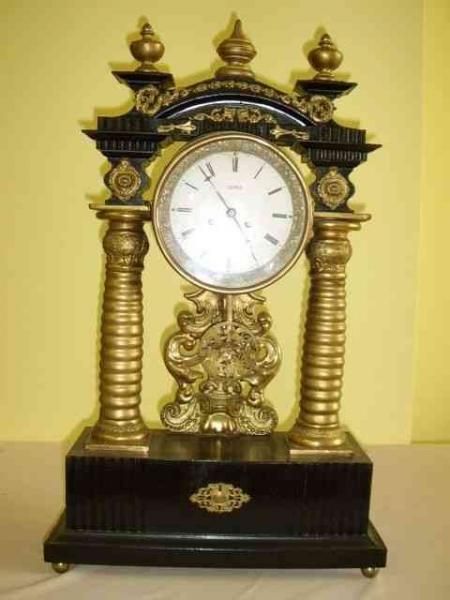
- Portico clock
- A clock featuring an architectural case supported by columns, often styled after classical Greek or Roman temples. These frequently incorporate visible pendulums swinging within the central opening.
- Bracket clock
- A portable table or shelf clock, originally designed to sit upon a wall bracket. British examples in mahogany often feature brass carrying handles.
- Fusee
- A conical pulley used in spring-driven clocks to equalise the torque of the mainspring as it unwinds. This mechanism improves timekeeping consistency across the running cycle.
Antique Pendulum Mantle Clock: Frequently Asked Questions
How do I wind a mantel clock?
Use the appropriate key on the winding squares located on the dial face, turning gently until you feel resistance. Do not overwind the mainspring, as this can damage the internal gearing.
Ensure you match the key size correctly to the winding arbor to avoid slipping and scratching the surrounding enamel or metal dial plate.
Where should I place my clock?
Position your clock on a stable, level mantelpiece or shelf away from direct sunlight, draughts, and damp walls. A flat surface prevents the pendulum from catching on the case interior.
Keep the clock away from exterior walls that experience significant temperature fluctuations, which can affect wood movement and metal expansion.
Why does the clock keep losing time?
Timekeeping discrepancies often stem from an unlevel surface or a pendulum that requires minor regulation via its adjustment nut. Moving the bob up or down alters the effective length and corrects the speed.
Accumulated dust in the gear train or dried lubricants can also slow the movement down, indicating that a professional service may be necessary.
How do I identify a French clock?
French mantel clocks typically feature cast ormolu, gilt bronze, or marble cases, often housing brass movements stamped with workshop medallions or maker names. The decorative vocabulary draws heavily from Louis XV, Louis XVI, and Empire styles.
Many French movements utilise external count wheels for the striking train and feature enamel cartouches for individual hours rather than a single painted dial surface.