
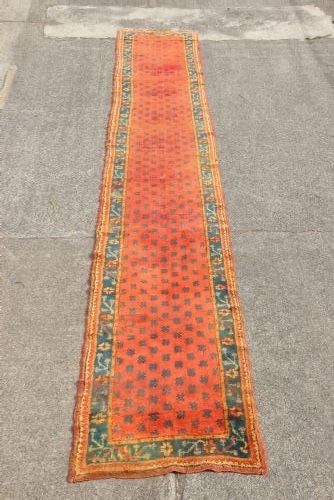
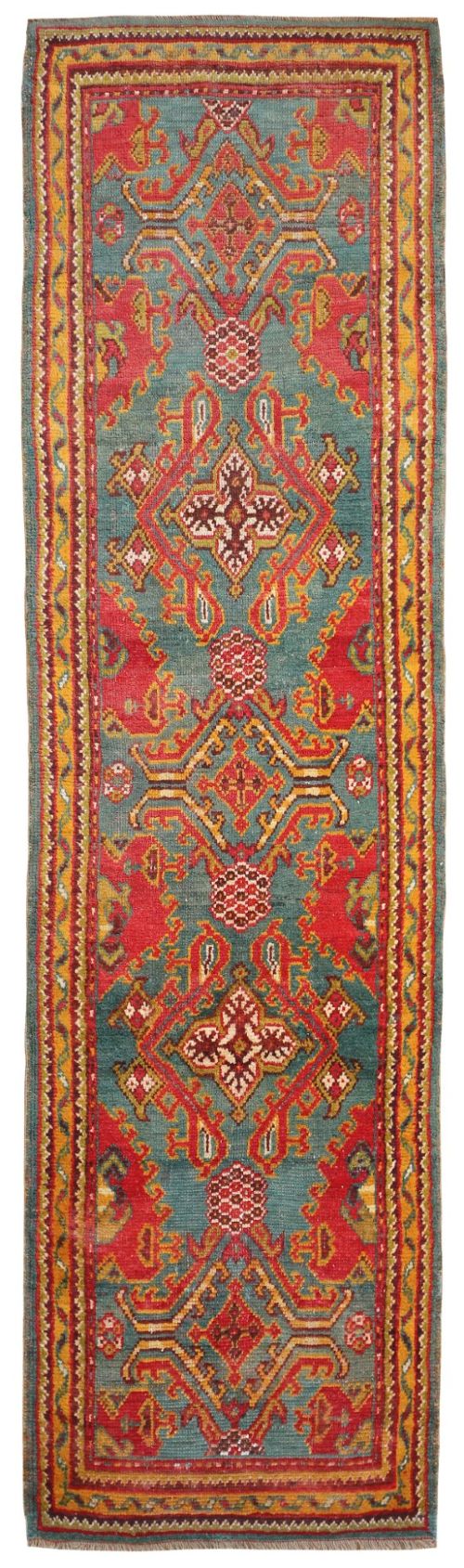



Antique Oushak Runner
An antique oushak runner brings softened Anatolian pattern and muted wool texture to a long hallway.
Antique Oushak Runner
An antique oushak runner is a long, narrow floor covering originating from the town of Ushak in western Anatolia, often categorised through Ottoman and traditional Turkish styles. These pieces stretch across residential corridors, displaying proportions that handle heavy foot traffic with distinctive proportions.
The pieces on this page span several decades from the late Victorian era up through the nineteen-twenties, appearing in formats ranging from long narrow strips to matched pairs. Buyers encounter traditional designs alongside kilim flatweaves and oversized carpet variations.
Most examples date from the turn of the twentieth century, carrying stylistic traits from Ottoman traditions. They emerge in various room lengths, maintaining the characteristic narrower width suited to passageways.
How they were made
Weavers constructed these runners using hand-knotted wool and cotton foundations, occasionally incorporating angora wool for added pile softness. Natural dye traditions provided the characteristic beige, green, and pink tones recorded in the archive.
The fabrication relies on hand-knotting techniques traditional to Anatolian workshops. Foundation warps and wefts of cotton support dense wool piles designed to withstand generations of daily use.
Several runners appear in matched pairs, perfect for grand hallways requiring symmetry on both sides of the door.
What varies in quality
Quality rests in the density of the hand-knotted pile and the clarity of the traditional design execution. Finer knots permit intricate curves within Ottoman motifs.
Condition and scale dictate the standing of individual runners. Matched pairs and particularly long narrow formats represent distinct tiers of desirability for domestic placement.
The Antique Oushak Runner Glossary
- Oushak
- A traditional weaving centre in western Anatolia known for producing distinct carpets and runners. These textiles often feature large-scale floral motifs and soft pastel colour palettes.
- Kilim
- A flatwoven textile produced without a pile by tightly interweaving warp and weft strands. This technique creates a lightweight runner distinct from knotted varieties.
- Angora wool
- A soft fibre derived from Angora goats, utilised in specific antique rugs for a lustrous pile. It yields a tactile surface quality observed in select nineteenth-century pieces.
- Warp
- The vertical foundation threads stretched tightly on a loom before weaving begins. Cotton warps provide structural stability for the heavier wool pile above.
- Anatolian
- Pertaining to the geographic region of Asia Minor, encompassing traditional Turkish rug-making areas. This designation links pieces to historical craft methods of the region.
Antique Oushak Runner: Frequently Asked Questions
Where should I place an oushak runner?
These narrow formats suit hallways, landings, and long corridors where standard area rugs do not fit.
Their elongated proportions bridge rooms while introducing muted Anatolian colours to transit spaces.
How do I clean an antique wool runner?
Gentle surface vacuuming without a rotating beater bar prevents fibre damage.
Professional specialist cleaning remains necessary for deeper maintenance to protect the natural dyes.
What is the difference between an oushak rug and a runner?
Runners feature an elongated, narrow proportion specifically designed for corridors and stairs.
Standard rugs maintain a more balanced rectangular aspect ratio meant for open floor spaces.
How do I date an antique oushak runner?
Dating relies on stylistic markers, construction materials, and historical period attributions recorded by makers.
Victorian and early twentieth-century examples display specific design shifts associated with Anatolian workshops.