
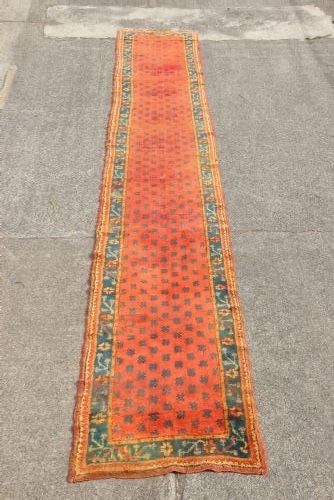



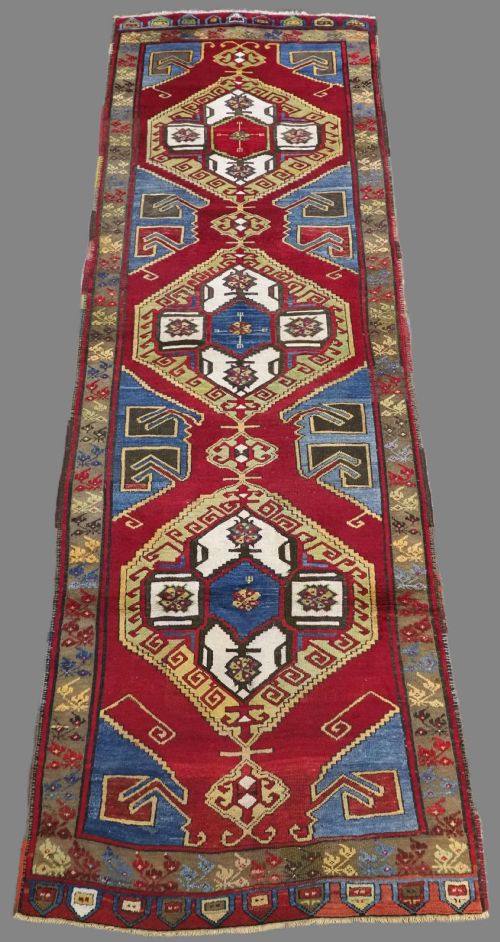


Turkish Hallway Runner
A turkish hallway runner brings rich colour and enduring craft to a narrow corridor.
Turkish Hallway Runner
A turkish hallway runner is a long, narrow floor covering designed specifically for corridors and narrow spaces. The pieces available span from the late nineteenth century into the early twentieth century, showing a clear preference for traditional formats.
Most examples hail from distinct regional weaving traditions such as Ushak, Konya Karapinar, Malatya, Taspinar, and Yagcibedir. These range from grand Oushak carpets scaled down for passage use to dense tribal pieces built for durability.
Buyers will encounter runner rugs, rug runners, and hybrid formats that blend flatweave kilim techniques with pile sections. The dimensions vary from narrow strips under sixty centimetres wide to substantial oversized formats exceeding four metres in length.
Materials and construction
These floor coverings are constructed primarily using wool and cotton. Wool serves as the principal material for the soft pile and the durable surface, while cotton often provides a sturdy foundation for the warp and weft threads.
The making involves hand-knotting and flatweaving techniques passed down through generations. Artisans utilised traditional looms to execute regional designs, incorporating enduring natural dyes that have mellowed gracefully over decades.
The listings span production dates from 1880 through to 1930, utilising wool and cotton throughout.
Assessing quality
Quality rests in the precision of the knotting density and the integrity of the structural foundation. Tighter knots and heavier wool foundations endure decades of heavy foot traffic in narrow hallways far better than looser weaves.
The artistic merit of the design composition and the depth of the dye palette dictate the standing of an individual piece. Balanced medallion layouts and harmonious colour retention elevate a rug beyond standard utility.
The Turkish Hallway Runner Glossary
- Kilim Kelim
- A flatwoven carpet or runner produced without a pile. These pieces offer a flat, durable surface often combined with knotted sections.
- Oushak
- A renowned style originating from a major weaving centre in western Anatolia. These pieces typically feature softer colour palettes and large-scale floral or geometric motifs.
- Yuruk
- A term describing rugs woven by nomadic or semi-nomadic groups in Anatolia. They frequently display bold geometric patterns and rich, saturated wools.
- Warp
- The vertical threads stretched lengthwise on the loom before weaving begins. The fringe of a rug is usually formed from the exposed ends of these threads.
- Weft
- The horizontal threads passed across the warp to hold the knots in place. Together, warp and weft form the underlying grid of the textile.
Turkish Hallway Runner: Frequently Asked Questions
How do I clean an antique runner?
Gentle surface brushing and professional specialist cleaning are essential for preserving aged wool and natural dyes. Avoid harsh chemical detergents and excessive water immersion.
Regular light rotation ensures even wear across high-traffic zones in domestic hallways.
Are these runners suitable for modern homes?
Their narrow proportions make them ideal for corridors, staircases, and galley kitchens. The vintage patination adds character to contemporary minimalist or traditional interiors alike.
Using an appropriate underlay prevents slipping and protects the antique foundation from hard flooring.
What does a distressed finish mean?
Distressed describes genuine wear and low pile resulting from decades of age and use. This mellowed state softens the initial brilliance of the dyes.
Such wear contributes to the visual texture prized by collectors of antique textiles.
How do I identify a regional style?
Regional attribution relies on specific knotting structures, wool characteristics, and traditional motif arrangements. Ushak pieces often show large florals, whereas tribal pieces lean towards geometric medallions.
Comparing border bands and palette choices helps narrow down the origin.