



Antique Marine Harbour Picture
An antique marine harbour picture captures the working life of historic coastal quays and bustling river docks through the eyes of Victorian and twentieth-century painters.
Antique Marine Harbour Picture
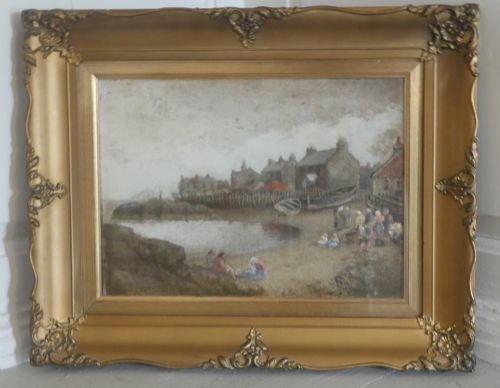
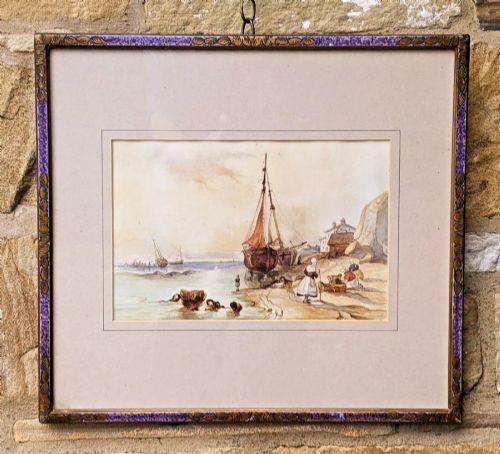
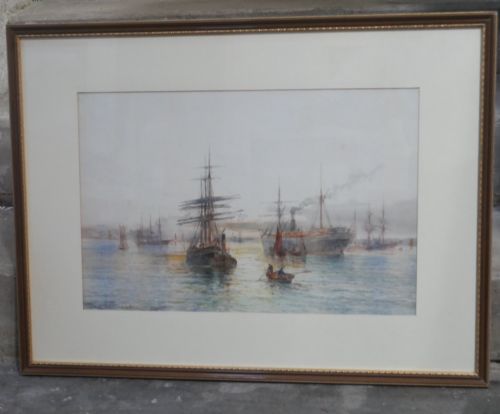
When you search for an antique marine harbour picture, you encounter framed watercolours, gouache works and oil paintings depicting sailing ships, fishing boats and coastal towns. These works span the Victorian period through to the mid-twentieth century, capturing British locations such as Whitby, Polperro and the River Thames alongside continental scenes.
The pieces on this page appear as both intimate watercolour studies on paper and substantial oil paintings on canvas or panel. Many are presented in period gilt wood frames that complement the maritime subject matter and the artistic conventions of their era.
How these artworks were made
Artists relied on watercolour pigment applied to paper, often enhanced with bodycolour or gouache to pick out highlights on restless water and white-sailed vessels. These works required swift, confident washes to capture changing coastal light and atmospheric dockside weather.
Oil painters utilised oil paint on canvas, wood or board, building up rich textures with brushes and palette knives to render the heavy timbers of hulls, the reflective surface of harbour water and the dense smoke of steam tugs. These oil paintings were routinely set within heavy gilt wood frames designed to project the image forward.
Several artists clearly spent hours painting muddy riverbanks while waiting patiently for the tide to turn.
What separates quality in these paintings
Quality rests upon the artist's command of maritime architecture and spatial perspective, distinguishing competent topographical records from truly accomplished coastal scenes. The ablest hands capture the specific weight of rigging, the correct waterline of a laden vessel and the subtle refraction of light on tidal mudflats.
The preservation of the pigment and the integrity of the original support dictate the standing of a piece, particularly with watercolours vulnerable to light damage. Furthermore, the presence of a matching period gilt wood frame enhances the historical coherence of the artwork.
Edward Mills·Alfred George Morgan·Charles William Wyllie·William Lee Hankey·William Tuck·Fred Waugh·T.S. Wallis·James Webb·James Thomas Watts·Kate E Booth·Ernest F. Hill·Frederick Stuart Richardson·Alfred Henry Vickers·Alfred Robert Quinton·William Kay Blacklock·Rowland Henry Hill·Frank W. Scarborough·Edward Henry Holder·William Langley·S. J. Lamorna Birch·Robert Anderson·Frank Rousse·John James Wilson·Owen Bowen·Micheal Matthews
The Antique Marine Harbour Picture Glossary
- Watercolour
- A paint consisting of colour suspended in a water-soluble vehicle, traditionally applied to heavy paper to create luminous coastal washes.
- Oil on Canvas
- A painting technique utilising pigments bound in a drying oil applied to a stretched woven fabric support, allowing for deep colour saturation and impasto texture.
- Gouache
- An opaque watercolour medium containing a white pigment filler, used by marine artists to add dense highlights to skies and foaming water.
- Gilt Wood
- Timber framing coated in a thin layer of gold leaf or metallic paint, standard for framing nineteenth-century fine art.
Antique Marine Harbour Picture: Frequently Asked Questions
Were these harbour paintings created outdoors?
Many artists produced initial sketches and watercolour studies directly on the quayside to capture accurate local details of shipping and architecture. They often completed larger oil paintings back in the studio using these field notes.
En plein air painting became increasingly popular during the Victorian and Edwardian periods as portable paints and ready-made canvases became widely available to travelling artists.
How can I tell a Victorian marine painting from a later work?
Victorian marine paintings frequently feature traditional sailing vessels, paddle steamers and detailed rigging reflecting nineteenth-century naval architecture. The palette often relies on deep earth tones and careful tonal layering.
Later twentieth-century works embrace broader brushwork and looser interpretations of light influenced by impressionism. Framing styles also shift from ornate Victorian plaster-work gilt frames to simpler mouldings as the decades progress.
What do terms like Lower Pool mean in these titles?
Titles referencing specific locations such as the Lower Pool or Upper Pool point directly to distinct navigational stretches of the River Thames in London. These areas were crowded with commercial shipping, wharves and international trade vessels.
Artists recorded these busy commercial hubs before modern containerisation transformed dockland geography. Identifying these landmarks helps date the operational era of the vessels shown in the picture.