



Antique Marble Fireplace Clock
An antique marble fireplace clock brings substantial weight and architectural presence to a room, functioning as both a reliable timekeeper and a striking decorative centrepiece.
Antique Marble Fireplace Clock
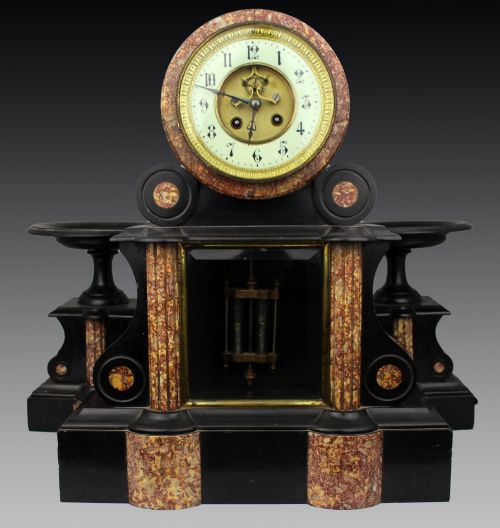
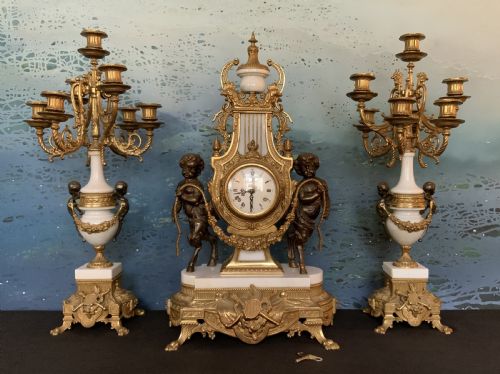
When you search for an antique marble fireplace clock, you are looking at substantial timepieces designed to sit on mantelpieces, frequently accompanied by matching garnitures such as candelabra. These objects range from severe neoclassical portico designs to ornate French Second Empire and Louis XVI style creations.
The versions you are most likely to meet on this page date from the nineteenth century, particularly the eighteen-sixties and eighteen-eighties, alongside occasional later twentieth-century interpretations and Art Deco examples.
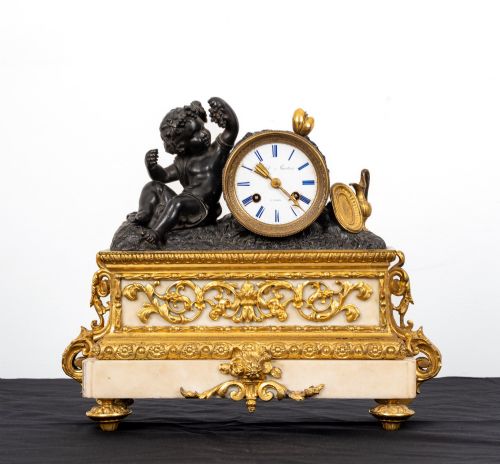
Forms vary from drumhead clocks and figural mantel pieces to portico clocks housed in black slate, white marble, red marble, and rouge marble.
How they were made
Makers constructed these clocks using heavy slabs of natural marble and black slate as the primary structural body, often incorporating cast brass, ormolu, and gilt bronze mounts.
Clock dials typically feature white enamel with Roman or Arabic numerals, protected behind curved glassbezels and driven by eight-day mechanical movements.
Some cherubs hold visible pendulums, swinging back and forth forever within their marble portals.
What varies in quality
The standard of an antique marble fireplace clock is determined by the crispness of the cast bronze or ormolu mounts and the depth of figure work, such as cherubs or classical bronzes. Fine examples display harmonious proportions between the stone housing and its metal ornamentation.
Subtleties in the selection of the marble itself, from uniform white or black to heavily veined rouge varieties, also distinguish standard production pieces from more ambitious workshop output.
Siffel and Cartier·Deniere and Cailleaux·James Ritchie and Son·Vincenti·Japy Freres
The Antique Marble Fireplace Clock Glossary
- Garniture
- A set of matching decorative objects designed to be displayed together on a mantelpiece, usually comprising a central clock flanked by two matching candelabra or vases.
- Ormolu
- Gilded bronze, applied as decorative mounts to enrich the appearance of the marble housing.
- Portico clock
- A distinct architectural clock style featuring a dial suspended within a frame supported by four columns.
- Drumhead clock
- A timepiece where the dial and movement are housed within a circular metal drum resting atop a rectangular marble base.
- Movement
- The internal mechanical mechanism driven by springs or weights that powers the clock and strikes the hours.
Antique Marble Fireplace Clock: Frequently Asked Questions
How do I wind an antique marble clock?
Most of these pieces utilise an eight-day mechanical movement accessed through the glass-covered dial face. You insert a matching winding key into the designated arbors and turn gently until resistance is felt.
Care must be taken not to overwind the mainspring, as this can damage the internal gearing.
Are garniture sets complete with candelabra?
Several listings on this page include matching pairs of candelabra or side ornaments designed to sit alongside the main timepiece. These sets offer a symmetrical arrangement for a large mantelpiece.
Check individual descriptions to confirm whether the matching pieces accompany the clock.
What is the difference between marble and slate?
Natural marble exhibits varied crystalline mineral structures and veining, appearing in white, red, or rouge varieties. Black slate is a fine-grained metamorphic rock often used to create heavy, architectural clock bodies.
Both materials provide the substantial weight required for nineteenth-century mantel clocks.
How do I identify a French style clock?
French pieces frequently display neoclassical, Louis XVI, or Empire design motifs such as gilt bronze mounts, urns, and figural bronzes. Many incorporate movements stamped by notable Paris or provincial workshops.
These clocks often reflect mid to late nineteenth-century aesthetic revivals.