
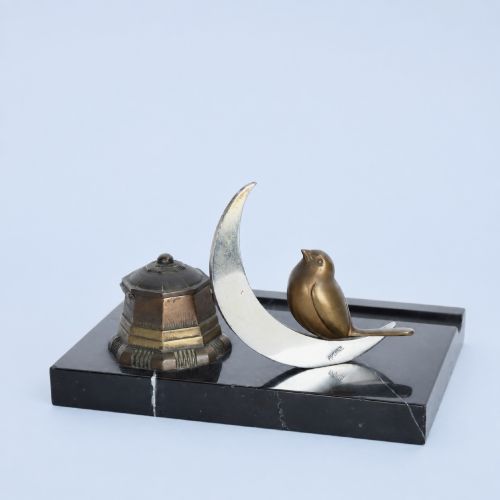


Antique Marble Desk Tidy
An antique marble desk tidy organises a writer's workspace with heavy stone, polished metals, and fitted inkwells.
Antique Marble Desk Tidy
An antique marble desk tidy brings heavy stone bases and fitted metal inkwells together to keep pens and writing materials in order. These desk accessories appear in forms ranging from simple trays to elaborate stands featuring birds, crescents, and portrait busts.
The pieces on this page span the nineteenth century, the Edwardian era, and the Art Deco period, drawing on French Empire, Neoclassical, and Art Nouveau styles. Onyx and lapis lazuli frequently accompany the marble, alongside mounts of bronze, gilt bronze, ormolu, and silver.
How they were made
Makers cut and polished solid blocks of marble and onyx to form the heavy rectangular or contoured bases of each desk tidy. Artisans then fitted these stone slabs with hand-cast bronze, ormolu, brass, or silver mounts, pen trays, and inkwell lids.
Detailed decorative elements such as birds, crescent moons, and portrait busts demonstrate cast metalwork techniques, occasionally complemented by inlaid sections of lapis lazuli.
Listings feature pieces spanning the nineteenth century, Edwardian era, and Art Deco period, incorporating marble, onyx, lapis lazuli, bronze, and ormolu.
What varies in quality
Quality rests on the depth of the casting and the precision of the stone cutting, distinguishing standard desk accessories from finer studio pieces. Sharply rendered bronze figures and crisp ormolu mounts elevate the piece above plain commercial work.
The choice and combination of materials also dictate standing, with rich stones such as lapis lazuli and complex multi-media assemblies representing the more ambitious examples of the desk maker's art.
Lefebvre of Belgium·Jules Dalou·Zimmermann
The Antique Marble Desk Tidy Glossary
- Ormolu
- A gilded bronze or brass mount applied to decorative objects. This technique creates a bright gold-coloured finish that contrasts with dark marble.
- Onyx
- A banded variety of chalcedony used frequently for nineteenth-century desk stands. It provides a translucent, polished surface.
- Inkstand
- A fitted tray or stand holding one or more inkwells alongside spaces for pens. These pieces formed the centrepiece of a traditional writing desk.
- Lapis Lazuli
- A deep blue metamorphic rock utilised for inlay work. Its rich colour adds striking contrast against neutral stone bases.
Antique Marble Desk Tidy: Frequently Asked Questions
What is an antique marble desk tidy?
An antique marble desk tidy is a desk accessory designed to hold inkwells, pens, and small writing implements upon a heavy stone base.
These pieces combine stone with metals such as bronze, brass, and ormolu, reflecting design styles from the nineteenth century through the Art Deco period.
How were these desk accessories used?
Desk tidies sat upon writing tables to keep liquid ink, nibs, and pens contained in one heavy, stable place.
The fitted wells held ink securely while the surrounding stone tray caught stray drips and held writing instruments ready for use.
How do I date a marble desk stand?
Dating relies on identifying the characteristic motifs, materials, and manufacturing techniques associated with specific periods.
For example, Neoclassical and Empire pieces utilise cast ormolu and bronze figures, whereas Art Deco examples favour geometric onyx and stylised bronze birds.
How do I care for marble and onyx?
Marble and onyx require gentle cleaning with a dry or very slightly damp soft cloth to preserve their polished finish.
Harsh chemical cleaners and excessive moisture must be avoided, particularly where stone meets exposed metal mounts or inlaid semi-precious stones.