




Art Deco Bronze Desk Accessory
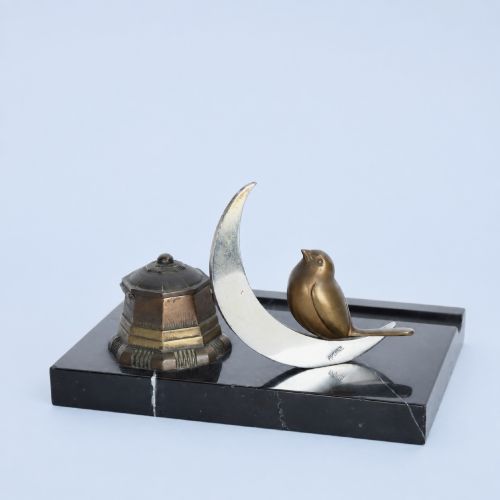
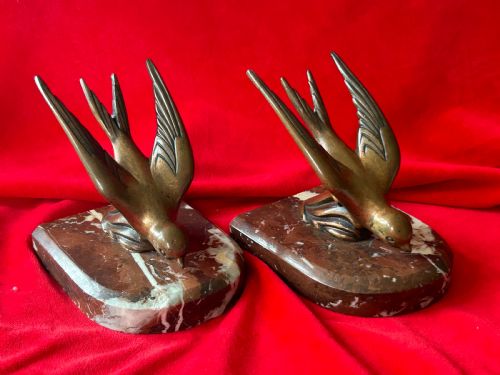
An art deco bronze desk accessory brings absolute style to a workspace, combining modernist geometry with animal and human figures in bronze, spelter and marble.
Art Deco Bronze Desk Accessory
When searching for an art deco bronze desk accessory, collectors encounter practical desk furniture shaped by the early twentieth century. Bookends, inkwells, table lighters and desk tidies form the core of what appears.
French and Austrian workshops dominate the offerings, frequently pairing metal castings with heavy stone bases. Animal subjects and literary figures recur constantly across the available selection.
Bookends emerge as the most frequent format, capturing everything from dogs and birds to elephants and literary portraits. These pieces reflect the functional elegance demanded by offices and libraries of the period.
Defining Quality
The choice and finishing of the stone base dictates overall refinement. Solid marble and onyx mounts with polished bevels indicate higher workshop standards than plain metal bases or simple wooden blocks.
Object types recorded in this category comprise bookends, desk accessories, table lighters, inkwells and desk stands.
Franz Gruber·C Omin·Asprey Of London·Herzig
The Art Deco Bronze Desk Accessory Glossary
- Spelter
- A zinc alloy frequently used as a cost-effective substitute for bronze during the period. It accepts patination and cold-painted finishes readily.
- Cold-painted bronze
- Metal castings decorated with non-fired paint applied directly to the surface. This technique creates vibrant polychrome finishes on animal and human figures.
- Desk tidy
- A desk accessory featuring built-in channels for pens alongside compartments for stamps or small stationery. These items organise the desktop with architectural flair.
- Alabaster
- A fine-grained, translucent stone utilised for carved bases and sculptural elements. Its soft veining contrasts sharply with dark metal figures.
- Patina
- The surface sheen and coloration developed on metal through age or chemical treatment. Original patination preserves the historic character of the piece.
Art Deco Bronze Desk Accessory: Frequently Asked Questions
Are these desk accessories entirely solid bronze?
Many pieces combine bronze or spelter figures with heavy stone bases made of marble, onyx or alabaster.
Makers selected these contrasting materials to provide the necessary weight and stability for holding books or pens.
How do I distinguish bronze from spelter?
Spelter is lighter in weight and tends to show a dull grey metal beneath any chips in the surface finish. Bronze exhibits a warmer reddish-brown metallic tone and greater durability.
Examining the underside or interior screw attachments often reveals the base metal.
Were these items meant for daily office use?
These desk accessories served both practical and decorative functions in professional offices and private libraries. Inkwells held liquid ink for writing, while desk tidies kept pens and paper clips organised.
Bookends supported heavy volumes on mahogany shelves and executive desks.
What periods do these pieces represent?
The selection spans the early twentieth century, focusing heavily on the art deco era around nineteen thirty.
Earlier items from nineteen hundred or nineteen ten also appear, showcasing transitional styles before full geometric modernism took hold.