


Vintage Marble Desk Set
These vintage marble desk sets are functional works of stone and metal that bring structured weight and period character to a working surface.
Vintage Marble Desk Set
A vintage marble desk set brings together heavy stone bases and utilitarian desk objects, most frequently encountered in the form of inkstands, clock garnitures, and desk tidies. These pieces span from the 19th century through the Edwardian era and into the geometric lines of Art Deco.
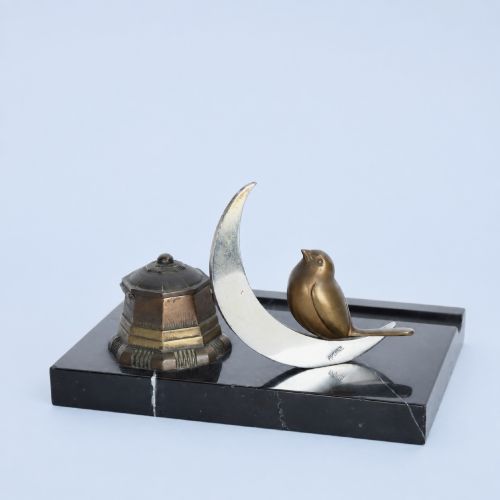
Buyers will find that the category encompasses various configurations, from simple pen trays with mounted inkwells to elaborate clock sets flanked by animal sculptures or candelabras. The materials shift from the polished black marbles and green onyx of the 1930s to the variegated vert marble and Sienna bases of earlier decades.
Origins heavily lean towards French workshops alongside English productions, incorporating functional elements like glass inkwells and brass or ormolu mounts. The resulting objects serve as both desktop organisation and decorative centrepieces reflecting the design priorities of their respective periods.
Materials and construction
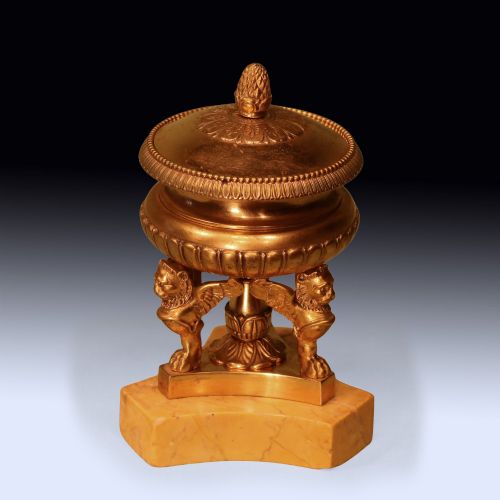
The foundation of these pieces relies on heavy natural stones, primarily marble and onyx, cut and polished into solid bases for desktop items. Workshops frequently paired these mineral slabs with cast metals, utilising brass, ormolu, gilt bronze, and spelter to create figures, pen rests, and inkwell lids.
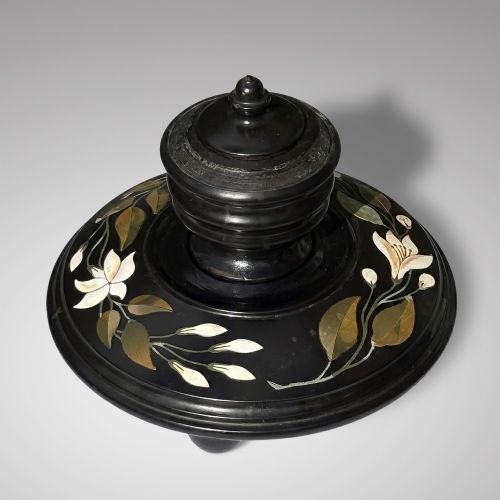
Decorative detailing often involved specialist techniques such as lapis lazuli inlay, enamel work, and silver mounts added to the stone bodies. Clocks integrated within these sets employed eight-day mechanical movements, while inkstands incorporated fitted glass inserts to hold liquid safely against the stone.
Materials across the selection range from polished black marble and green onyx to lapis lazuli inlay and gilt bronze.
Judging quality in stone desk furniture
Quality rests upon the selection and working of the stone itself, distinguishing uniform, finely polished mineral bases from simpler slabs. The integration of the mounted elements - whether cast bronze figures, animal sculptures by named makers, or detailed ormolu mounts - dictates the ambition of the piece.
The refinement of the secondary materials, such as heavy cast metal work rather than lighter alloys, and the inclusion of specialised decorative techniques like micro-inlay elevate the standing of a desk set. A cohesive design where the clock, inkwell, and base share a unified stylistic vision rather than a cobbled assembly represents the upper tier of production.
Albert Marionnet·Michel Decoux·Zimmermann
The Vintage Marble Desk Set Glossary
- Garniture
- A set of matching decorative objects, typically a central clock accompanied by flanking pieces such as candelabras or urns.
- Ormolu
- Gilt bronze, where a finely ground high-carat gold-mercury amalgam is applied to a bronze base, creating a rich golden surface.
- Spelter
- A zinc alloy commonly used as a cost-effective alternative to bronze for casting sculptural figures on bases.
- Inkstand
- A fitted tray or stand holding one or more inkwells, often including spaces for pens and sanders.
- Ashford marble
- A Derbyshire limestone inlaid with various coloured minerals to form floral or geometric patterns, popular in Victorian decorative items.
Vintage Marble Desk Set: Frequently Asked Questions
How do I clean a marble desk set?
Dust the stone regularly with a soft, dry cloth to prevent accumulation in carved recesses. Avoid abrasive cleaners or acidic substances which can etch the polished surface of the marble or onyx.
For metal mounts, use a dry brush to remove debris without disturbing the original patina or gilt surfaces. Take care around glass inkwell inserts and mechanical clock faces during maintenance.
What periods do these desk sets come from?
The pieces span from the early 19th century through the Victorian and Edwardian periods, extending into the 1930s. Each era introduces distinct stylistic traits, from ornate ormolu mounts to sleek geometric Art Deco forms.
Earlier pieces often favour rich variegated marbles and classical motifs, while later 20th-century examples showcase streamlined black marble bases paired with spelter animals.
Were these sets meant for everyday writing?
These desk accessories were created for affluent Victorian, Edwardian, and mid-20th-century studies, offices, and libraries. They served as both functional writing tools and status symbols for the desk.
The inclusion of heavy inkwells, pen trays, and integrated timepieces provided everything a writer required within a single coordinated arrangement.
How do I identify Art Deco pieces?
Art Deco desk sets typically feature strong geometric lines, stepped bases, and contrasting materials like black marble paired with green onyx. Sculptural elements often include stylised animals such as panthers, greyhounds, and birds.
These pieces contrast sharply with the more ornate scrolling foliage and classical figures found on earlier 19th-century Victorian and Empire examples.