


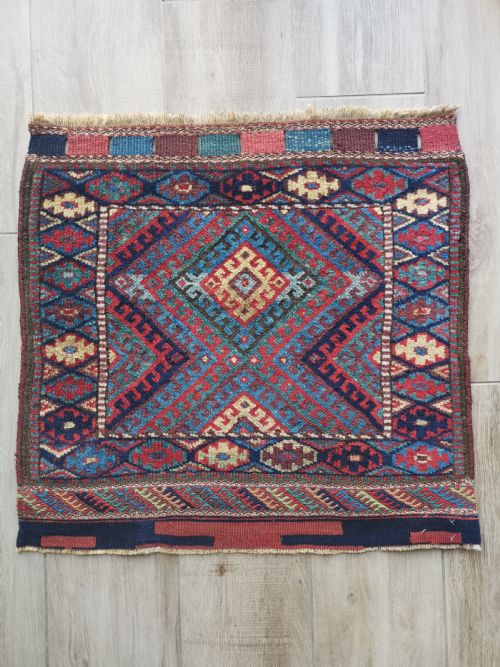


Antique Khorjin Rug
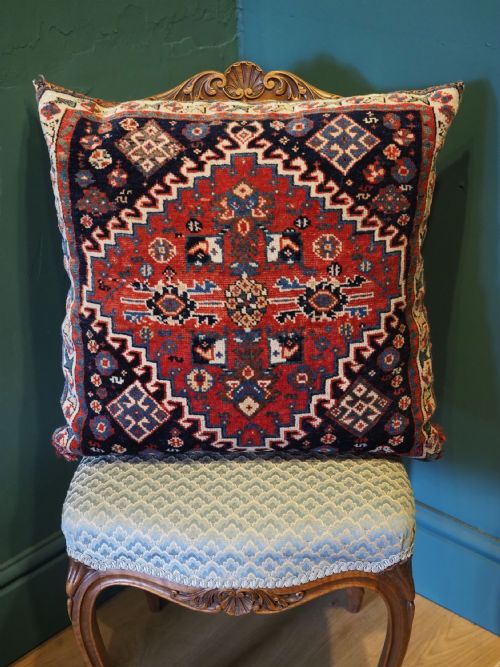
An antique khorjin rug brings the portable artistry of Persian nomads into a room as a striking small textile or cushion.
Antique Khorjin Rug
When you examine an antique khorjin rug, you are looking at fragments and whole faces of traditional double saddlebags woven by nomadic and tribal groups across Persia, the Caucasus, and Afghanistan. These utilitarian objects served as baggage for transport on horses, camels, and donkeys before being repurposed or collected as flat weaves and pile rugs.
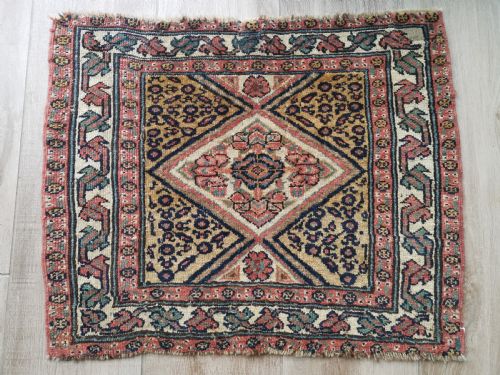
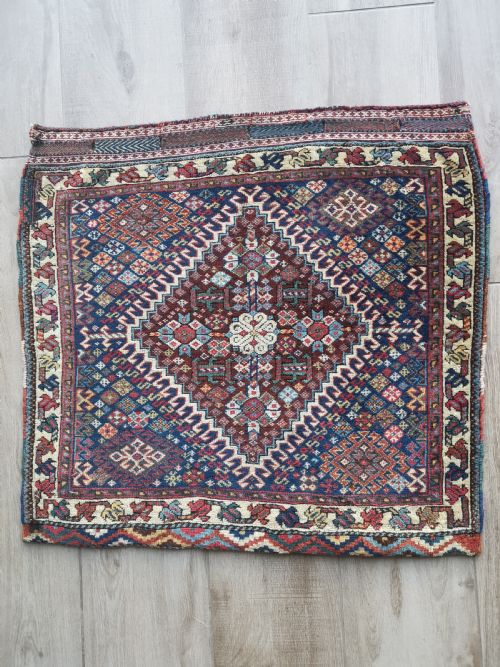
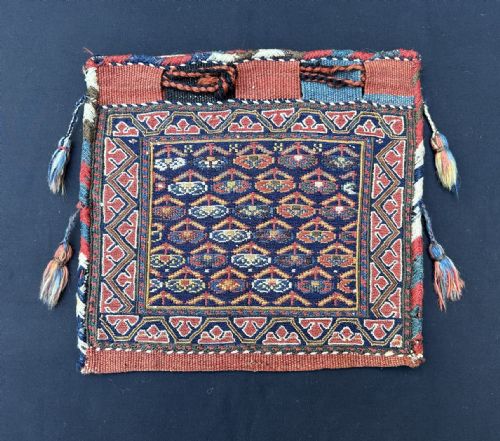
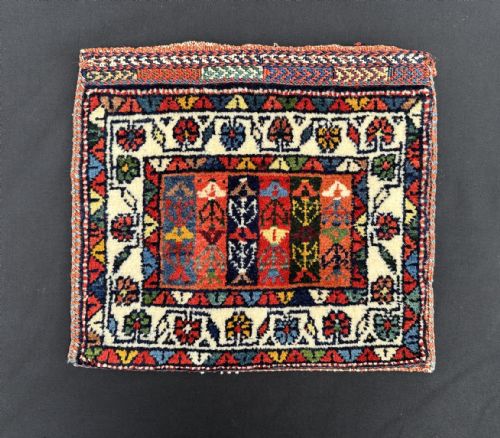
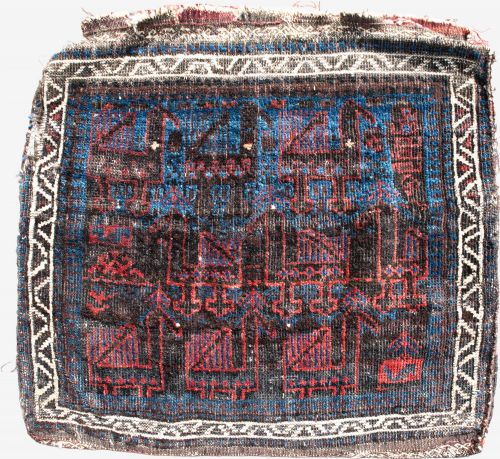
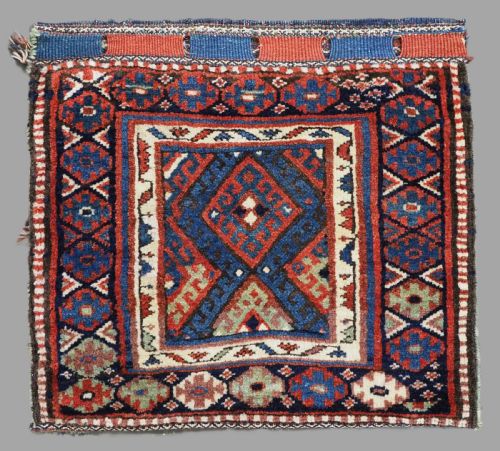
The version most commonly encountered on this page is the bagface, where the decorative front panel has been separated from the plain weave back, or preserved complete with its original reverse. These pieces frequently appear as small square or rectangular formats, often adapted today as decorative cushions or wall hangings.
Originating from tribal confederations such as the Qashqai, Afshar, Shahsavan, Jaf Kurd, and Baluch, these textiles reflect distinct regional aesthetics. Makers utilised local iconography, including central medallions, boteh motifs, and tile patterns, which identify the specific weaving group responsible for the piece.
Materials and construction
Weavers constructed these textiles primarily using hand-spun wool for both the foundation warps and the pile, supplemented occasionally by cotton for structural stability. Goat hair often appears in the outer selvedges and robust plain weave backs to withstand the friction of nomadic travel.
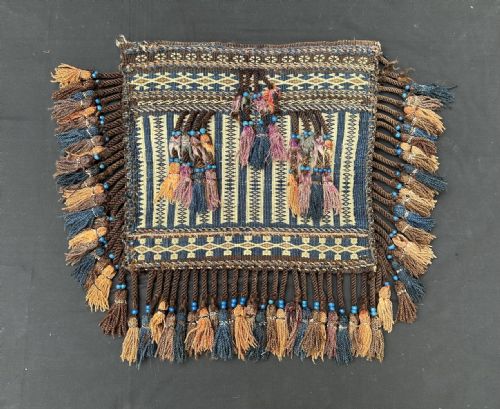
Natural dyes provide the enduring palette, derived from plant and mineral sources that mellow gracefully over decades. Certain examples incorporate supplementary decorative elements such as glass beads and cowrie shells worked directly into the structure.
Some nomadic bags still retain decorative cowrie shells and glass beads stitched in to ward off the evil eye.
Assessing quality and execution
Quality in these nomadic weavings rests upon the density of the knotting and the handling of the wool. Finer examples display tightly packed knots and precise geometric drawing, whereas coarser pieces show a looser, more robust folk execution.
The integrity of the remaining structure heavily influences desirability, separating complete bags with intact plain weave backs from single bagfaces that have lost their reverse. The vibrancy and depth of the natural dye palette also dictate the visual strength of the piece.
The Antique Khorjin Rug Glossary
- Khorjin
- The traditional Persian term for a double-sided saddlebag used by nomadic tribes for transport and storage. These bags were designed to be slung across the back of a pack animal.
- Bagface
- The decorative woven front of a saddlebag. Collectors frequently preserve these panels independently after the utilitarian rear sections have worn away or been removed.
- Soumac
- A flat-weave technique where coloured weft threads wrap over and under the vertical warp threads in a continuous brocading motion. This method creates a textured surface resembling embroidery on the reverse.
- Boteh
- An ancient almond-shaped motif with a curved upper tip, frequently interpreted as a floral spray, cypress tree, or flame. It remains a fundamental design element across Persian tribal weaving.
- Chanteh
- A small personal bag or vanity pouch woven by nomadic women for carrying small personal items. These pieces mirror the technique and design vocabulary of larger saddlebags in a miniature format.
Antique Khorjin Rug: Frequently Asked Questions
What is a khorjin?
A khorjin is a traditional double saddlebag woven by nomadic tribes in regions such as Persia and the Caucasus for carrying belongings during seasonal migrations.
Today, these items survive largely as individual decorative panels or complete bagfaces preserved for their tribal artistry.
How were these bags used?
Nomadic families slung these durable double bags across pack animals to transport household goods, grains, and personal possessions.
The sturdy plain weave backs and reinforced openings were built to endure the rigours of constant travel.
How do I care for a textile?
Protect these historic textiles from prolonged direct sunlight to prevent natural dyes from fading over time.
Gentle vacuuming without a rotating brush helps remove dust without disturbing the hand-spun wool pile.
How are different tribes identified?
Specific tribal attributions rely on distinctive design elements, colour combinations, and structural weaving techniques unique to groups like the Qashqai or Shahsavan.
Motifs such as tile patterns and specific medallion structures often point directly to a particular regional workshop or confederation.