
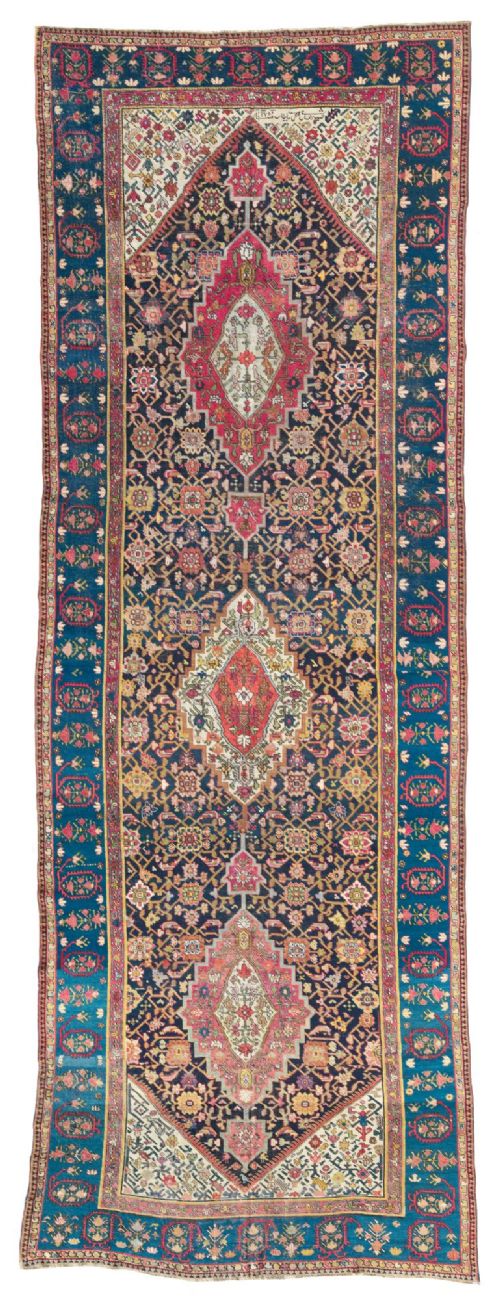
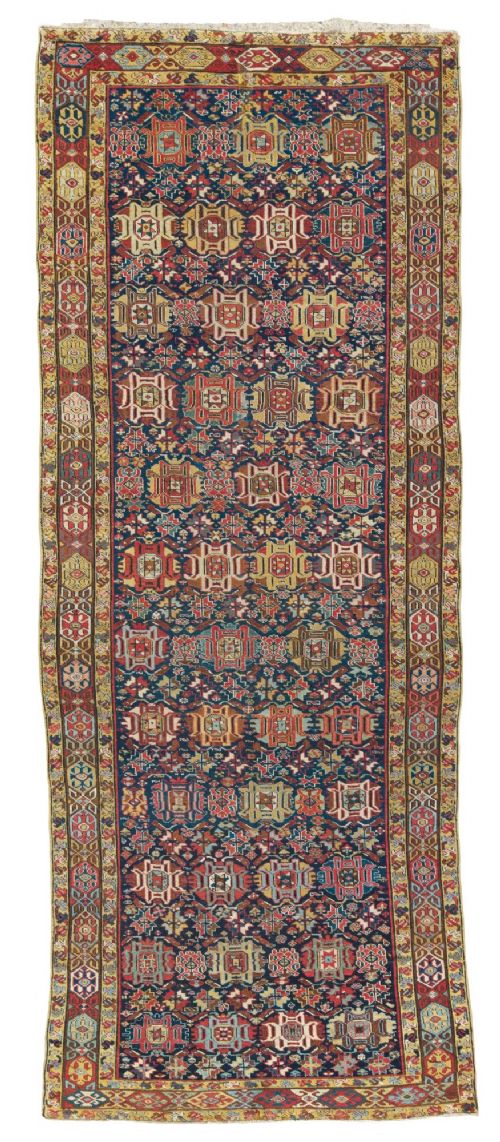


Antique Kelleh Runner
An antique kelleh runner is a substantial tribal or village carpet offering narrow proportions and rich wool pile woven across nineteenth and early twentieth century Persia and the Caucasus.
Antique Kelleh Runner
An antique kelleh runner provides a longer format than a standard room carpet, designed originally for the specific dimensions of Persian and Caucasian domestic interiors. The examples seen here span from the mid-nineteenth century through to the early twentieth century, incorporating regional workshops and tribal traditions.
Most pieces on this page originate from Kurdish, Bidjar, Malayer, and Karabagh weaving traditions, often categorized under Persian tribal or traditional Persian styles. These textiles function as large floor coverings and narrow runners, combining geometric layouts with botanical motifs.
The format typically balances a generous length with a narrower width, distinguishing these rugs from square carpets and standard small rugs. Their origins cover various districts of Persia and the Caucasus, displaying the distinct knotting techniques and design repertoires of each locale.
Materials and construction
The foundation and pile rely heavily on wool and hand-spun wool, frequently supported by cotton warps and wefts in regional village productions. Spinners and weavers utilised locally sourced animal fibres that accepted natural and early aniline dyestuffs.
Weavers tied dense knots onto wool or cotton foundations, creating durable pile surfaces designed for heavy domestic use. The structure involves hand-knotted construction paired with sturdy overcast selvages and flatwoven ends.
The listings span from 1850 through 1930, utilising wool and hand-spun wool materials across Persian and Caucasian styles.
Assessing quality in weaving
Quality rests in the crispness of the drawing and the saturation of the wool pile, where finer knot density allows for sharper rendition of motifs like boteh, tree of life, and dragon borders. Early pieces often show greater nuance in dyestuff variation.
Structural integrity and even wear across the long expanse determine the condition of the runner, alongside the originality of the side cords and end finishes. Higher grade examples maintain structural balance without excessive distortion along the narrow axis.
Bidjar·Kurdish·Karabagh·Khamseh·Senneh
The Antique Kelleh Runner Glossary
- Kelleh
- A large format carpet or long rug possessing an elongated rectangular proportion suited to specific room dimensions.
- Boteh
- A pear-shaped almond motif symbolizing life and eternity, frequently repeated across the field of Persian and Caucasian rugs.
- Harshang
- A traditional crab pattern motif found in borders and fields, featuring stylized geometric floral arrangements.
- Cloud band
- A ribbon-like curving motif originating from Chinese art and adopted into Caucasian and Persian rug design.
- Warp
- The vertical threads stretched tightly on the loom that carry the structural foundation of the woven textile.
Antique Kelleh Runner: Frequently Asked Questions
What is an antique kelleh runner?
An antique kelleh runner is a traditional hand-knotted long carpet originating primarily from nineteenth and early twentieth century Persia and the Caucasus.
These textiles provide narrow, elongated proportions designed to fit specific architectural spaces like hallways and large rooms.
Where were these rugs made?
The pieces originate from various weaving centres and tribal regions across Persia and the Caucasus, including Kurdish districts, Bidjar, Malayer, and Karabagh.
Each area developed distinct colour palettes and geometric or floral design vocabularies tied to local village traditions.
How do I style a long runner?
These narrow carpets suit long hallways, galleries, and narrow living spaces where standard rectangular rugs do not fit.
Their substantial length and distinct borders draw the eye along architectural lines while providing durable wool flooring.
How can I tell the age of a runner?
Age is assessed through wool characteristics, dye types, structural wear, and traditional design motifs associated with nineteenth and early twentieth century production.
Hand-spun wool and early regional colour combinations typically indicate pieces woven prior to the mid-twentieth century.