




Antique Horse Watercolour
An antique horse watercolour captures the agility, strength and daily labour of equines through the fluid brilliance of nineteenth and early twentieth-century pigment on paper.
Antique Horse Watercolour
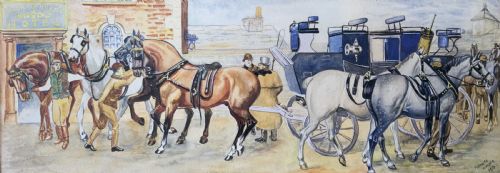
When you search for an antique horse watercolour, you encounter original works spanning the Georgian, Victorian and Edwardian periods, executed by British and European artists. The subjects range widely across agricultural work, coaching scenes, military campaigns and equestrian sports like hunting and racing.
The most common version met on this page is the early twentieth-century or Victorian pastoral work, typically depicting working shires, farm carts or rural lanes. These pieces record a time before mechanisation, when horses were the vital engine of transport and industry.
How They Were Made
Artists applied watercolour pigment and ink onto heavy paper sheets, often mounted within wooden frames behind protective glass. The technique relies on translucent washes of colour built up in layers to capture light, shadow and movement.
Many of these works utilise oak or period wooden moulding frames, occasionally accompanied by charcoal, pastel or grisaille underdrawing beneath the watercolour paint.
The archive spans the eighteenth, nineteenth and twentieth centuries, documenting British and European equestrian art.
What Varies in Quality
Quality rests upon the artist's command of equine anatomy, perspective and gesture, where the best hands render the tension and muscle structure of a horse in motion with absolute economy. Lesser examples stiffen the animal into a rigid diagram, losing the vitality that defines the better sheets.
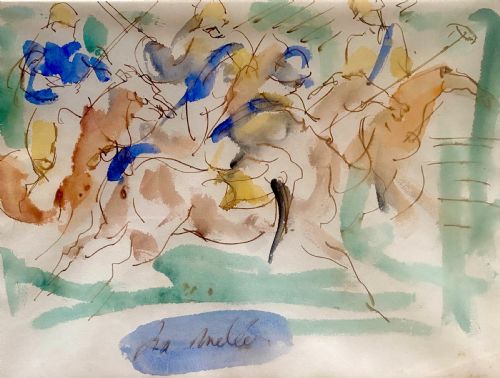
The harmony of the surrounding landscape and the atmospheric depth of the background separate standard topographical sketches from masterworks of British sporting art and impressionism.
Albert Ludovici Jnr·Herman S Melville·William Manners·James William Booth·Charles James Lauder·Basil Nightingale·John Augustus Atkinson·Helena Maguire·George Hamilton Constantine·Rowland Henry Hill·Thomas Mackay·Adrian Jones·Robert Hollands Walker·Basil Bradley·Charles Clifford Turner·John Sanderson Wells·David Woodlock·Charles H Poingdestre·Charles Johnson Payne Snaffles·William J Hodgson·Henry Charles Fox·Walter Duncan·Johan Noah Bemmel·Pierre Gaillardot·Francis Cecil Boult
The Antique Horse Watercolour Glossary
- Watercolour pigment
- The finely ground colour particles suspended in a water-soluble binder used by artists on paper.
- Grisaille
- A painting executed entirely in shades of grey, neutral grey, or monochromatic tones.
- British Sporting Art
- The genre dedicated to horses, hunting, racing, and shooting, strongly represented in nineteenth-century collections.
- Pastoral
- A style of fine art depicting rural life, farm animals, and agricultural landscapes in a peaceful setting.
- Provenance
- The documented history of ownership and origin associated with a specific work of art.
Antique Horse Watercolour: Frequently Asked Questions
What subjects appear in these paintings?
The subjects encompass working farm horses, plough teams, coaching scenes, military cavalry, fox hunting and horse racing. Artists captured both rural labour and leisure pursuits across Britain and Europe.
Agricultural and town scenes dominate the earlier Victorian periods, while sporting subjects expand into the Edwardian era.
How should I frame and display a watercolour?
Watercolours require careful framing behind glass with acid-free mounts to prevent the paper from touching the glazing. Keep them away from direct sunlight to preserve the fugitive pigments.
Period frames in oak or moulded wood complement the age of the paper and enhance the character of the artwork.
How do I distinguish between periods?
Georgian and early nineteenth-century works often feature tighter brushwork and restrained palettes, focusing on documentary accuracy. Victorian and Edwardian examples show freer handling, influenced by British Impressionism and plein-air techniques.
Signatures, framing materials and paper watermarks provide further clues to dating an unsigned sheet.
Were these works meant as studies or finished art?
Some survive as rapid sketchbook studies or preliminary drawings, while others were completed as fully rendered gallery exhibitions. Both finished watercolours and sketch sequences offer direct insight into the artist's hand.
Sketches often reveal the spontaneous observation behind larger commissioned canvases.