
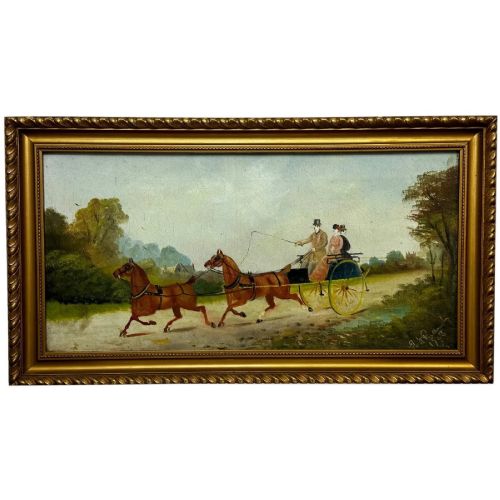
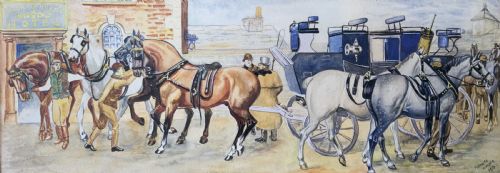


Antique Horse Carriage Artwork
Antique horse carriage artwork captures the movement and tradition of coaching days, offering a window into nineteenth and early twentieth century transport.
Antique Horse Carriage Artwork
When you search for antique horse carriage artwork, you encounter visual records of coaching, street scenes, and equestrian transport from the nineteenth century and the early twentieth century. The selection on this page ranges from detailed watercolour paintings and chalk drawings to oil on canvas and colour lithograph prints.
You meet various specific forms across these listings, including mail coach winter scenes, town views with cabs and traps, and rural coaching journeys. These pieces bridge topographical art and sporting art, recording how people and mail travelled before the widespread adoption of motor vehicles.
Materials and methods
Artists working in this genre used oil paint on canvas, watercolour on paper, and chalk on paper, often framing the finished works in wood such as oak or walnut. Printmakers produced colour lithographs to replicate popular coaching subjects for a wider domestic audience.
The physical application ranges from fine brushwork capturing the harness details and horse anatomy to looser plein air impressionism depicting Parisian streets and snowy English roads.
Quality and execution
Quality in these works rests upon the artist's command of horse anatomy, movement, and the mechanics of carriages such as coaches, traps, and gigs. Stronger pieces convey the weight of the vehicle and the tension in the harness with anatomical precision.
The handling of atmospheric conditions, particularly winter snow scenes and nocturnal lighting, distinguishes accomplished paintings from simpler decorative illustrations. Provenance, signature clarity, and period framing also contribute to the distinction between pieces.
Albert Ludovici Jnr·Cecil Charles Windsor Aldin·WILLIAM MANNERS·Charles James Lauder·Philip Henry Rideout·Samuel Henry Alken·Eduard Leon Cortes·John Charles Maggs·John Richard Worsdale·John Vine of Colchester·H. Alken·James Pollard
The Antique Horse Carriage Artwork Glossary
- Trap
- A lightweight, two-wheeled carriage pulled by a single horse. These appear frequently in Edwardian and late nineteenth-century rural scenes.
- Lithograph
- A print made from a flat stone or metal plate on which an image has been drawn with a greasy substance. Colour lithographs layered multiple inks to imitate paintings.
- Naive art
- Art produced by someone without formal academic training, often characterised by a flat perspective and direct observation. Several nineteenth-century British examples demonstrate this distinct stylistic approach.
Antique Horse Carriage Artwork: Frequently Asked Questions
What periods do these artworks cover?
The pieces span the nineteenth century and the early twentieth century, encompassing Victorian, Edwardian, and Belle Epoque eras.
Dates within the listings extend from the eighteen-fifties through to the nineteen-thirties, reflecting both contemporary observation and later nostalgic views of coaching history.
How were these scenes originally created?
Artists employed oil paint on canvas, watercolour, chalk, and ink on paper to depict horses and carriages.
Printmakers also utilised lithography to reproduce popular coaching and street scenes for domestic display.
Where do the settings in these artworks take place?
The locations include London streets, Parisian boulevards, rural English country lanes, and specific routes like the road from York to London.
Many compositions focus on transit between towns during winter weather, highlighting mail coaches caught in snowstorms.
How should I care for paper-based horse carriage artwork?
Watercolours, drawings, and prints on paper require protection from direct sunlight to prevent fading of the pigments and discolouration of the paper support.
Framing with acid-free mounts and glass helps shield the delicate media from atmospheric moisture and dust.