



Antique Forest Landscape Oil
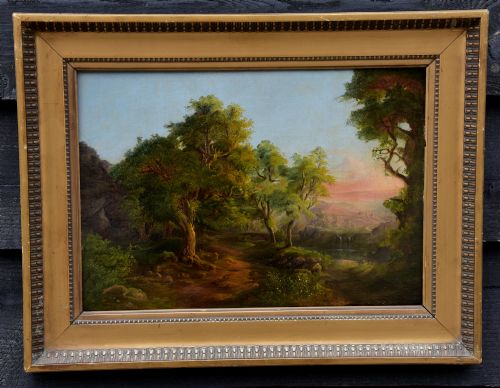
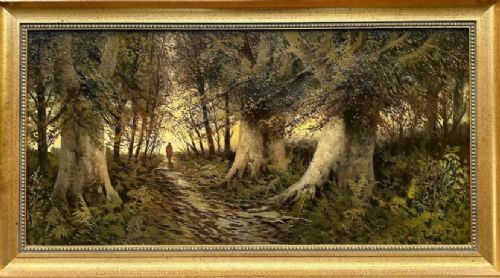
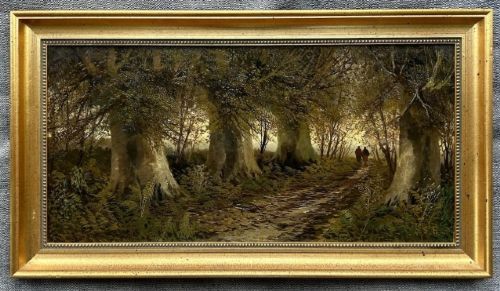
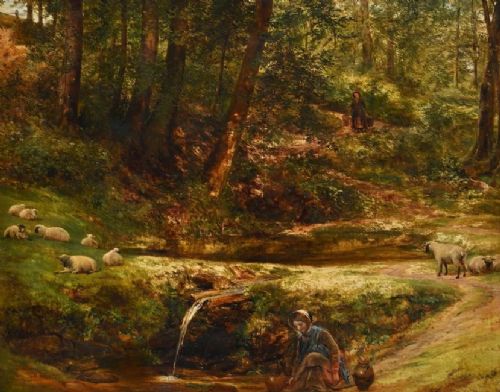
An antique forest landscape oil captures woodland light and shadow through layered pigments.
Antique Forest Landscape Oil
An antique forest landscape oil captures wooded terrain, riversides, and clearings through painted pigment. These works focus on trees, foliage, and natural light rather than urban subjects.
The selections span the eighteenth, nineteenth, and mid-twentieth centuries. Canvas and wood panel support the oil medium across British, French, German, and Danish schools.
Works range from intimate board studies to large framed canvases depicting sunset woods, autumn glades, and winter droving scenes.
How they were made
Painters applied oil paint using brushes and palette knives onto stretched canvas or wooden panels made of mahogany or board. Gold leaf frames often house the finished works.
Pigments build up in layers to create depth in foliage and light effects at sunset or midday.
Several canvases quietly record forgotten cows grazing beneath ancient forest boughs.
What varies in quality
Brushwork precision and pigment preservation define the tier of a canvas. Skilled artists handle light filtration through branches with controlled tonal variation.
The stability of the wooden panel or canvas support and the integrity of the original surface determine the enduring condition of the painting.
William H Myers·Thomas W Lascelles·Richard Redgrave·Thomas Bromley Blacklock·David Watts·James Proudfoot·Jan Evert Morel·Ernest Higgins Rigg·Frederick Golden Short·J McIntyre·Augustus William Enness·A Wood·Albert de Belleroche·Walter Emsley·William Mellor·Charles Pettitt·Henri Harpignies·A Sefton·Camille Magnus·Erich Fleischman·Eiler Rasmussen Eilersen·Eliza Agnetus Emilius Nijhoff·Eugène D’Argence·Peter Busch·Sam Bough
The Antique Forest Landscape Oil Glossary
- Canvas
- A heavy woven fabric stretched across a wooden frame to serve as a painting surface. Oil paint adheres securely to its textured weave.
- Wood Panel
- A rigid wooden support, sometimes mahogany, used instead of fabric. Panels provide a firm backing for detailed brushwork.
- Oil Paint
- Pigment mixed with a drying oil such as linseed. It dries slowly, allowing artists to blend tones smoothly.
- Board
- A compressed flat sheet used as an inexpensive painting support. It appears frequently in smaller nineteenth-century studies.
- Barbizon School
- A nineteenth-century French art movement focused on direct observation of nature and forest scenery. Artists painted en plein air in the Fontainebleau forest.
- Impressionism
- A style emphasising loose brushstrokes and the shifting qualities of light. Works from this movement record outdoor atmospheres directly.
Antique Forest Landscape Oil: Frequently Asked Questions
How do I hang a heavy framed oil painting?
Secure picture wire directly to heavy-duty D-rings screwed into the wooden stretcher bars or frame sides. Hang the piece from wall studs using appropriate masonry or plaster fixings.
Ensure the weight sits evenly to maintain level alignment on the wall surface.
Should I clean the surface of an antique oil painting?
Surface dust accumulates on varnished oil layers over decades. Leave chemical cleaning and varnish removal to a professional conservator to avoid pigment damage.
Light, dry dusting with a soft brush suffices for routine maintenance.
How do I identify the period of a forest landscape oil?
Examine the reverse of the canvas, stretcher bars, and panel for maker stamps, handwritten inscriptions, and old exhibition labels. Framing style and canvas weave also offer dating clues.
Compare stylistic traits against documented works by the listed artist or school.
Where should I place an oil painting in my home?
Select an interior wall away from direct sunlight and extreme temperature fluctuations. Radiators and damp areas accelerate canvas degradation and paint cracking.
Stable humidity keeps wood panels and canvas tension secure over time.