






Barbizon School Oil Painting
A barbizon school oil painting brings rural nineteenth-century France into a room through muted tones, quiet pastures and observed natural light.
Barbizon School Oil Painting
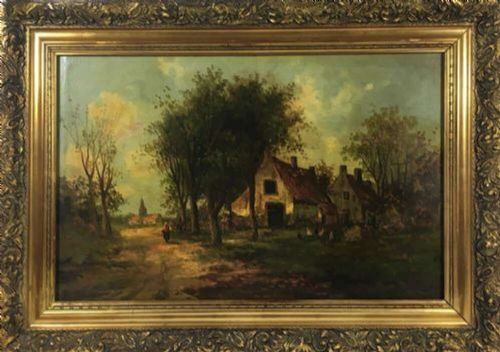
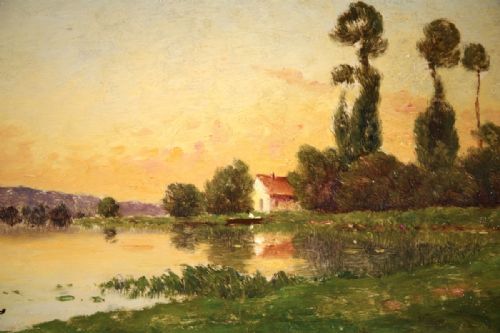
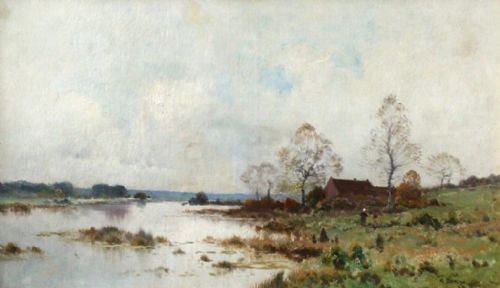
A barbizon school oil painting depicts rustic landscapes, pastoral scenes and river views rooted in nineteenth-century French realism. These works capture the countryside around Fontainebleau, focusing on trees, farmyards, cattle and humble dwellings observed directly from nature.
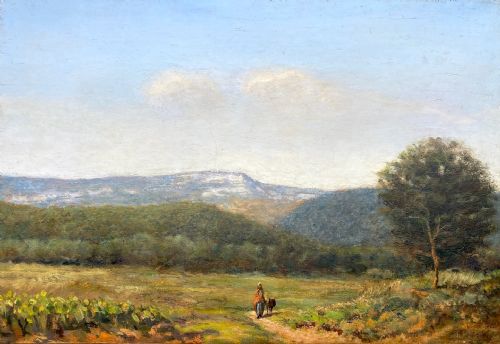
Most examples found here date from the nineteenth century, including Victorian-era British interpretations influenced by the French movement. Painters of this circle turned away from classical mythology to record the topography of Provence, the Loire and rural riverbanks.
The subjects on this page range from French farmyards and riverside paths to quiet pastoral landscapes with figures. Buyers often encounter canvases framed in giltwood or gilt wood, carrying the characteristic dark palettes and atmospheric brushwork of the period.
Materials and technique
Artists painted in oil on canvas, and occasionally on paper laid down on panel, building up rich surfaces of oil paint. This medium allowed painters to achieve deep chiaroscuro effects, capturing the play of light and shadow beneath forest canopies and overcast skies.
Surviving works are frequently housed in period giltwood, gilt wood or gilded wood frames enhanced with moulded plaster ornamentation. These frames complement the earthy greens, browns and ochres characteristic of the nineteenth-century palette.
The inventory records French and British landscapes, pastoral scenes with cattle, and river views dating from the victorian era and the eighteen-sixties.
Distinguishing quality
Quality rests in the handling of atmospheric light and the assurance of the brushwork across the canvas. Stronger works convey depth and texture in foliage and terrain without relying on excessive detail.
The integration of the painting with its original giltwood or gilded wood frame influences desirability. Cohesion between the tonal depth of the oil paint and the condition of the frame marks the finer examples.
Paul Désiré Trouillebert·Henri Jaques Delpy·Alphonse Robert·Pierre Emmanuel Eugene Damoye·Henri Joseph Harpignies·Jules-Louis Dusaussay
The Barbizon School Oil Painting Glossary
- Barbizon School
- A nineteenth-century movement of French artists who painted landscapes directly from nature, centring around the village of Fontainebleau. This approach paved the way for impressionist plein air painting.
- Chiaroscuro
- The strong contrast between light and dark within a painting. This technique creates volume and dramatic atmospheric depth in rural scenes.
- Plein Air
- The practice of painting outdoors to capture direct observations of natural light and weather. It is central to the method of these nineteenth-century landscape painters.
- Giltwood
- Timber that has been covered with a thin layer of gold leaf. Frames made in this material frequently accompany nineteenth-century fine art.
- Oil on Canvas
- Pigment mixed with drying oil applied to a stretched woven fabric support. It remains the primary medium for these historical works.
Barbizon School Oil Painting: Frequently Asked Questions
What is a barbizon school oil painting?
A barbizon school oil painting is a nineteenth-century artwork depicting French rural landscapes, forests and river scenes. These pieces focus on realistic portrayals of nature rather than idealized historical subjects.
Pioneered near the forest of Fontainebleau, the movement emphasised painting outdoors and capturing honest, atmospheric views of everyday pastoral life.
How do I identify a barbizon school painting?
Look for earthy tones, muted greens and browns, and an emphasis on trees, rivers, and farmyards under atmospheric skies. Brushwork is often painterly and atmospheric rather than hyper-realistic.
Signatures or attribution to artists associated with the Fontainebleau circle, alongside nineteenth-century canvas and framing materials, help confirm the period and origin.
Where were these paintings created?
These works were largely created in France, particularly around the village of Barbizon near the forest of Fontainebleau. Painters gathered here to study the rural landscape directly.
Other regions of France, such as Provence and the Loire valley, also provided subject matter for these nineteenth-century artists.