


Antique Entrance Hall Table
An antique entrance hall table sets the tone the moment the door opens, offering a practical surface and a distinct period presence.
Antique Entrance Hall Table
An antique entrance hall table encompasses console tables, centre tables, side tables, and hall stands designed for the main entrance of a property. These pieces serve both a decorative and practical function, greeting visitors with period character from the Georgian, Victorian, Edwardian, and nineteenth-century periods.
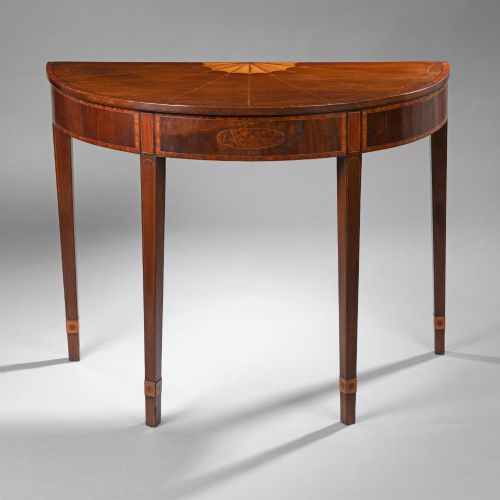
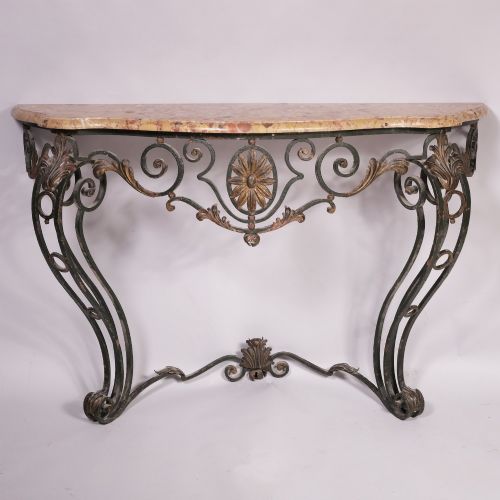
Console tables and demi-lune shapes appear frequently, often designed to sit flush against a wall in a narrow hallway. Larger spaces accommodate centre tables or hall stands featuring marble shelves and ceramic elements.
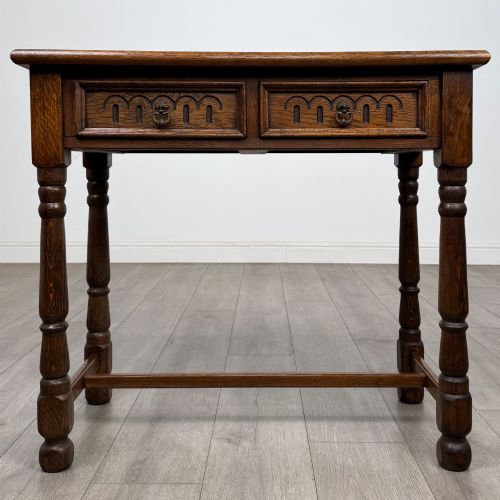
The materials and styles span mahogany, oak, walnut, and satinwood, alongside French Empire and Aesthetic Movement designs. Buyers encounter everything from simple side tables to grand marble-topped giltwood consoles.
How they were made
Cabinet makers utilised dense timbers such as mahogany, oak, walnut, and satinwood, often shaping them into curved demi-lune, serpentine, or bow fronts. Boxwood stringing and ebonised finishes provide surface contrast.
Top surfaces frequently incorporate heavy materials like marble or porphyry, supported by carved wooden bases, giltwood frames, or brass details. Ceramic inserts, notably Minton tiles, appear in specific hall stand designs.
Mahogany, marble, and brass recur across nineteenth-century and Georgian entrance hall tables.
What varies in quality
The refinement of the carved woodwork and the choice of primary timber define the upper tier of tables. Finer examples display precise boxwood inlay, well-executed serpentine or bow fronts, and substantial marble or porphyry tops rather than simpler wood surfaces.
Structural integrity and the quality of the finish dictate value. Original hardware, clean ebonising, and intact giltwood mirrors paired with console tables distinguish superior pieces from standard workshop output.
Ellen E. Houghton of Minton
The Antique Entrance Hall Table Glossary
- Demi-lune
- Half-moon shape. This design allows console tables to sit flat against a hallway wall while projecting a curved front.
- Serpentine
- Wavy outline. Tables with this profile feature a convex centre flanked by concave sides, or vice versa.
- Giltwood
- Wood covered with gold leaf or a gilt finish. It appears on ornate frames and mirrors matched with console tables.
- Porphyry
- An igneous rock with large crystals. It provides a dense, decorative stone surface for high-end table tops.
- Ebonised
- Wood stained or painted to imitate ebony. This dark finish characterises Aesthetic Movement hall tables.
Antique Entrance Hall Table: Frequently Asked Questions
What is a console table?
A console table is a narrow table designed to stand flat against a wall, frequently used in entrance halls where floor space is limited.
These pieces often feature demi-lune or serpentine shapes and can include marble tops or matching mirrors.
Where does a centre table go?
A centre table stands freestanding in the middle of a room or a spacious entrance hall rather than against a wall.
These tables allow access from all sides and often feature carved timber bases or circular tops.
How do I spot Victorian pieces?
Victorian entrance hall furniture often uses heavy mahogany, rich carving, and functional additions like marble shelves or ceramic tile inserts.
Look for the darker wood tones and robust construction characteristic of the nineteenth century.