
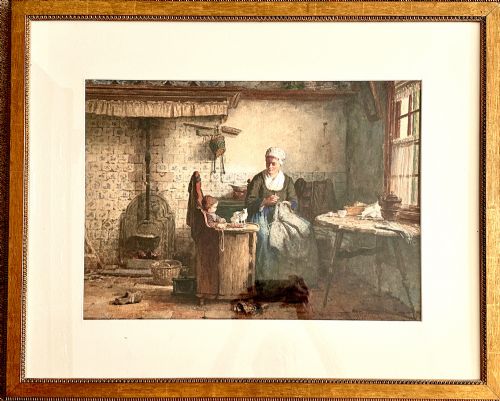


Antique Dutch Watercolour
An antique dutch watercolour captures the light and atmosphere of the Netherlands through delicate pigments applied to paper.
Antique Dutch Watercolour
An antique dutch watercolour is typically a nineteenth-century painting on paper, often depicting windmills, harbours, rivers, and local townscapes or figures in traditional dress.
The works you encounter most frequently on this page date from the nineteenth century and the early twentieth century, spanning styles from realism to folk art and impressionism.
Subjects range from bustling markets and fishing boats at Scheveningen or Dordrecht to quiet architectural studies of historic buildings like the Vleeschhal in Haarlem.
How they were made
Artists created these works using watercolour pigments and ink applied directly onto paper, sometimes employing pen and wash techniques for architectural drawings.
Finished watercolours were traditionally framed behind glass in wood or gilt wood frames to protect the paper from moisture and light damage.
Listings feature paper, watercolour pigments, ink, wood, and glass across nineteenth-century and early twentieth-century periods.
What varies in quality
Quality rests in the precision of the brushwork and the artist's ability to capture atmospheric light and architectural detail on paper.
Works by listed nineteenth-century masters or named continental and British painters command greater attention than anonymous folk art or provincial school pieces.
Hendrik Valkenberg·Thomas Bush Hardy·Jan van Couver·Fred Mayor·Johan Noah Bemmel·David Adolph Constant Artz·James Robertson Miller·John Syer·Louis Van Staaten·George Sheffield·G Vonk·Jan Van Goyen·James W Milliken·John Hamilton Glass·Christiaan Andriessen·Andrew B Donaldson·William Henry Harriott·Henry Bacon
The Antique Dutch Watercolour Glossary
- Grisaille
- A painting executed entirely in shades of grey or neutral greyish monochrome. This technique was frequently used for tonal studies and landscape views.
- Wash
- A thin, transparent layer of diluted watercolour pigment applied across the paper. It creates smooth backgrounds for skies and water.
- Gilt wood frame
- A wooden picture frame coated with a thin layer of gold leaf or gilt finish. These frames protect the watercolour behind glass.
- Architectural drawing
- A precise technical or artistic drawing of a building facade. These works emphasise structural detail and perspective.
Antique Dutch Watercolour: Frequently Asked Questions
What is an antique dutch watercolour?
An antique dutch watercolour is a painted paper artwork depicting scenes from the Netherlands, created primarily during the eighteenth, nineteenth, and early twentieth centuries.
These paintings capture landscapes, marine views, and daily life using water-soluble pigments and ink.
How can I tell the age of a painting?
Dating relies on the paper type, framing materials, artist signatures, and stylistic markers such as nineteenth-century realism or impressionist tendencies.
Inscribed titles and dates on the front or verso often provide direct evidence of when the work was made.
Who painted these works?
The artists include both Dutch masters and foreign painters who travelled to the Netherlands to capture its landscape, coastlines, and architecture.
Many pieces bear signatures or attributions to named nineteenth-century figures and school artists.