


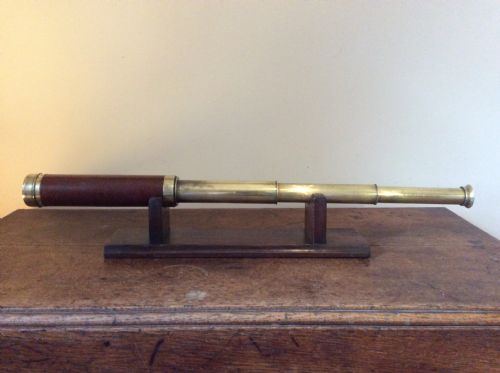


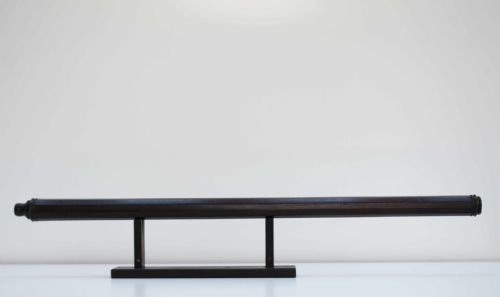
Antique Desk Telescope
An antique desk telescope brings functional maritime optics indoors, offering brass barrels and leather grips for serious study or display.
Antique Desk Telescope
An antique desk telescope is a precision scientific instrument designed for terrestrial observation or celestial viewing from a library, study, or coastal post. Buyers searching for an antique desk telescope encounter portable spyglasses, multi-draw marine instruments, and substantial library telescopes suited for tabletop display.
The selections available here span significant historical periods, running from mid eighteenth century decagonal examples through Georgian, Regency, and Victorian eras into Edwardian pieces. These instruments include naval telescopes, officer of the watch models, and explorer spyglasses.
Makers such as Ross of London, Cary London, John Gilbert, and Dollond represent the English optical trade across these periods. Forms vary from single draw hexagonal tubes to nine sided bodies and fruitwood encased terrestrial scopes.
How they were made
Makers constructed these instruments primarily from turned brass, pairing metal barrels with glass optical lenses to achieve magnification. Many domestic and marine models feature stitched leather casing or fine wood veneers like mahogany, oak, and fruitwood over the inner tubes.
Advanced construction techniques involved multi-draw mechanisms, allowing several brass sections to collapse smoothly into one another. Specialised variants incorporate hexagonal, decagonal, or nine sided geometries formed with precision joinery and metalworking.
Current listings feature instruments spanning the Georgian, Regency, Victorian, and Edwardian periods, utilising brass, glass, leather, oak, mahogany, and fruitwood.
What varies in quality
Quality in these instruments rests upon the clarity of the optical glass and the precision of the signed maker attribution on the brass barrel. Signed works by noted opticians like Ross of London or John Gilbert command greater scholarly and collector interest.
The physical execution of the housing distinguishes fine pieces, notably complex geometric body shapes such as decagonal or nine sided forms rather than standard round tubes. The preservation of original leather dressings and smooth draw action also elevates an instrument.
Ross of London·Cary London·John Gilbert·Dollond
The Antique Desk Telescope Glossary
- Draw
- A sliding section of the telescope barrel that extends to focus the instrument. Multi draw models collapse into compact lengths for storage.
- Terrestrial
- An optical instrument configured to view land objects upright rather than inverted for astronomy. Most library and marine spyglasses utilise this setup.
- Achromatic
- An optical lens design corrected to reduce colour fringing and improve image sharpness. Mid eighteenth century examples sometimes utilised non achromatic configurations.
- Spyglass
- A small, portable handheld telescope used historically by officers and travellers. These often feature leather dressed outer bodies for grip and protection.
- Marine telescope
- An instrument built for use at sea, typically featuring robust brass construction to withstand salt air and motion. Officer of the watch variants fall into this category.
Antique Desk Telescope: Frequently Asked Questions
What is a library telescope?
A library telescope is a larger optical instrument designed for stationary indoor use on a desk or table rather than handheld field transport.
These pieces provide higher magnification for studying distant terrestrial landmarks or celestial objects from the comfort of a study.
How do multi draw telescopes work?
Multi draw telescopes use nested concentric brass tubes that slide outward to extend the focal length of the optical system.
Pulling each section fully locks the barrel into position, allowing a long instrument to collapse into a portable size.
What is an officer of the watch telescope?
An officer of the watch telescope is a maritime spyglass used historically by naval officers on deck for signaling and spotting vessels.
These are typically wrapped in leather for a secure grip in wet marine environments and feature straightforward single or multi draw brass construction.
How do I date an antique telescope?
Dating relies on maker signatures, address details engraved on the brass draw, materials like fruitwood or nickel, and overall optical style.
Georgian and Regency models often display simpler cylindrical forms, while Victorian and Edwardian pieces show refined multi draw engineering.