
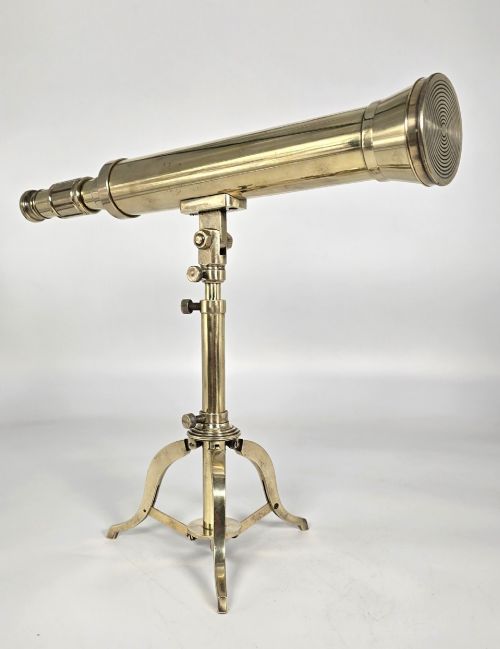


English Victorian Telescope
An english victorian telescope is a brass and glass instrument of maritime or field use, prized for its optical clarity and historical utility.
English Victorian Telescope
When searching for an english victorian telescope, buyers encounter portable hand-held devices designed for terrestrial and astronomical viewing. These instruments range from pocket-sized multi-draw travel units to large library and officer of the watch models.
The multi-draw brass spyglass stands out as the most common form on this page, often sheathed in leather or turned wood such as fruitwood, oak, walnut, or mahogany. These portable versions collapse into compact cylinders for transport.
Specialised variants also appear, including walking cane telescopes with bone handles, folding tripod-mounted brass stands, and military campaign configurations intended for field service.
Materials and construction
Makers built these instruments primarily from turned brass tubes fitted with glass optical lenses. Metal components often received hand-polished finishes alongside precision-threaded draw sections.
Exterior protection and grip relied on applied materials such as stitched leather, mahogany, fruitwood, and bone. Workers wrapped cylinders in leather or fitted wooden sleeves to insulate the cold metal during handling.
Listings feature brass, glass, leather, oak, fruitwood, mahogany, bone, and nickel across instruments dated from 1850 to 1920.
Judging optical and mechanical standard
Quality separates by the precision of the draw mechanism and the clarity of the internal glass lenses. Smooth extension across multiple brass draws indicates superior engineering by skilled opticians.
Signatures inscribed on the brass draw tubes by established makers distinguish higher-tier instruments from anonymous workshop output. The presence of original fitted wooden cases or tripod stands elevates the completeness of the piece.
Ross of London·Newton and Co·Davis of London·Broadhurst and Co·JH Steward·Baker London·Henry Hughes·Dollond·J Sewill·Henry Ward·Lawrence and Mayo·JP Cutts·NSL
The English Victorian Telescope Glossary
- Draw
- A sliding tube section that extends from the main barrel to focus the instrument. Multiple draws allow a long telescope to collapse into a short pocket-sized cylinder.
- Terrestrial telescope
- An optical instrument configured with erecting lenses to display land objects the right way up. These differ from astronomical versions which present inverted images.
- Spyglass
- A small hand-held refracting telescope used primarily for quick observations at sea or across land. This term historically described compact multi-draw travel instruments.
- Officer of the watch telescope
- A robust maritime spyglass utilised by naval officers for routine watches and signalling. These usually feature a single large objective lens and leather-wrapped brass body.
English Victorian Telescope: Frequently Asked Questions
What is a day or night telescope?
A day or night telescope is an optical instrument designed to function under varying light conditions. These models utilised larger objective lenses to gather extra illumination during dawn, dusk, or night operations.
Such instruments often served naval officers and watchkeepers who required continuous observation capabilities through changing weather and light levels.
How do I date a telescope?
Dating relies primarily on maker signatures, address details engraved on the brass, and stylistic construction methods. Inscribed dates or retailer marks provide the most direct chronological evidence.
The number of draw sections and the choice of exterior cladding materials like leather or specific woods also offer clues regarding the manufacturing era.
Can I use these for astronomy?
Terrestrial models display images the right way up for land viewing but possess optical configurations tailored for horizon sights rather than deep space. Astronomical versions use different lens arrangements that leave stars inverted.
While larger library and starboy models suit basic celestial observation, most portable examples are built specifically for land and maritime landscapes.