
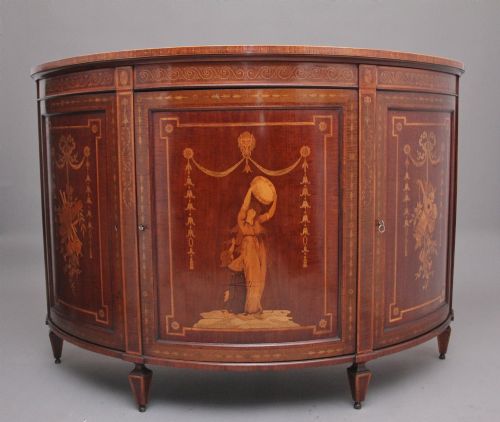


Antique Demilune Commode
An antique demilune commode offers a graceful half-round silhouette that fits tight against a wall while holding significant presence.
Antique Demilune Commode
When you search for an antique demilune commode, you encounter half-round furniture designed primarily for storage and display against drawing room walls. These pieces emerge in formats ranging from Georgian mahogany and satinwood to later French painted and inlaid interpretations.
The versions you meet most frequently on this page span the eighteenth century through the Edwardian era and the early twentieth century. They present as commodes, side cabinets, and half-round chests with fitted marble tops or fine marquetry surfaces.
Origin points across the evidence include English Sheraton Revival and George III workshops alongside French Louis XV and Louis XVI style ateliers. Each piece utilises its curved facade to soften the corners of a formal interior.
How They Were Made
Cabinetmakers built these curved carcasses using dense timbers such as mahogany, satinwood, kingwood, and burr elm over sturdy pine or oak foundations. They shaped veneers carefully across the tight radius of the frame to achieve a smooth continuous sweep.
Surfaces frequently feature intricate marquetry, parquetry, hand-painted decoration, and Vernis Martin finishes. Heavy mounts in ormolu and brass often edge the marble tops and accent the aprons and feet.
The selection here spans the eighteenth century to the nineteen-thirties, with materials ranging from marble and ormolu to satinwood and burr elm.
What Varies in Quality
The distinction between ordinary and exceptional pieces lies in the precision of the veneer work and the tightness of the curved joints. Superior examples maintain crisp inlay without lifting, alongside heavier, better-figured timbers.
Mounts and hardware also separate grades of manufacture, where cast bronze or ormolu follows the contours cleanly rather than sitting flat against a curved surface. The quality of the marble top, its thickness, and its veining complete the assessment.
James Hicks·Kaufman
The Antique Demilune Commode Glossary
- Demilune
- Half-moon shape, describing furniture with a flat back and a curved semicircular front. This profile allowed cabinets to sit flush against walls while projecting softly into the room.
- Marquetry
- The art of applying pieces of veneer to a structure to form decorative patterns and pictures. Craftsmen used contrasting timbers to create floral or geometric motifs across the curved doors and drawers.
- Ormolu
- Gilded bronze applied to furniture mounts, feet, and keyhole escutcheons. It provides a bright metallic contrast against dark mahogany or polished kingwood.
- Parquetry
- Geometric wood inlay forming tiling patterns such as cubes or chequers. It differs from marquetry by relying on regular angular shapes rather than pictorial designs.
- Vernis Martin
- A type of decorative lacquer finish developed in France to imitate Asian lacquer. It uses multiple translucent coats of varnish over painted scenes to achieve depth and gloss.
Antique Demilune Commode: Frequently Asked Questions
Where should I place a demilune commode?
These pieces suit narrow hallways, entrance foyers, and drawing rooms where a rectangular cabinet would project too far into the floor space. Their curved profile softens the transition between doorways and walls.
They also function well beneath large mirrors or paintings, providing a stable surface for lamps and decorative objects without blocking foot traffic.
How do I care for marble top commodes?
Marble requires gentle cleaning with warm water and a soft cloth, avoiding acidic cleaners that etch the polished stone surface. Use coasters under glasses to prevent rings from forming on vintage stone.
Waxing the timber base should be done sparingly, keeping polish away from the junction where the wood meets the stone top.
What is the difference between French and English styles?
English versions from the Georgian and Sheraton periods tend to rely on fine timber grains, subtle stringing, and restrained neoclassical proportions. They often feature satinwood or mahogany with minimal hardware.
French pieces from the Louis styles frequently employ heavier marquetry, painted panels, elaborate ormolu mounts, and shaped marble tops designed for visual impact.
How do I date an inlaid cabinet?
Dating relies on examining the secondary woods inside the drawers, the style of the marquetry, and the construction methods used on the curved carcass. Hand-cut dovetails and older backing boards point toward eighteenth-century origins.
Later Revival pieces from the Edwardian period or the early twentieth century often show more standardised internal framing while imitating earlier eighteenth-century designs.