



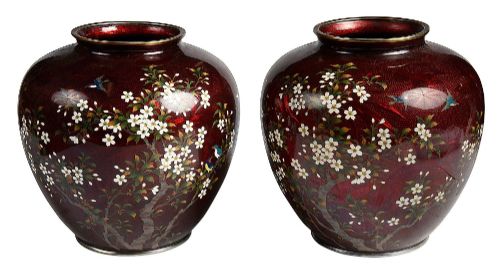


Antique Cloisonne Jar
These antique cloisonne jars bring vibrant enamels and intricate wirework into a room, offering both Japanese Meiji and Chinese decorative traditions.
Antique Cloisonne Jar
An antique cloisonne jar sits among diverse vessels including vases, lidded gourd pots, ginger jars, and koro incense burners spanning the nineteenth and early twentieth centuries. These pieces cross Japanese Meiji and Chinese decorative styles, showing forms from small sugar bowls to large covered vases.
The pieces most frequently met on this page are lidded jars and vases from the nineteenth century and the Meiji period. Buyers encounter both Japanese works utilising silver wire or ginbari enamel and Chinese bronze or copper vessels.
Makers and origins define the scope, ranging from Japanese pieces associated with Ando Jubei to Chinese Qing style works. Forms vary from ginger jars to covered vessels created for decorative display.
How they were made
Makers form these jars using copper, brass, or bronze as a base metal foundation. Thin metal wires are soldered onto this body to create the compartments that hold the coloured enamels.
Enamel paste fills the cells created by the wire framework before the vessel undergoes firing and polishing. Silver foil and specialised techniques such as ginbari and basse-taille appear in Japanese Meiji examples to add depth beneath translucent enamels.
Antique Cloisonne Jar Retail Price Guide 2026
Typical asking prices for cloisonne jar among the pieces listed under this phrase on Sellingantiques today, from the lower quarter to the upper quarter. They describe what is for sale here now, not the wider market.
What varies in quality
Quality rests in the precision of the wirework and the control of the enamel during firing. Finer vessels display exceptionally thin, even wire cells and smooth, uniform enamel surfaces without pitting.
Masterpieces achieve distinction through complex imagery such as tree bark textures, dragons, birds, and flowers integrated into the design. Signed pieces and those utilising advanced silver foil underlays sit at the upper end of the range.
Ando Jubei
The Antique Cloisonne Jar Glossary
- Cloisonne enamel
- A technique where metal wires form raised cells on a copper, brass, or bronze body to contain coloured glass paste before firing. This method creates intricate patterns across vases, jars, and bowls.
- Meiji period
- The era in Japanese history spanning from 1868 to 1912, known for exceptional refinement in metalwork and cloisonne production. Pieces from this time often feature delicate flora and fauna.
- Ginbari
- A Japanese enamelling technique employing a textured silver foil background beneath translucent enamel. It produces a reflective patterned depth visible through the coloured surface.
- Koro
- A traditional eastern incense burner featuring a perforated cover, frequently cast in bronze or copper with cloisonne decoration. These vessels served both ritual and decorative purposes.
- Basse-taille
- An enamelling method where the metal ground is carved or engraved underneath translucent enamel. Light reflects off the varied depths to create tonal gradations.
Antique Cloisonne Jar: Frequently Asked Questions
How do I date an antique cloisonne jar?
Dating relies on material combinations, colour palettes, and stylistic markers such as Meiji period motifs or Qing dynasty forms. Nineteenth-century examples often employ heavier bronze or copper bases with robust wirework.
Later pieces from the early twentieth century introduce specific enamelling innovations like translucent red ginbari. Comparing the style of the flora, fauna, or dragons to documented pieces helps narrow the decade of production.
Were these jars used for storage?
Many lidded vessels and ginger jars originated as decorative display items rather than utilitarian containers for food or spices. Their delicate enamel surfaces meant they were primarily prized as ornamental works of art in European and Asian interiors.
Over time, some lidded pots functioned as sugar bowls or ginger jars, but their survival in fine condition suggests careful handling. Today they serve as focal points on mantels, tables, and cabinets.
How do I clean an antique cloisonne jar?
Dusting gently with a soft, dry cloth is the safest way to maintain the enamel and metal surfaces. Moisture should be kept away from older metal bases and any exposed wire joints.
Harsh chemical cleaners or abrasive polishes must be avoided entirely because they can damage the delicate glass enamels and antique patinas. Professional conservation advice should be sought for stubborn residues.