



Antique Brass Castor Rack
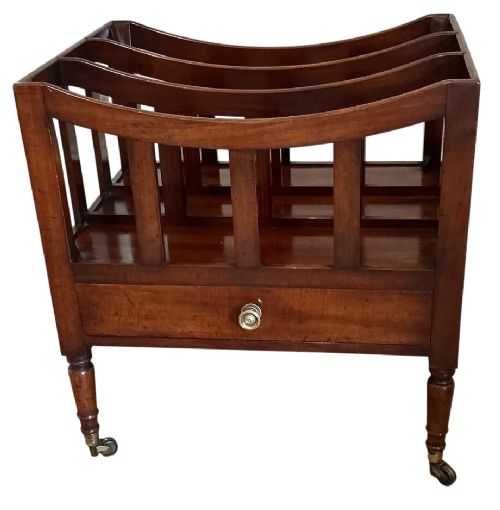
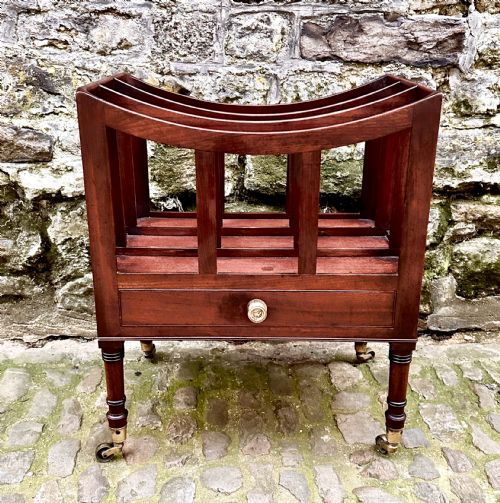
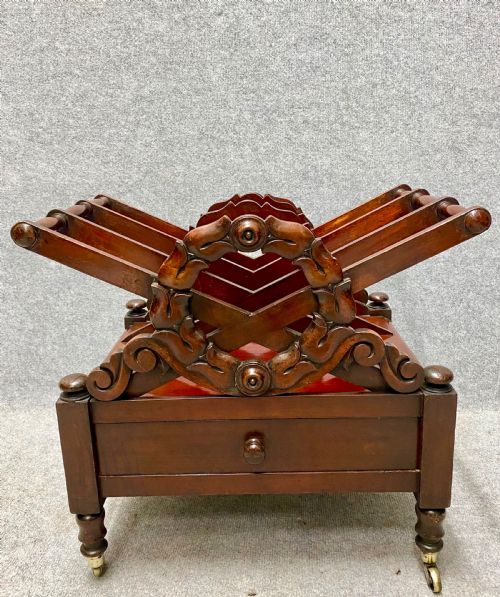
These antique brass castor rack items are fine wooden canterburys and music stands raised on castors, prized for organising folios and newspapers in period interiors.
Antique Brass Castor Rack
An antique brass castor rack usually appears as a canterbury, magazine rack, or folio stand, serving as a movable compartment for papers and periodicals. Most examples on this page date from the Regency, Georgian, and Victorian periods.
The standard form comprises multiple vertical wooden divisions above a low drawer, mounted on brass castors for easy movement across the floor. They function equally well today for holding current magazines or sheet music near a fireside.
Makers designed these stands in mahogany, rosewood, and ebonised mahogany, often featuring boat shapes or oversized proportions suited to country houses.
How they were made
Cabinet makers constructed these pieces primarily from solid mahogany and rosewood, sometimes employing ebonised finishes to achieve a dark, uniform surface. The timber was selected for grain pattern and strength, particularly in the upright slats and carrying rails.
Small brass castor wheels were fitted to the base of each leg, allowing the loaded stand to roll smoothly across carpets and floorboards without straining the joints. Divisions were joined securely to the baseboard to withstand the weight of heavy folios and newspapers.
Listings feature pieces spanning the Georgian, Regency, and Victorian periods, constructed from mahogany, rosewood, and ebonised mahogany.
What varies in quality
Quality rests in the timber selection and the crispness of the turned or carved details on the upright supports and legs. Superior examples display finely figured mahogany or rich rosewood grains across the primary surfaces and drawer fronts.
The integration of the brass castors and the rigidity of the internal divisions distinguish finer pieces from standard workshop output. Attribution to notable makers such as Gillows of Lancaster or J.C. Loudon elevates the standing of an individual piece.
Gillows of Lancaster·J.C. Loudon
The Antique Brass Castor Rack Glossary
- Canterbury
- A low stand with divisions for holding sheet music, newspapers, or folios, typically fitted with castors. It originated in the late eighteenth century and often includes a single drawer beneath.
- Folio stand
- A larger piece designed to hold large books, prints, or portfolios of paper. These often feature adjustable sides or massive proportions.
- Regency
- An English design period spanning the early nineteenth century, characterised by classical restraint and influences from ancient Greece and Rome. Pieces from this era frequently utilise fine mahogany and brass detailing.
- Ebonised
- Wood finished to resemble ebony, usually achieved by staining and polishing a dark hardwood such as mahogany. This technique was favoured during the Victorian period for striking visual contrast.
Antique Brass Castor Rack: Frequently Asked Questions
What is a canterbury used for?
A canterbury serves as a small, movable rack designed to hold newspapers, magazines, and sheet music within a sitting room. The upright divisions keep papers separated and tidy.
In period homes, they sat beside pianos or reading chairs for easy access to daily reading material.
Are these stands strong enough for modern magazines?
These pieces were built from solid hardwoods like mahogany and rosewood to hold heavy folios and bound newspapers. Modern periodicals present no structural challenge to their original design.
The inclusion of brass castors also makes them practical for repositioning beside a modern sofa.
What is the difference between a canterbury and a folio stand?
A canterbury is generally smaller, featuring multiple vertical divisions and often a low drawer for smaller items. A folio stand is typically larger and built to support oversized prints and bound volumes.
Both types rely on brass castors for mobility in the room.