
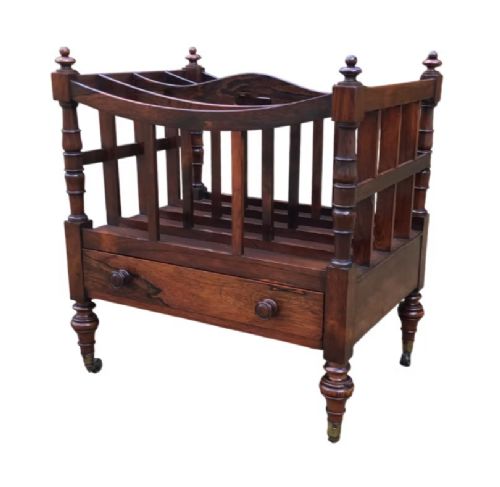
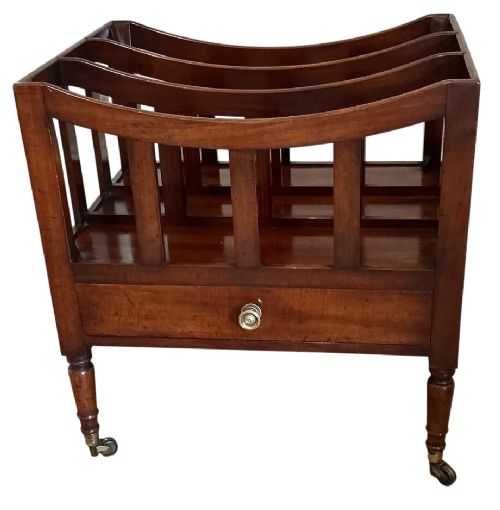
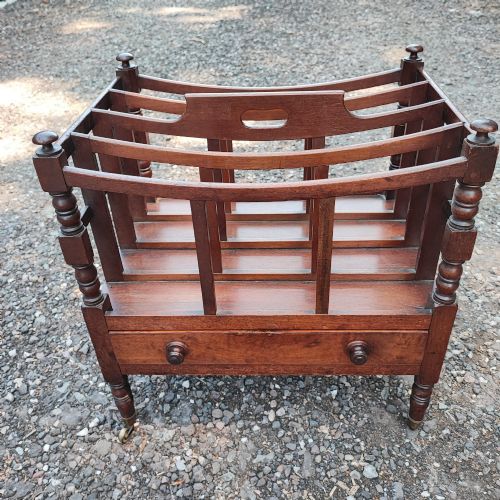


Regency Period Newspaper Rack
A regency period newspaper rack brings architectural grace and tidy order to a room, holding daily journals just as it did two centuries ago.
Regency Period Newspaper Rack
A regency period newspaper rack typically takes the form of a canterbury, a low freestanding stand designed with vertical partitions to hold periodicals and journals upright. These pieces emerge chiefly from the Regency and George III eras, though examples extend into Victorian times and later revivals.
Most pieces seen on this page are constructed from rich timber like mahogany and rosewood, often shaped into boat-like silhouettes or simple compartmented frames. They combine practical storage with slender legs and carrying handles, serving as both newspaper racks and music stands.
The form adapts easily to various interior settings, offering a compact footprint alongside distinct period character. Buyers encounter variations ranging from strict Regency originals to later revival interpretations sharing the same classic blueprint.
What varies in quality
Quality rests primarily in the choice of timber and the crispness of the cabinetwork, where figured veneers and careful grain matching distinguish finer examples. The refinement of the turned supports and the integrity of the original brass fittings elevate a piece above standard workshop production.
Proportion and balance dictate the visual success of the stand, as superior makers achieved lighter, more harmonious frames without sacrificing structural stability. The preservation of the timber surface finish further marks the distinction between ordinary utility items and exceptional cabinet pieces.
Some stands doubled as music storage, meaning your daily broadsheet shares lineage with centuries of hastily dropped sheet music.
Gillows
The Regency Period Newspaper Rack Glossary
- Flame mahogany veneer
- A thin slice of mahogany timber cut from the fork of the tree where the branches join the trunk, producing a fiery, flamelike grain pattern. Cabinetmakers applied this to prominent surfaces for visual impact.
- Regency
- An English stylistic period spanning the early nineteenth century, characterised by classical restraint, architectural lines, and inspiration from ancient Greece and Rome. Furniture from this era often utilises dark woods and brass mounts.
- Rosewood
- A heavy, dense timber with a deep reddish-brown colour and dark figuring, prized for high-end cabinet making. It takes a fine polish and appears frequently on superior nineteenth-century pieces.
Regency Period Newspaper Rack: Frequently Asked Questions
What is a canterbury?
A canterbury is a low, compartmented stand designed for storing newspapers, periodicals, and music sheets within easy reach of a seating area.
Originally developed in the late eighteenth century, the form quickly became a staple piece for keeping daily reading materials organised and tidy.
How do I date a newspaper rack?
Dating relies on examining the timber species, construction methods, and stylistic cues such as leg turning and overall proportions.
Pieces from the Regency era tend to show classical restraint and specific wood selections like rosewood or flame mahogany, whereas later revivals often exhibit minor differences in construction depth.
Were these used for newspapers?
Yes, these stands were built to hold contemporary journals, newspapers, and unbound sheets of music in separate upright compartments.
The vertical divisions kept papers neatly separated and prevented them from slumping over while resting beside a sofa or desk.
Where should I place a rack?
These racks sit comfortably beside armchairs, sofas, or alongside bookcases where daily reading materials are frequently gathered.
Their compact size and finished backs allow them to stand freely in a room rather than strictly against a wall.