


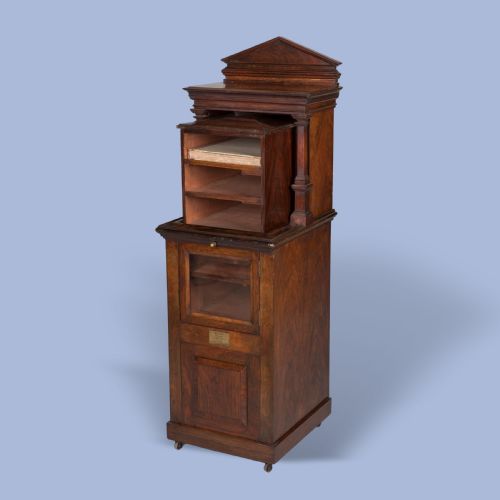


19th Century Mahogany Canterbury
A 19th century mahogany canterbury brings both useful division for folios and journals and solid Regency or Victorian character to a room.
19th Century Mahogany Canterbury
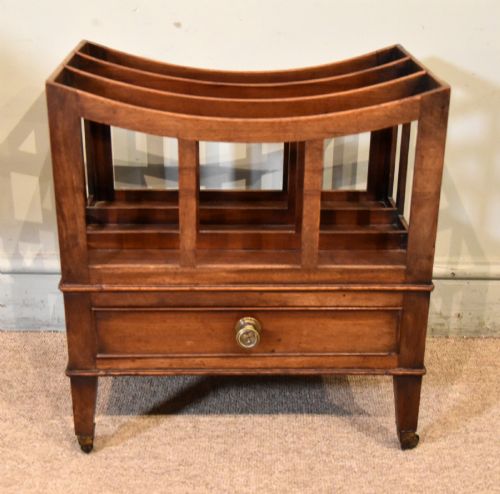
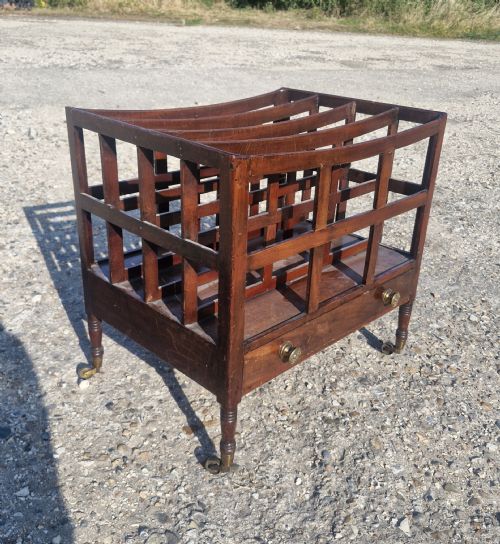
A 19th century mahogany canterbury is a practical stand designed to hold sheet music, magazines, and newspapers within divided compartments, often resting on castors for easy movement. These pieces originate from the Georgian, Regency, and Victorian eras, reflecting the domestic habits of genteel households.
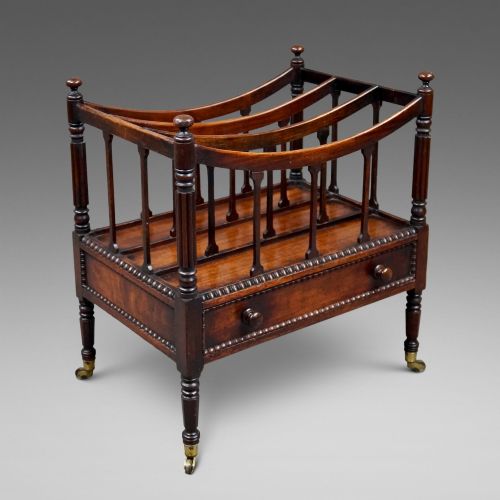
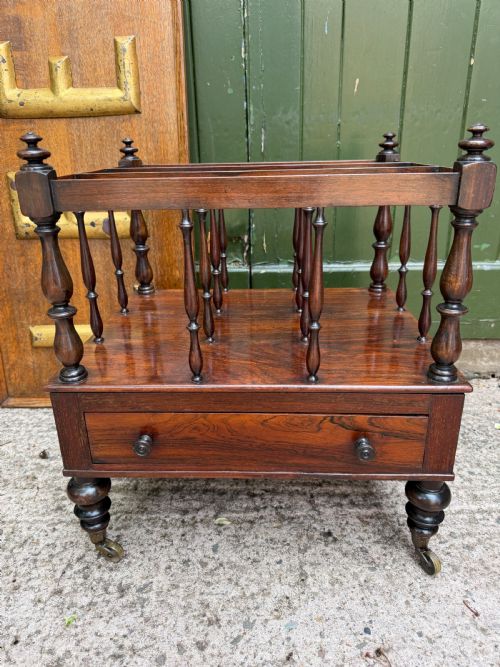
The versions most commonly met on this page include boat-shaped designs, multi-section racks with pierced scroll divisions, and pieces incorporating a single base drawer. Makers also produced hybrid forms such as music stands, whatnots, and dwarf bookcase canterburys.
Examples span from George III origins around eighteen hundred to later Victorian interpretations, showing shifts in proportion from delicate Regency frames to sturdy country house pieces. Each variation serves the core function of organising paper goods while anchoring a traditional interior.
Materials and Construction
Cabinet makers relied primarily on mahogany, sometimes enriched with contrasting boxwood stringing, rosewood accents, or brass details and castors. The timber was selected for its rich grain and durability, capable of supporting the structural weight of divided vertical slats.
Construction techniques involve finely joined divisions, often pierced or fret-cut into scroll patterns, mounted above a low plinth or drawer base. Turned uprights and delicate spindle supports demonstrate the joinery skills standard to workshops of the period.
Listings feature mahogany as the primary timber, occasionally accompanied by rosewood, boxwood, and brass hardware across Regency and Victorian periods.
Judging Quality
Quality rests upon the crispness of carved details, such as wreath-carving or turned finials, and the integrity of the timber figure. Finer examples display thoughtful proportion in the graduated shelves or boat-shaped profiles rather than purely utilitarian assembly.
The refinement of the pierced divisions and the presence of original brass castors or working base drawers distinguish higher-tier pieces. Plainly constructed items serve their function adequately, whereas superior versions exhibit meticulous attention to secondary timbers and joinery.
Gillow’s·J.C.Loudon
The 19th Century Mahogany Canterbury Glossary
- Canterbury
- A low stand with divided sections used for holding sheet music, folios, and periodicals. It typically sits on castors to allow movement across a floor.
- Folio stand
- A piece of furniture designed to hold large sheets of paper, prints, or maps in an upright position. They share a similar lineage with musical storage racks.
- Whatnot
- An open set of multi-tiered shelves used for displaying ornaments or holding books. Some forms integrate canterbury sections in the lower tier.
- Pierced scroll
- Woodwork cut through in ornamental scroll patterns to form the partitions of a rack. This technique lightens the visual weight of the dividers.
- Regency
- A stylistic period spanning the early nineteenth century defined by classical restraint and elegance. Furniture from this era often incorporates bold mahogany grains and brass mounts.
19th Century Mahogany Canterbury: Frequently Asked Questions
What is a 19th century mahogany canterbury used for?
These pieces were originally built to store sheet music, unbound books, and periodicals near a piano or seating area. Today they serve equally well for modern magazines and daily newspapers.
Their compartmentalised design keeps paper goods upright and ordered while adding period character to a living space.
How do I tell a Regency canterbury from a Victorian one?
Regency examples, dating from the early nineteenth century, generally feature cleaner classical lines, boat shapes, and restrained brass details. Victorian pieces often appear sturdier with heavier proportions and simpler turned supports.
Looking at the joinery and timber choice helps clarify the manufacturing decade.
Do these stands usually have drawers?
Many designs incorporate a single shallow drawer fitted beneath the main slatted rack, intended for smaller accessories like tuning forks or sheet music notes. Not all versions include this feature, as open rack variants were equally common.
Examining the base reveals whether a drawer was part of the original blueprint.
Where should I place a canterbury in a room?
Because they are finished on all sides and often fitted with castors, these stands sit comfortably beside armchairs, sofas, or desks. Their low profile ensures they do not block sightlines.
They function best where reading materials accumulate naturally.