
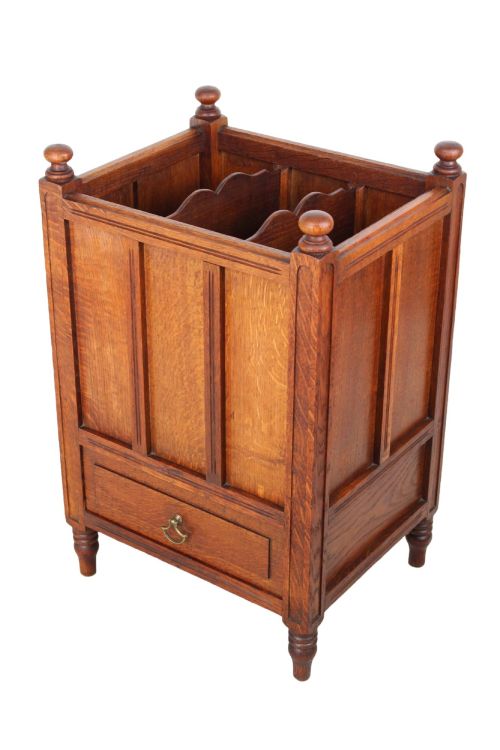


Vintage Music Divider Stand
A vintage music divider stand, also known as a canterbury, keeps sheet music and folios organised with traditional compartmentalised design.
Vintage Music Divider Stand
A vintage music divider stand organises scores and sheets with vertical wooden partitions, offering a practical compartmented structure. Buyers searching for this phrase encounter items primarily categorised as canterburys alongside magazine racks.
The selections span distinct historical periods from the Regency era through to the Edwardian period and the 1930s. Mahogany and oak dominate the forms, supplemented by bamboo, burr walnut, and rosewood constructions.
Most examples function as standalone furniture pieces featuring vertical divisions for keeping folios upright. Certain pieces incorporate lower drawers or carved details such as Prince of Wales feathers.
How they were made
Cabinetmakers utilised dense timbers like mahogany, oak, walnut, and rosewood to construct the structural frames and vertical dividers. These hardwoods provided the necessary durability to support heavy bound volumes of music.
Alternative materials such as bamboo and rattan appeared in late Victorian interpretations, offering lighter structural alternatives. Decorative techniques involved burr veneers, inlay work, and hand-carved motifs.
The listings here feature items spanning from 1800 through the Victorian, Edwardian, and 1930s periods, constructed in mahogany, oak, burr walnut, and bamboo.
What varies in quality
The calibre of timber selection and decorative execution distinguishes standard pieces from superior examples. Finely figured mahogany, burr walnut veneers, and intricate inlay demonstrate higher workshop skill.
Carved details like Prince of Wales feathers or integrated drawers elevate the craftsmanship of a canterbury beyond simple slatted frameworks. The integrity of the joinery across the vertical dividers dictates long-term structural stability.
The Vintage Music Divider Stand Glossary
- Canterbury
- A low stand with upright divisions, originally designed for holding sheet music and loose folios. These items often include carrying handles and lower drawers.
- Regency
- An architectural and decorative style spanning the early nineteenth century, characterised by classical restraint and polished mahogany surfaces. Pieces from this period frequently display clean architectural lines.
- Victorian
- A period of varied revival styles and eclectic manufacturing techniques spanning the mid to late nineteenth century. Items from this era utilise diverse materials including bamboo and burr walnut.
- Edwardian
- A decorative era spanning the early twentieth century favouring lighter woods and refined domestic furnishings. Oak and mahogany items predominate in this period.
Vintage Music Divider Stand: Frequently Asked Questions
What is a music divider stand used for?
These stands hold sheet music, folios, and periodicals upright within vertical wooden partitions. They keep scores accessible near pianos and instruments in domestic rooms.
Historically, they maintained order amongst unbound musical compositions before the widespread standardisation of bound volumes.
How do I identify a Regency canterbury?
Regency pieces date from around the early nineteenth century and typically employ solid mahogany timbers. They feature clean structural proportions and traditional turned upright supports.
Design elements from this time reflect classical influences without the heavier ornamentation seen in later Victorian furniture.
Are bamboo music stands antique?
Bamboo and rattan examples appeared during the late Victorian period, particularly around the eighteen-nineties. These pieces reflect an aesthetic interest in exotic natural materials.
Construction methods combine split bamboo frames with woven panels to create lightweight compartmented stands.
Can these stands store modern magazines?
The vertical partitions accommodate contemporary periodicals and large softcover books alongside historical music sheets. The compartment depth suits modern reading materials.
Care should be taken not to overload delicate nineteenth-century timber dividers with excessive heavy volumes.