


Alphabet Needlework Sampler
An alphabet needlework sampler records stitched letters and numerals, preserving domestic skill and youthful patience across centuries of needlecraft.
Alphabet Needlework Sampler
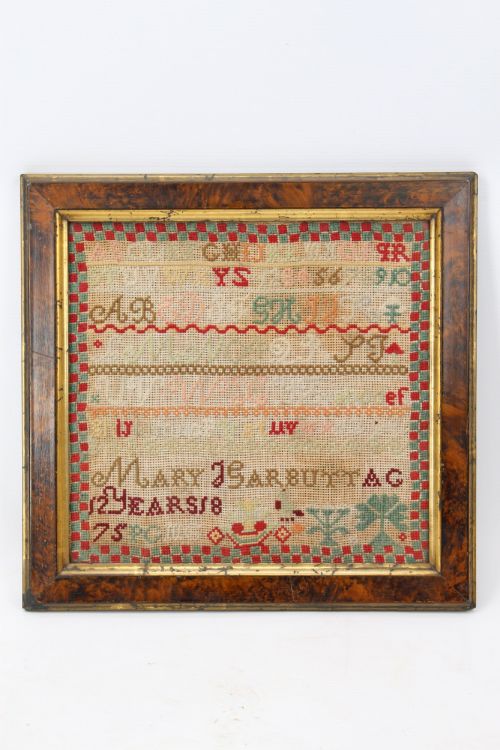
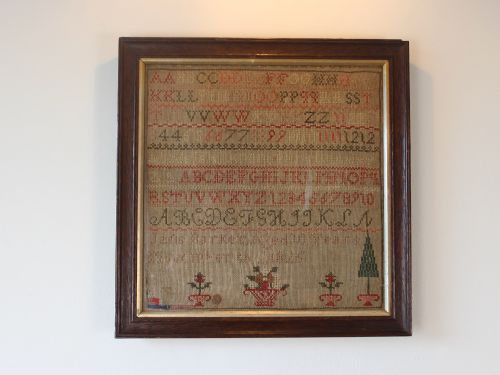
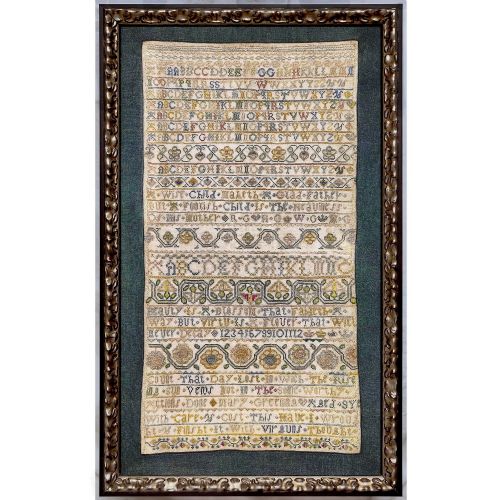
An alphabet needlework sampler forms a preserved record of stitched letters, numerals, and moral verses worked by hand. These textiles range from simple rows of lettering to elaborate pictorial compositions framed for display.
The versions most commonly met on this page date from the Georgian and Victorian eras, often bearing the name, age, and date of the young maker. Early examples from the late seventeenth and eighteenth centuries appear occasionally, featuring narrower bands of pattern and fewer pictorial elements.
Materials and construction
Stitchers worked primarily on linen grounds using thread, wool, and silk thread. The foundation fabric provides an even grid for counting threads and executing precise stitches.
Makers utilised a variety of embroidery techniques to form alphabets, numerals, and decorative borders. Finished panels were frequently mounted behind glass within wood frames for preservation.
One Scottish schoolgirl left a visible stitch error proudly immortalised in her woolwork.
Distinctions in quality
The clarity of the lettering and the regularity of the stitching separate finer examples from simpler schoolroom exercises. Skilled execution requires disciplined tension and careful planning of the layout.
The inclusion of complex pictorial motifs, detailed borders, and complete inscriptions adds depth to a piece. Original framing and legible documentation regarding the maker and date further elevate the character of the textile.
The Alphabet Needlework Sampler Glossary
- Band sampler
- An early form of textile featuring horizontal bands of different embroidery patterns and alphabets. These pieces served as reference libraries for stitches before paper pattern books were common.
- Ground
- The foundational fabric, typically linen, upon which the embroidery is stitched. The thread count of the ground determines the scale and fineness of the finished work.
- Tapestry sampler
- A needlework panel employing various stitches to build pictorial scenes or dense patterns. These works often incorporate religious texts or moral verses alongside alphabets.
- Embroidered panel
- A finished textile piece designed for display rather than utility. These works frequently feature mounted borders and protective glass.
Alphabet Needlework Sampler: Frequently Asked Questions
What is an alphabet needlework sampler?
An alphabet needlework sampler is a historic textile created by a maker to practice and demonstrate proficiency in stitching letters and numbers.
These pieces frequently include names, dates, and verses, serving as both educational exercises and personal records.
Who made these historic samplers?
Young girls in domestic settings or at school typically worked these samplers as part of their education in needlecraft and literacy.
Schools and academies often supervised the production, occasionally recording the institution on the linen ground alongside the maker's age.
How should I display a sampler?
Display samplers away from direct sunlight to prevent the fading of silk and wool threads against the linen background. Keeping them behind protective glass shields the delicate fibres from dust and atmospheric moisture.
Ensure hanging locations experience stable indoor temperatures and minimal humidity fluctuations to preserve the fabric.
How do I date an antique sampler?
Many samplers include stitched dates and the age of the maker directly within the composition. When dates are absent, stylistic clues such as lettering fonts, border designs, and framing materials help indicate the period.