




Allegorical Figural Clock
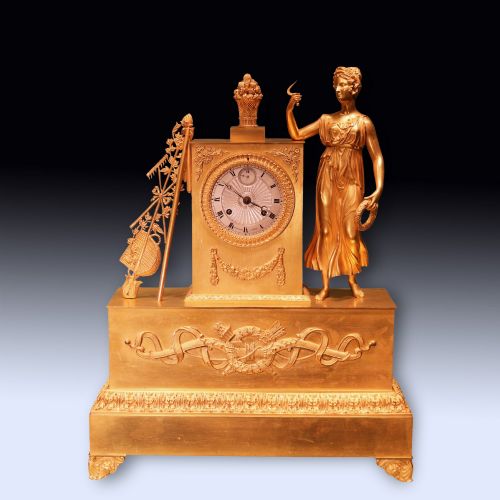
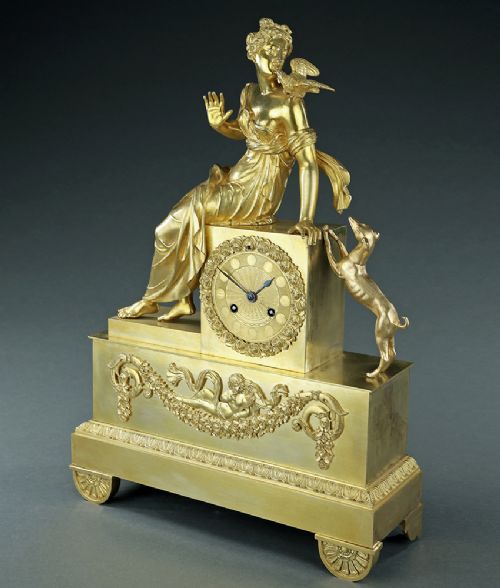
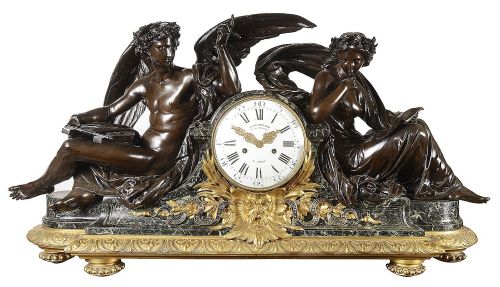
An allegorical figural clock holds a symbolic human or mythological sculpture in gilt bronze or marble, carrying centuries of French design straight to your mantelpiece.
Allegorical Figural Clock
An allegorical figural clock combines a functional timepiece with symbolic sculptural figures cast in bronze, spelter, or ormolu. These works appear most frequently in nineteenth-century French forms, drawing on neoclassical, Louis XVI, French Empire, and Art Nouveau styles.
Makers housed these movements within architectural cases of marble, glass, and gilt bronze, often accompanied by matching clock garnitures. The sculptural subjects range from classical deities to personified virtues such as love, fidelity, and chastity.
Victorian and nineteenth-century examples dominate the selection, showing distinct shifts from rigid classical symmetry toward the fluid lines of the Art Nouveau period around nineteen hundred.
How they were made
Foundry workers cast the metallic elements in bronze, brass, spelter, or ormolu, applying mercury gilding or surface patination to achieve deep lustre. Sculptors modelled human and allegorical figures with fine anatomical detail before mounting them beside the clock housing.
Stonemasons shaped rouge marble and other dense stones to form heavy architectural bases that supported both the heavy metal cases and the mechanical movements. Enamel dial faces carried painted numerals, protected behind bevelled glass panes fitted into the metal bezel.
Allegorical Figural Clock Retail Price Guide 2026
Typical asking prices for allegorical figural clock among the pieces listed under this phrase on Sellingantiques today, from the lower quarter to the upper quarter. They describe what is for sale here now, not the wider market.
Listings feature pieces spanning the nineteenth century, including Victorian works and items dated around nineteen hundred.
What varies in quality
The definition and crispness of the bronze chasing separate standard castings from exceptional foundry work, where every fold of drapery and facial expression remains sharp. Signature marks from known Parisian makers indicate higher workshop standards and superior mechanical reliability.
The choice of materials shifts the character of the piece entirely, with solid ormolu and rouge marble commanding greater presence than lighter spelter frames. Preserved surface gilding and intact enamel dials retain the intended visual balance of the original design.
Canaillor of Paris·Deniere Et Fils·Victor Paillard
The Allegorical Figural Clock Glossary
- Ormolu
- Gilt bronze produced by applying a mercury and gold amalgam to a bronze base and firing it. This technique creates a durable golden finish seen across nineteenth-century French mantel clocks.
- Spelter
- A zinc alloy utilised as a less expensive alternative to bronze for sculptural figures. It takes patination well but lacks the weight and resonance of genuine bronze.
- Garniture
- A set consisting of a central clock flanked by matching decorative objects such as urns or candelabra. These matched groupings were designed to sit together on a mantelpiece.
- Enamel
- A glassy substance fused to a metal dial face through high-temperature firing. It provides a smooth, white background for painted clock numerals.
Allegorical Figural Clock: Frequently Asked Questions
How do I identify the period?
You can identify the period by examining the sculptural style and materials used in the case. Neoclassical and French Empire pieces display strict classical symmetry, while Art Nouveau examples feature fluid, organic lines.
Dates range across the nineteenth century, with Victorian and circa nineteen hundred pieces showing distinct shifts in aesthetic preference.
What are clock garnitures?
Clock garnitures are decorative matched sets that include side ornaments such as urns or candelabra designed to flank the central timepiece. They create a unified display across a mantelpiece or sideboard.
These three-piece sets share matching materials like ormolu, bronze, and rouge marble.
How should I care for these clocks?
Keep these clocks away from direct sunlight and damp environments to protect the marble bases and enamel dial faces. Dust the metal components gently with a dry, soft cloth.
Mechanical movements require periodic professional servicing to maintain accurate timekeeping.