

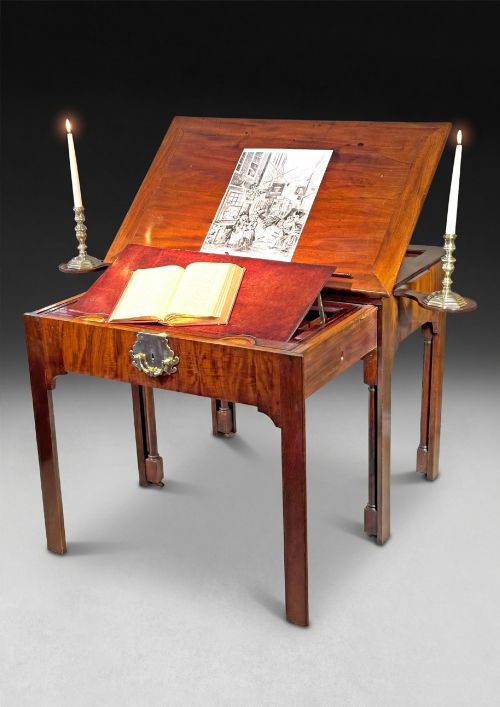
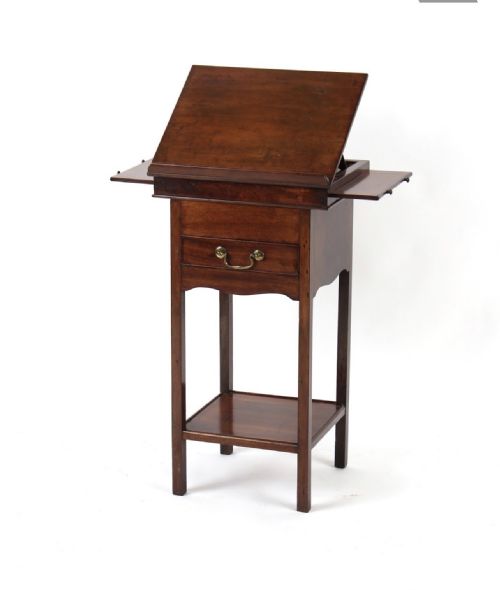
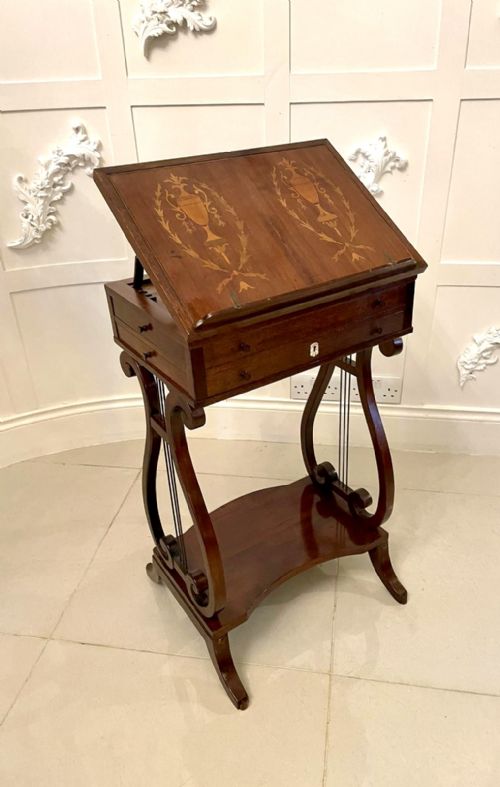
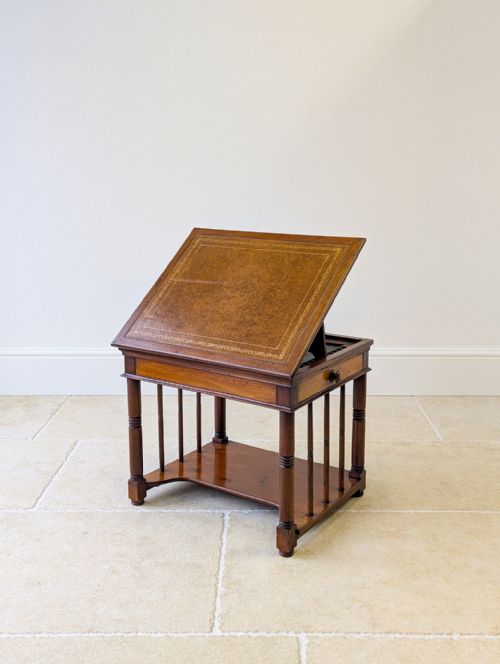


Adjustable Writing Table
These adjustable writing table pieces offer the mechanical flexibility and fine timber work that scholars and draughtsmen relied upon.
Adjustable Writing Table
An adjustable writing table combines a writing surface with mechanical provisions for reading, drawing or drafting. The pieces on this page span the eighteenth century, the Regency era, the Victorian period and the Edwardian years.
Mahogany dominates the material record, frequently accompanied by rosewood, satinwood and brass fittings. Forms range from compact campaign reading stands and library chairsides to substantial architect desks and George III tables.
Buyers meet variations that include folio stands, sliding book rests and rising top mechanisms. The Georgian and Regency examples often demonstrate complex internal ratchets and hinged supports.
Materials and construction
Cabinetmakers utilised dense timbers such as mahogany and rosewood for structural stability and fine grain. Secondary woods and decorative veneers like satinwood and boxwood add contrast to borders and edges.
Adjustable Writing Table Retail Price Guide 2026
Typical asking prices for adjustable writing table among the pieces listed under this phrase on Sellingantiques today, from the lower quarter to the upper quarter. They describe what is for sale here now, not the wider market.
Listings for this phrase include pieces from the Georgian, Regency, Victorian and Edwardian periods in mahogany, rosewood and brass.
Quality and craftsmanship
The sophistication of the internal mechanism dictates much of the standing of an adjustable writing table. Finely engineered brass ratchets and smooth rising actions separate complex metamorphic desks from simpler fixed pieces.
Timber selection and secondary detailing, such as boxwood stringing and figured mahogany grain, mark out superior cabinetmaking. The precision of the joinery around hinges and folding book rests demonstrates the maker's skill.
Gillow of Lancaster
The Adjustable Writing Table Glossary
- Metamorphic
- A descriptive term for furniture designed to transform from one form or function to another. These pieces often conceal ratchets or folding sections.
- Architect's table
- A specialised desk featuring a rising centre section supported by a ratchet, allowing drawings or books to be tilted at an angle.
- Campaign table
- Portable furniture designed for military officers or travellers, often featuring folding legs and brass corner braces.
- Folio stand
- An upright rack or shelf attached to a desk to hold large paper folios, prints or maps safely.
- Ratchets
- Toothed metal racks used to hold a hinged desk top or reading stand at various raised angles.
Adjustable Writing Table: Frequently Asked Questions
How do adjustable reading tables work?
These tables rely on internal wooden or brass ratchets and hinged struts to lift the writing surface or book rest to various angles. Users disengage the support arm to lower the top back to a flat position.
Such mechanisms allow a draughtsman or reader to shift between writing flat and viewing documents upright without moving to another piece of furniture.
What timber was used most often?
Mahogany is the primary timber found across these pieces, appearing in Georgian, Regency and Victorian examples. Rosewood also occurs in nineteenth-century pieces alongside satinwood and boxwood stringing.
These dense hardwoods provided the durability required for heavy library use and intricate mechanical adjustments.
Are these desks suitable for daily laptop use?
The adjustable reading surfaces and rising platforms provide a functional height for modern screens and keyboards. Many pieces include integrated leather or baize writing panels.
Care should be taken with antique hinges and ratchets when adjusting the weight of modern equipment.
How do I spot a Georgian architect's table?
Georgian architect's tables typically feature a large rectangular mahogany top with a central section that ratchets upward on a hinged prop. They often incorporate pull-out candle slides or side drawers for drafting instruments.
Such pieces date from the eighteenth and early nineteenth centuries and show substantial proportions and fine timber figures.