


Adjustable Brass Fender
These adjustable brass fender designs expand to fit your hearth, bringing period weight and polished metal to the room.
Adjustable Brass Fender
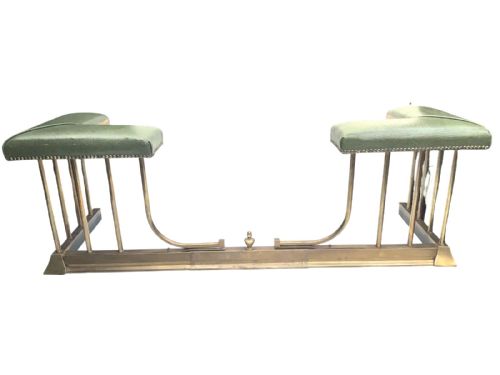
An adjustable brass fender is a metal hearth guard designed to keep embers contained while adapting in length to fit various fireplace openings. You will see these pieces span simple extending rails from the Victorian era as well as substantial Edwardian club variants fitted with upholstered leather seats.
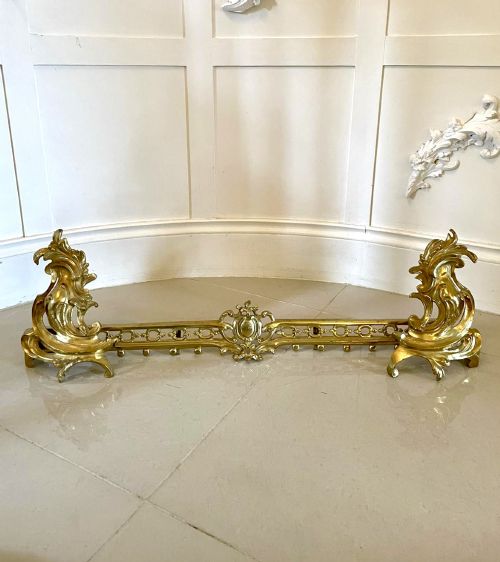
The form ranges from plain extending English hearth kerbs to ornate French pieces decorated in the Louis XV and Rococo styles. Most examples date from the nineteenth and early twentieth centuries, constructed to slide smoothly and lock at the desired width.
How they were made
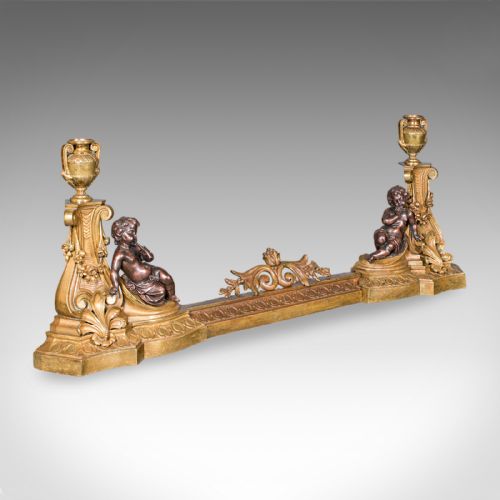
Makers utilised cast and sheet brass, ormolu, and gilt bronze, often mounting heavy metal frameworks onto sturdy inner sliding bars. Selected pieces incorporate buttoned leather upholstery across integrated corner or bench seats.
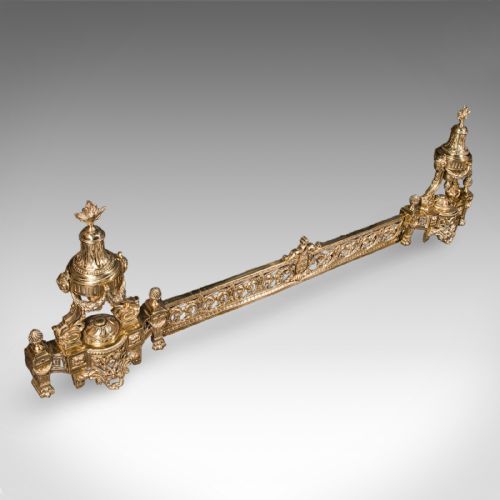
Surface finishing involved polishing the solid metal components to a bright shine or applying a rich gilt layer over bronze and brass castings. Scrollwork and decorative chenets were individually cast and chased before assembly.
Materials recorded across the archive include solid brass, ormolu, gilt bronze, and buttoned leather.
What varies in quality
Quality rests upon the weight of the metal and the smoothness of the extending mechanism. Heavy cast brass or bronze sections with crisp chasing and secure joints sit at the upper end of the scale.
The calibre of the leather upholstery and the depth of the gilding further separate standard utility pieces from grander domestic examples. Finer items retain rigid frames that extend without sagging or binding.
The Adjustable Brass Fender Glossary
- Club fender
- A hearth guard featuring low upholstered seats on either side, allowing people to sit close to the fire. They became popular in large country houses during the late nineteenth and early twentieth centuries.
- Chenet
- A decorative firedog placed at the hearth, sometimes associated with or forming part of broader fender assemblies. French examples frequently display ornate Rococo scrolling.
- Ormolu
- Gilded bronze used for decorative metalwork mounts and fittings. It provides a warm, enduring golden finish on period fireplace accessories.
- Fire kerb
- A low metal barrier enclosing the hearth to prevent logs and ash from spilling onto the floor. These often form the foundational extending rail of simpler fender designs.
Adjustable Brass Fender: Frequently Asked Questions
How do adjustable brass fenders work?
These fenders feature an overlapping sliding mechanism that allows the side or front sections to expand or contract. This permits precise adjustment to match the exact width of your stone or brick hearth.
To alter the width, you gently pull or push the telescoping rails until they reach the desired span. Most designs use an inner track system to maintain stability when fully extended.
Are club fenders comfortable to sit on?
Club versions incorporate padded leather seats designed for warmth and comfort close to the fire. The upholstery is traditionally buttoned and supported by a robust metal frame.
Because the seats are low to the ground, they provide a cosy vantage point directly beside the hearth rather than standard armchair seating.
How do I clean polished brass?
Polished brass requires gentle maintenance using appropriate metal cleaners to preserve the surface shine without removing fine detail. Avoid harsh abrasives that can scratch cast or gilded areas.
Leather seats should be treated separately with suitable leather conditioners to keep the hide supple and prevent cracking over time.
How do I tell Victorian from Edwardian pieces?
Victorian examples tend towards heavier cast brass, ornate Rococo revival scrolling, and straightforward extending kerbs. They reflect the industrial weight and decorative exuberance of the nineteenth century.
Edwardian pieces frequently introduce upholstered leather club seats and slightly lighter, polished brass frames. The overall aesthetic shifts towards practical domestic comfort for large country house interiors.