



Adam Style Pier Table
An adam style pier table brings neoclassical symmetry and carved proportion into a room, offering a surface designed to sit flat against a wall.
Adam Style Pier Table
When you search for an adam style pier table, you encounter console tables, console cabinets, and side tables that follow neoclassical design principles.
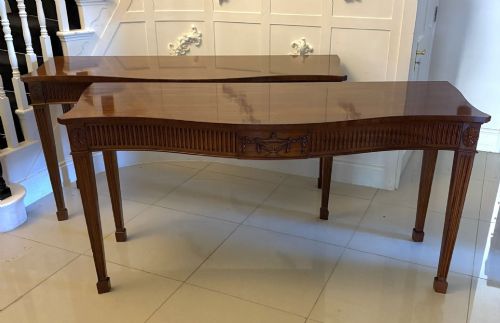
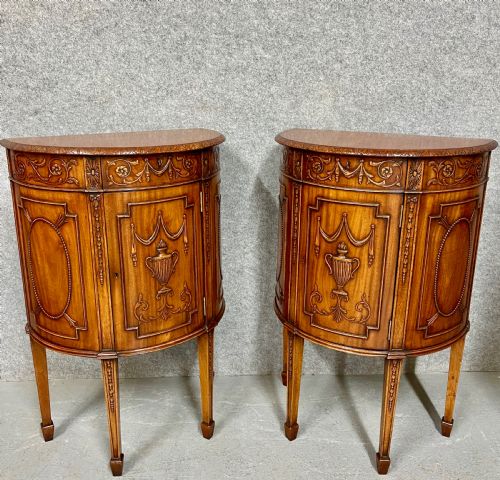
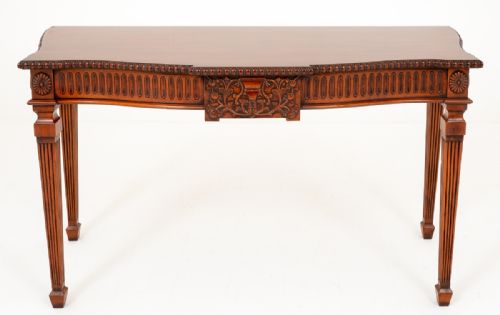
The pieces on this page span the 18th century, 19th century, Edwardian era, and 1920, appearing in forms such as serpentine serving tables, demi-lune hall tables, and elliptical pier tables.
Originating from the Georgian period through to later revivals, these items combine architectural symmetry with delicate carved ornament.
How they were made
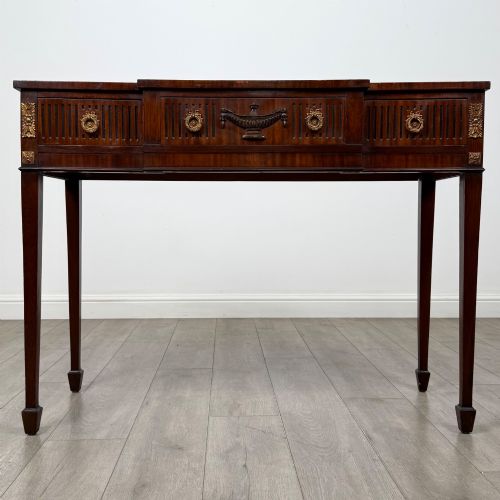
Carpenters constructed the carcases predominantly from mahogany, alongside painted wood and giltwood surfaces.
Decorative schemes incorporate brass elements and inset marble tops, shaped into rectangular, demi-lune, and serpentine forms.
Carvers applied neoclassical motifs, such as classical drapery and urns, directly to the timber or highlighted them through gilding and paint.
Listings feature mahogany, giltwood, and painted finishes alongside inset marble tops.
What varies in quality
The refinement of the carving dictates much of the distinction, separating pieces with crisp, deep neoclassical enrichment from those with softer or more mechanical detail.
Materials also divide the standard, with original marble tops and integrated brass mounts representing a higher grade of construction than plain wooden alternatives.
The Adam Style Pier Table Glossary
- Pier table
- A table designed to stand against a wall, typically between two windows beneath a pier glass mirror.
- Demi-lune
- A half-moon shape used frequently for console and hall tables to save floor space.
- Neoclassical
- A style of art and architecture drawing on classical antiquity, characterised by symmetry, straight lines, and classical ornament.
- Giltwood
- Wood that has been coated with gold leaf or a gold-coloured substance.
- Serpentine
- A curved line that is convex in the middle and concave at the sides, often seen on table fronts.
Adam Style Pier Table: Frequently Asked Questions
Where should a pier table go?
These tables fit flat against a wall, traditionally placed between windows beneath a mirror or in a narrow hallway.
Their shallow depth allows them to occupy transitional spaces without obstructing movement.
How do I spot an Adam revival piece?
Revival items from the nineteenth and early twentieth centuries adopt the neoclassical vocabulary of Robert Adam, including urns, swags, and fluted legs.
They mirror the proportions of eighteenth-century originals while utilising the woodworking techniques of their own time of manufacture.
What is the difference between a pier table and a console table?
While the terms often overlap in historic listings, a pier table specifically references placement against the wall space between architectural openings.
Console tables share the wall-anchoring format but encompass a broader range of bracket-supported or four-legged side furniture.
Were these tables used for dining?
Some larger variants functioned as serving tables in dining rooms, particularly serpentine forms intended for food and drink presentation.
Smaller demi-lune and elliptical versions served primarily as decorative hall furniture for lamps or visiting cards.